• Skip to main content

    Magazine: Sulphur

    A tale of two acid tower systems

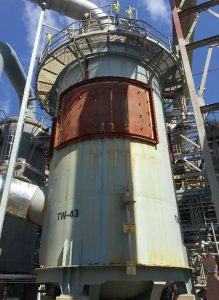
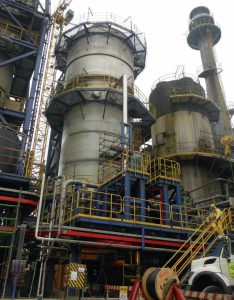
    All acid towers eventually require replacement. In this article, K. Sirikan, A. Mahecha-Botero et al of NORAM Engineering and Constructors Ltd discuss two recently executed acid tower replacement projects. The first project involved the replacement of a brick-lined tower by an alloy acid tower for a sulphur burning plant in North America. The second project involved the replacement of a brick-lined acid tower with a NORAM designed brick-lined tower for a smelter off gas acid plant in South America. The impacts of various design considerations on acid tower replacement projects are compared, including in-situ replacement versus a new location; brick-lined versus alloy shell, and selection criteria for mist eliminators.
    Sulphuric Acid News Roundup

    Copper major Freeport-McMoRan is reportedly on verge of finalising a $2.8 billion deal with China’s Tsingshan to build a copper smelter in Weda Bay, Indonesia. The Indonesian government said that the companies were aiming to conclude negotiations by the end of March. It also said that most of the financing will be borne by Tsingshan, with Freeport possibly only needing to provide funding for 7.5% of the total project cost. The smelter would have a copper concentrate input capacity of 2.4 million t/a.

    Sulphuric Acid News Roundup

    Norilsk Nickel has finally closed down its nickel smelting operation at Nikel in Russia’s Murmansk region; the company’s oldest still operating production facility. The shutdown is part of the company’s environmental programme, which aims to significantly reduce its environmental impact at all production sites. The Nikel closure will eliminate SO2 emissions in the cross-border area with Norway, which had become a major bone of contention with the Norwegian government. Norilsk aims to reduce SO2 emissions at Kola by 50% by the end of 2020 and 85% by the end of 2021, and is modernising its production in Monchegorsk, including the construction of new state-of-the-art facilities.

    SRU troubleshooting tools

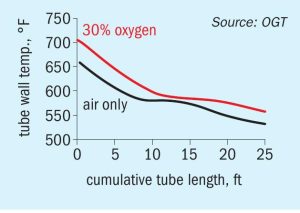
    Process and simulation models can be valuable tools when troubleshooting to solve operational issues in sulphur recovery units. Two examples are provided. In the first case study it is shown how a tuned model was useful in troubleshooting an SRU that was experiencing lower than expected recovery efficiency and apparent channelling in the first catalytic converter. In the second case study an SRU simulation tool is used to investigate sulphidic corrosion in a waste heat boiler.