Price Trends
Market Insight courtesy of Argus Media
As we near the end of the third quarter of 2022, the attention of the nitrogen industry is focused on the coming northern hemisphere winter, and the prospects for higher natural gas prices as temperatures fall and power and heating demands rise. Vladimir Putin has been stoking these worries to try and force a climbdown from European countries over the sanctions that followed his invasion of Ukraine, with the flow of gas through the Nordstream 1 pipeline across the Baltic Sea gradually dwindling over the summer and finally stopping altogether at the end of August due to “technical issues” – an explanation somewhat undermined by the subsequent statement from spokesman Dmitry Peskov that gas would flow again once sanctions were eased. This is a familiar enough tactic; Russia has used gas stoppages to pressure Ukraine and Europe several times over the past two decades.
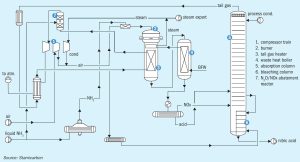
Optimisation of the nitric acid process depends on good process visualisation tailored to the specific process parameters of the plant, improvements in combustion efficiency, reduction of N2 O emissions and the optimal use of platinum group metals.
Leaks in the high-pressure synthesis section of a urea plant can have catastrophic consequences. UreaKnowHow.com started to collect incidents in an incident database and in 2017 AmmoniaKnowHow.com and UreaKnowHow.com introduced FIORDA, the Fertilizer Industry Operational Risk Database, a global open source risk register for ammonia and urea plants.
Most nitric acid is used for production of fertilizer nitrates and ammonium nitrate explosives, but it is also used in polyamides, polyurethanes and aniline dyes as well as a number of industrial processes including ore treatment. High ammonia prices have pushed nitric acid prices to record levels this year, but growth predictions remain robust.
Clariant has announced a reorganisation into three global business units instead of the previous five, with the business unit presidents to be located in the regions with the largest customer base and highest growth potential for the respective businesses. It will also create a new executive steering committee that will include the CEO, the CFO and the presidents of the new business units.
Casale reviews urea plant revamping process schemes and successful case studies for energy savings and TOYO discusses its latest revamping technologies including application of the new generation low-pressure, energy-saving ACES21-LP™ process.
Overall the market finds itself in a period of illiquidity, and is exposed to further uncertainty in 4Q because of the European energy crisis. Spiralling natural gas costs in Europe, with Dutch TTF gas prices trading around e200/MWh, are forcing European fertilizer producers to close ammonia capacity and buy in from overseas.
The war in Ukraine has severely affected the supply of ammonium nitrate and CAN from Russia and Ukraine, with particular potential impact on Europe and Latin America. Can urea make up the difference?
A round-up of current and proposed projects involving non-nitrogen synthesis gas derivatives, including methanol, hydrogen, synthetic/substitute natural gas (SNG) and gas- and coal-to-liquids (GTL/CTL) plants.