Phosphate process improvements
Advances in technology, equipment and reagents are enhancing phosphate fertilizer production. Optimisation of standard equipment is also vital for ensuring process efficiency.
Fertilizer plant owners are installing highly efficient and reliable scrubbing equipment to satisfy increasingly strict emissions regulations globally. We highlight recent advances in scrubbing performance and technology.
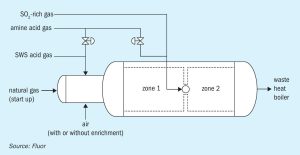
Fluor demonstrates how SRU/TGTU plants within sour gas facilities can facilitate the capture of CO2 and generate H2 by implementing advanced sulphur recovery technologies.
It has long been known that sulphur dioxide aerosols can reflect sunlight back into space. On a large scale, this has tended to come from volcanic eruptions. The explosion of the island of Krakatoa in 1815 led to the following year, 1816, becoming known in Europe as ‘the year without a summer’. More recently, it is estimated that the eruption of Mount Pinatubo in the Philippines in 1991, the second largest eruption of the 20th century, sent around 18 million tonnes of SO2 into the stratosphere. Temperatures in the troposphere – the atmospheric layer closest to the earth – dropped by about 0.5°C as a result for about two years afterwards.
When candle filter mist eliminators installed in the absorption towers in sulphuric acid plants are not sufficiently wet, problems can occur such as free SO3 at the stack, NOx issues and emission non-compliance. Begg Cousland Envirotec discusses how these problems can be overcome by the installation of an annular wetting ring solution.
Industry turnover is a reality, and keeping new employees informed of hydrogen safety procedures in sulphuric acid plants is key to keeping plants fully operational and incident free. Elessent Clean Technologies discusses the steps facilities need to take to prevent hydrogen incidents.
The world has seen a number of hydrogen explosions in double absorption plants mostly in the intermediate absorption tower (IAT). To review this increase and to determine the causes, an International Hydrogen Safety Workgroup was formed including major acid plant contractors, major acid producers, and consultants in the sulphuric acid arena. Davis & Associates Consulting explores some of the findings.
CO2 emission abatement strategies have become increasingly important as the world strives to combat global climate change. RATE discusses carbon capture options available for sulphur recovery units.
Sulphur run-down lines are typically sized by referencing past projects and ‘rules of thumb’. Very little analysis is performed to identify the impacts of slope, fittings, valves, etc. It is critical to maintain an open vapour path from the condenser to the sealing device. CSI has observed problems in the field which appear to be caused by undersized run-down lines and has developed a method of predicting the liquid level in a run-down line that considers the most common elements.
Cansu Doganay of Lux Research takes a look at the current technology landscape for methane pyrolysis for producing low-carbon hydrogen from natural gas.