Category: Products

India planning urea plant

India is preparing to set up its first urea manufacturing facility in Russia to secure long-term fertiliser supplies and reduce exposure to global price shocks, according to Indian media reports. The proposed project, backed by Rashtriya Chemicals and Fertilisers (RCF), National Fertilisers Ltd (NFL) and Indian Potash Ltd (IPL), aims to tap Russia’s abundant reserves of natural gas and ammonia, key raw materials that India lacks. The venture is reportedly scheduled to be announced during Vladimir Putin’s visit to India in December. The facility is said to aim at ultimately producing 2 million t/a of urea. India is currently the second-largest consumer and third-largest producer of fertilisers globally, but it remains vulnerable to global commodity swings.

Kent appointed to Yanbu Green Hydrogen Hub

Kent, a global leader in integrated energy services, has been appointed by ACWA Power as owner’s engineer for the Yanbu Green Hydrogen Hub, a major green hydrogen and ammonia export facility being developed in Saudi Arabia. Situated in the port city of Yanbu on the Red Sea, the project will feature full integration across the green hydrogen value chain. This includes its own dedicated renewable power generation, desalination plants, ammonia production lines and an export terminal. At full scale, the facility will deliver up to 400,000 t/a of renewable hydrogen, converted into over 2.2 million t/a of green ammonia for international markets. With more than 4 GW of electrolysis capacity planned, the Yanbu hub is expected to be nearly twice the size of the NEOM Green Hydrogen Project.

Market Outlook

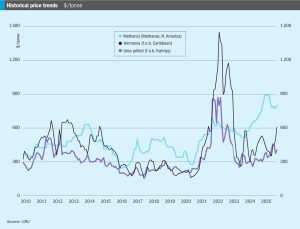
l The market looks very tight through the end of the year, though some expect supply to improve in Q4. Prices are unlikely to ease in the coming weeks. l Woodside’s Beaumont New Ammonia Project is now 97% complete, and the producer expects production from the first train in late 2025. There is no information from Gulf Coast Ammonia on when to expect commercial production. l There was an absence of fresh confirmed business into northwest Europe. Still, producers with ammonia capacity in the region are expected to be maximising output given the favourable economics at current spot natural-gas prices at the Dutch TTF.

Cooperation agreement for e-fuels demonstration plant

Sasol and Topsoe have signed a cooperation agreement with the German Aerospace Centre (DLR) and EPC contractor Griesemann for the construction, operation and research and development activities of DLR’s sustainable aviation fuels demonstration plant at the Leuna Chemical Complex, Germany. The demonstration plant is currently under construction and expects to produce 2500 t/a of e-fuels, starting in Q4 2027. The e-fuels produced will comprise mainly of kerosene, using renewable feedstocks such as biogenic CO2 and green hydrogen. With €130 million of funding secured from the German Federal Ministry for Transport, the plant will be the largest demonstration and research facility globally for the production of e-fuels.

Feasibility study on sustainable methanol plant

NextChem subsidiary MyRechemical has been selected by Mana Group and Equinor to conduct a feasibility study for a waste-to-methanol plant at Norway's Mongstad refinery. The project will use NX Circular™ technology to convert urban and industrial waste into chemical grade syngas which will be further processed to produce low-carbon methanol. The facility is expected to produce circular methanol with a low carbon footprint, eligible under the EU Renewable Energy Directive criteria. This methanol could initially replace marine bunker fuel to meet the targets of the FuelEU Maritime regulation, exempting final users from buying ETS credits and paying penalties, and potentially later be used as feedstock for methanol-to-jet facilities to produce sustainable aviation fuel (SAF) compliant with FuelEU Aviation regulation.

Classification for hydrogen-fuelled tug

ClassNK has added Japan's first hydrogen-fuelled tug Ten-Oh to its register, built by Tsuneishi Shipbuilding Co., Ltd. This vessel was developed and built under the 'Nippon Foundation Zero Emission Ships Project', a grant program by The Nippon Foundation aimed at developing ships with zero CO2 emissions. Based on discussions among the parties involved during the planning stage of the vessel, ClassNK reviewed the safety requirements and countermeasures for hydrogen-fuelled ships by applying Part GF of its 'Rules and Guidance for the Survey and Construction of Steel Ships' etc. These reviews focused on issues such as preventing explosions caused by the high ignitability of hydrogen and mitigating the potential impacts of hydrogen fuel leakage on crew members and the environment.