Price Trends
Meena Chauhan, Head of Sulphur and Sulphuric Acid Research, Argus Media, assesses price trends and the market outlook for sulphur.
Ordinarily I try to choose a different subject each issue for an editorial, but as April lengthens towards May, and here in the northern hemisphere we start to see the first signs of summer, there unfortunately remains only one subject that is obsessing every industry, and that is the Covid-19 pandemic and its impact upon every aspect of our lives. Since our last issue we have all had to come to terms with ‘lockdown’ and ‘social distancing’, as the grim toll of deaths climbs in all regions. Here at BCInsight we are working without an office as best we can, and issues of Sulphur will continue to land in your email inboxes, but paper copies of the magazines may take longer to arrive, if at all, as shipping and customs procedures are tightened all around the world, and I can only apologise and ask that you bear with us.
How the macro market responds to the coronavirus pandemic over the months ahead and governmental response in different parts of the globe will likely have a lasting impact on the outlook for the sulphur market.
A look at the major factors influencing the sulphur market around the world.
Sulphur’s annual survey of recent, current and future sulphur recovery unit construction projects maps the developing shape of brimstone production from fuel and gas processing plants worldwide.
What are the limits for future single stream sulphuric acid plant capacities? H. Storch, C. Bartlett, and S. Mohsler of Outotec discuss design considerations for large capacity sulphuric acid plants with reference to the world’s largest acid plants built to date.
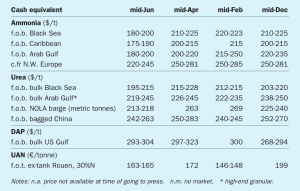
The impact of coronavirus on both supply and demand continues to provide considerable uncertainty to the market. Industrial demand seems to have been worst affected, and fertilizer related demand has largely kept up, although shutdowns in India’s ammonium phosphate sector have also affected demand. Spring is traditionally the strongest time for fertilizer demand, and this has helped support prices at least in the short term.
Southeast Asia has been a major site for new syngas projects in recent years as countries such as Indonesia, Malaysia and Brunei continue to monetise their natural gas resources.
Olefins production from methanol, particularly in China, has come to dominate the methanol market over the past few years. However, environmental and market concerns complicate the outlook there.
A Stamicarbon urea plant attempts to start up after a scheduled turnaround. Due to maintenance issues, it is necessary to shut down and block in the synthesis section several times. Although licensor’s procedures have been followed, several signs of active corrosion are noticed in the liner of the reactor. What could the cause be for this unexpected behaviour? Can sharing experiences from colleagues from other urea plants provide valuable support to find the root cause or even provide new insights into possible new causes? One observation is that the typical heating up rate of a liner in a reactor is much higher than recommended (refer to diagram). The condensation heat of steam heats up the liner much faster than the carbon steel pressure bearing wall. This creates stress on the liner and affects the lifetime of the liner. Another observation is a temperature rise in the reactor during a blocking in situation. This can be a cause for loss of oxygen required for passivation, resulting in higher corrosion rates.