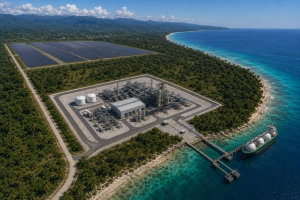
Hynfra plans Mindoro green ammonia hub
Hynfra, a Polish developer of green hydrogen and ammonia projects, has signed a memorandum of understanding with a Philippine partner to build a green ammonia complex on the island of Mindoro.


Hynfra, a Polish developer of green hydrogen and ammonia projects, has signed a memorandum of understanding with a Philippine partner to build a green ammonia complex on the island of Mindoro.

The government of Kazakhstan says that the country will build its first ammonia-urea plant at Aktau, in the Mangistau region, with a total investment cost put at $1.6 billion.The Kazakh Industry and Construction Ministry and KazAzot PRIME have signed an investment agreement for the construction of the complex, with commissioning scheduled for 2030. Plant capacity is expected to be 660,000 t/a of ammonia, 580,000 t/a of urea and 500,000 t/a of ammonium nitrate. The government says that the plant will reduce import dependence, supply domestic farmers, and strengthen export potential. By 2030, Kazakhstan’s ammonia production capacity is projected to reach 2.3 million t/a, ensuring self-sufficiency and export growth.

AkzoNobel says that it is providing long-term corrosion protection and chemical and heat resistant coatings for the wind power and chemical processing facilities at the Songyuan Hydrogen Energy Industrial Park. Constructed by China Energy Engineering Group Co., Ltd., it is the world’s largest integrated green hydrogen-ammonia-methanol project. Now on its second phase, the industrial park operates entirely on 100% renewable electricity and is currently focused on producing 45,000 t/a of green hydrogen and 200,000 t/a of green ammonia and methanol.
Metso has been awarded an order to supply key cellhouse process equipment for a zinc smelter expansion project in South Asia. The value of the order was undisclosed, as was the name of the customer, which is one of the leading zinc producers globally.
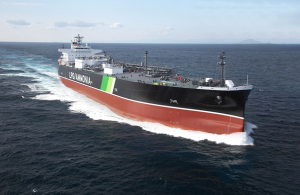
JERA has signed time charter agreements with NYK Bulkship (Asia) and Mitsui O.S.K. Lines (MOL) for four fuel ammonia carriers to support Japan’s first commercial scale low carbon ammonia value chain from the US to Japan.
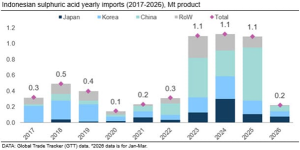
As Indonesia's nickel industry drives significant import demand of sulphuric acid in recent years, CRU is launching a new weekly CFR Indonesia acid price assessment on 28 May to bring transparency to this key spot market.

JSW Steel says that it has signed a memorandum of understanding with Bharatia and Carbon Iceland International to develop a 300,000 t/a green methanol facility. The plant will capture carbon dioxide emissions from JSW Steel’s existing Raigad facility in Maharashtra state, and combine them with hydrogen produced from water electrolysis using renewable electricity. Under the […]

The International Finance Corporation, Siemens Financial Services and Fullerton Carbon Action Fund have signed definitive agreements for a total equity investment of $105 million in Hygenco Green Energies. The investment will support the development of multiple commercial green hydrogen projects which Hygenco aims to deliver as part of India’s National Green Hydrogen Mission. Hygenco broke […]
Uniper Global Commodities has signed a long-term binding offtake agreement with AM Green Ammonia India for up to 500,000 t/a of renewable ammonia certified as a Renewable Fuel of Non-Biological Origin (RFNBO). The agreement, the first of its kind for an Indian company, was signed by Michael Lewis CBE, CEO of Uniper, and Anil Kumar […]
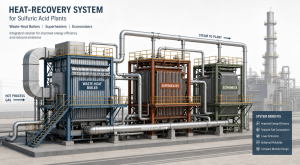
Elessent Clean Technologies has entered a strategic alliance with India‑based Thermal Systems Private Limited to supply steaming equipment for MECS® sulphuric acid plants in North and South America.