Africa

Millennial starts Phase 3 drilling at Banio

Written by Natalie Noor-Drugan


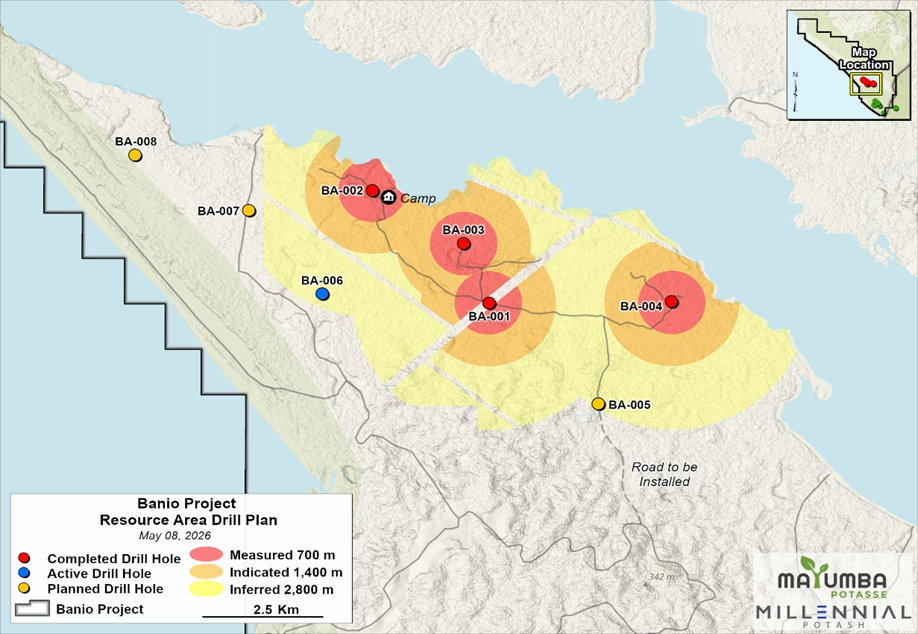
Canadian junior Millennial Potash Corp. has begun Phase 3 drilling at its flagship Banio Potash Project in Gabon, launching four potash‑specific holes for a total of about 4,000m of drilling. The new holes are designed to test the southern and western extensions of the currently outlined mineralisation and to evaluate how far the deposit continues in those directions.

Image: Location of the drill holes for the Phase III program. Image courtesy of Millennial Potash.

Chair Farhad Abasov said the company sees Phase 3 as “an important step in unlocking further value from this highly prospective potash project”. He noted that the four holes are located south and west of previous drilling and are intended to support potential resource expansion and “further demonstrate the scale of the opportunity at Banio”. Two of the holes, BA‑007 and BA‑008, sit on the recently acquired Haute Banio exploration permit, which covers the coastal part of the project area closer to the planned port and other infrastructure.

Millennial highlighted that Banio already carries a substantial mineral resource base. The project has a Measured Mineral Resource Estimate (MRE) of 648.2 million tonnes grading 15.7% KCl, an Indicated MRE of 1.8 billion tonnes grading 15.6% KCl, and an Inferred MRE of 3.56 billion tonnes grading 15.6% KCl, based on updated estimates published in November and December 2025. Management believes drilling in this previously untested area could add further tonnes to that resource base and says an updated MRE will be completed once Phase 3 is finished.

The four‑hole programme will target the southern and western extensions of thick potash sequences, locally more than 100m thick, intersected in earlier holes. According to the company, its geological model suggests the new drilling will move deeper into the evaporite basin, where there is strong potential to hit all ten potash cycles with significant cumulative thickness. The new area is mainly savannah, and an old road has been rehabilitated from the town of Mayumba, allowing road access for rigs and supplies and removing the need for barges and boat support.

Each hole is expected to reach around 1,000m depth, and the programme is planned to be completed in the fourth quarter of 2026. Millennial says it will keep the market updated as drilling progresses and as assay results and geological interpretations become available. The updated resource estimates from Phase 3 are expected to flow into the company’s ongoing Definitive Feasibility Study for Banio, which remains scheduled for completion by the end of 2026.

Latest in Africa

Electrolyser contract signed for green ammonia project

Chinese companies Sungrow Hydrogen and CRRC Zhuzhou say that they have secured electrolyser supply contracts for the first phase of a geothermal-powered hydrogen and ammonia project in Olkaria, Kenya, developed by Chinese firm Kaishan Group. Kaishan signed a steam supply agreement with state utility KenGen in October 2025, under which KenGen will supply steam from existing geothermal wells for Kaishan to generate 165MW of electricity to power the electrolysers. Chinese firm Wuhuan Engineering is serving as engineering, procurement and construction contractor. Works on the site began in November 2025.

MoU for green ammonia hub

Abu Qir Fertilizers & Chemicals, Alexandria Fertilizers, Orascom Construction SAE, and Green Hydrogen Development Holding, a subsidiary of China’s United Energy Group (UEG), have signed a memorandum of understanding (MoU) to explore the development of a Mediterranean green hydrogen hub in Alexandria. The proposed project would centre on a large-scale green hydrogen facility powered by wind and solar, with output integrated into existing ammonia infrastructure in the region. Under the agreement, UEG and Orascom will lead feasibility studies covering 500 MW of renewable energy generation and green hydrogen production, while Abu Qir and Alexfert will assess integration into ammonia operations and support access to local infrastructure.