Sulphur 423 Mar-Apr 2026
20 March 2026
SulGas® Mumbai 2026
CONFERENCE REPORT
SulGas® Mumbai 2026
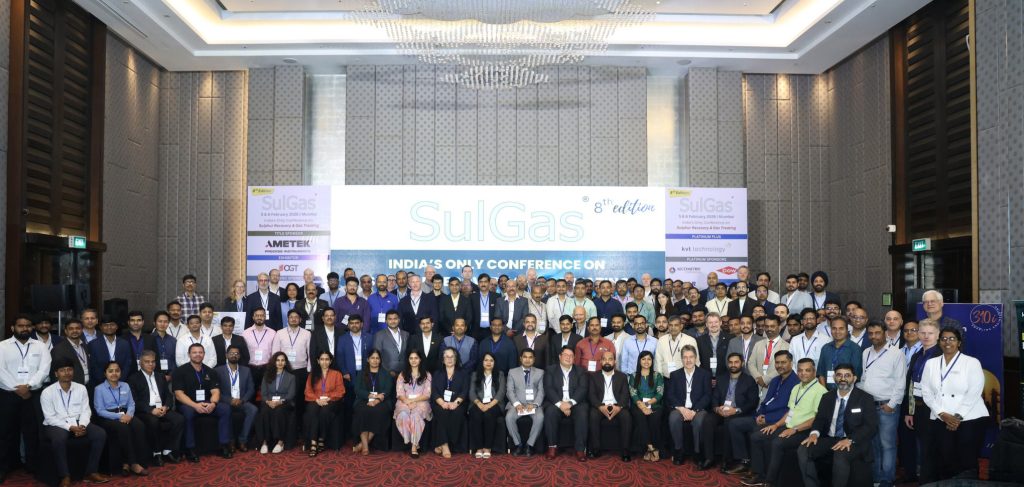
The 8th SulGas® Mumbai sulphur recovery and gas treating conference and exhibition, organised by Three Ten Initiative Technologies LLP, took place on 5 and 6 February 2026. We report on some of the key topics on the agenda.
SulGas® 2026 returned to the Holiday Inn, Mumbai for this year’s event, bringing together public-sector oil companies, private refiners, licensors, engineering companies, solvent and column equipment manufacturers, as well as control and instrumentation companies. This year saw participation from over 155 attendees representing more than 68 companies across various areas of sulphur handling and gas processing.
The conference’s agenda featured ten sessions covering:
- Amine unit performance and energy optimisation
- Liquid treating
- Gas dehydration
- SRU controls and upset management
- SRU oxygen enrichment
- Innovations in carbon capture
- SRU thermal integrity and safety
- Sulphuric acid technologies
- SRU modelling
- Tail gas and degassing.
The conference featured 26 speakers in interactive technical sessions, fostering maximum technical exchanges among participants. Each session concluded with a detailed panel discussion, sparking valuable dialogue between the audience and speakers.
An additional valuable feature of 310i’s knowledge forums is the open house session that allows unhindered discussion on any topic of interest to the audience, including plant problems, follow up questions with speakers, and experience sharing from all the stakeholders.
Some of the topics discussed at the conference are highlighted below.
Optimising the energy demand of an amine reboiler
Amine plants play an important role in protecting the environment. They remove H2S and CO2 from sour gas and liquid hydrocarbon streams, allowing them to be safely burned, vented to the atmosphere, or sold into households. A well operated amine system will make sure that the treated gas stream meets the strict specifications. However, if not fully understood, the amine plant can be very inefficient, using far more energy than necessary. On the other hand, over-optimisation of the energy consumption can adversely affect the system, potentially leading to corrosion issues.
When regenerating the amine, it is critical to first and foremost prevent acids (H2S and CO2) from entering the reboiler in large enough quantities that they will cause corrosion, and secondly the amine must be regenerated enough such that each absorber in the system meets the specification for its treated gas stream.
Ben Spooner of SGS Amine Experts discussed how to determine the optimal energy input needed in the amine reboiler and recommended the following steps:
- Optimise the amine circulation rate to each absorber.
- Set the heat duty to the reboiler as a ratio with the total amine arriving at the regenerator.
- Fine-tune the ratio set point with the regenerator overhead temperature measurement.
- Doublecheck the ratio and overhead temperature readings are correct by calculating the ratio of the flow rates of reflux water to amine.
- Use a simulator to verify that:
- The amine increases in temperature from the moment it enters the regenerator.
- 95% of acid gases are stripped from the amine before it enters the reboiler.
- In the vapour return line from the reboiler to the regenerator there less than 0.5 mol% H2S and CO2.
- If there are heat stable amine salts present these must be input into the simulation or the last two points will not be accurate.
Instrumentation solutions for reliable and safe operation of the SRU
In refinery processing, maintaining instrumentation for sustainable and reliable operation of the sulphur recovery unit and the tail gas treating units can be difficult due to frequent choking, sulphur deposition and corrosion issues.
Due to stringent emission control norms and environmental regulations, the reliability, safety and efficiency of the SRU and TGTU have become a primary focus at BPCL Bina Refinery, which operates an SRU with three trains with a capacity of 3 x 243 t/d, commissioned in 2010.
Nirmalya Nandi of Bharat Petroleum Corporation Limited shared the methodologies and innovative solutions implemented by the instrument team at BPCL to address the challenges of frequent choking and instrument failure, aimed at ensuring continuous safe operation. The methodologies employed focused on:
- Process monitoring enhancement: Upgrading physical instrumentation to monitor pressure profiles and flame intensity.
- Logic and interlock upgrades: Converting trip logic from 1oo1 (one out of one) to 2oo3 (two out of three) to prevent spurious trips and enhance reliability.
- Automation schemes: Developing stoichiometric calculation schemes for air demand and auto-loading configurations for dispatch.
- Physical hardware modifications: Implementing purging arrangement and steam jackets to combat sulphur solidification and deposition.
Collectively, through the strategic implementation of these solutions the SRU and TGTU at BPCL Bina Refinery have transitioned from being potential bottlenecks to highly reliable units with an operation availability of more than 95%.
The hybrid optimised SRU
Ayan Dasgupta of Fluor Daniel India Pvt. presented a case study for a hybrid sulphur recovery unit design, which integrates acid gas enrichment with high level oxygen-enriched operation, to deliver an optimal balance of cost, efficiency and reliability. The case study demonstrated that these systems can operate seamlessly while achieving energy and cost savings, maintaining environmental compliance, and improving plant uptime.
By adopting a smart, flexible oxygen-enrichment strategy, modern gas processing plants and refineries can achieve higher sulphur recovery rates, lower emissions and enhance operational reliability driving both performance and profitability in sulphur recovery operations.
Technical benefits such as higher thermal efficiency, elimination of spare trains and reduced energy consumption combined with operational advantages like flexibility and resilience, enable facilities to manage throughput variability and maintenance downtime without flaring or capacity loss. This approach is particularly valuable for plants with space constraints or those seeing to revamp existing units for increased capacity and performance.
Simulation for amine treatment of hydrocarbon liquids
Liquid extraction is widely used in the refining and natural gas industries for a variety of applications, including to strip sulphur compounds, mainly H2S, COS and mercaptans from LPGs and NGLs. Yet despite its wide use, designing these units with confidence has remained elusive due to the complete lack of commercial models. In practice, engineers often rely on ideal-stage calculations supplemented by anecdotal estimates for tray efficiency or HETP values. This approach takes no account of how the treater’s actual internals, dispersed phase selection, flow rate it handles, or the composition and temperatures of the streams feeding it affect its performance.
Dr. Anand Govindarajan of Three Ten Initiative Technologies reported on a new mass transfer rate-based liquid treater model, which allows engineers, for the first time, to be able to analyse and predict the performance of trayed and packed treaters in acid-gas liquid hydrocarbon service with the same reliability that rate-based simulation of gas treatment using amines has provided for the past 30 years.
The simulation’s calculations include the Sauter mean diameter of the dispersed-phase droplets (which helps set the interfacial area and hydraulics within and outside the droplets), as well as tray-by-tray and packed segment-by-segment interfacial compositions and fluxes. These results provide insight into the operating regime, specifically whether the separation is limited by phase equilibrium or by mass transfer, and which phase is limiting. Interfacial area and interfacial tension are also calculated. Simulations are predictive and not reliant on empiricism.
Until now the effect of tray details such as sieve hole size and tray spacing, and packing details such as type, material and size on treater performance has remained largely unknown. Even the effect of amine type and strength on the removal of sulphur compounds from LPGs has remained unexplored. Rate-based simulation is a game changer allowing the effect of all relevant parameters to be quantified.
Addressing the safety concerns of oxygen enrichment
The benefits of oxygen enrichment in sulphur recovery units are well known, oxygen provides a useful debottlenecking solution for hydraulically limited SRUs, allowing substantial increases in capacity for revamped plants and reducing the size of greenfield oxygen-based SRUs. Replacing air with oxygen in a Claus combustion chamber reduces the gas volume to be heated, eliminating the need for preheaters, which lowers investment costs, plot space and complexity. Higher combustion chamber temperatures as a result of oxygen enrichment improve the destruction of impurities like BTX or NH3 . Many refineries and gas processing units dealing with lean acid gas face a challenge in maintaining the required reaction furnace temperature for effective contaminant destruction. Traditionally, the solution has been co-firing with natural gas, which is an expensive fuel source that generates Scope 1 CO2 emissions. Oxygen enrichment naturally elevates the adiabatic flame temperature by eliminating the nitrogen heat sink, achieving high operating temperatures without the need for supplemental fuel gas.
Despite these benefits, the adoption rate of oxygen enrichment in the industry has often been held back by industry reluctance regarding oxygen usage due to the risks of internal ignition or combustion. Alexander Haenel of Air Liquide Global E&C Solutions addressed some of the most common concerns in his presentation, expressing that oxygen is not a hazard, rather it is a utility that requires respect and proper engineering. The risks are manageable. The primary hazards, often caused by inappropriate velocities, improper material selection, or weak protective barriers, can be effectively mitigated through a rigorous, risk-based design approach. Safety should be managed by strictly adhering to ignition prevention strategies and consequence mitigation, ensuring that oxygen systems are designed according to proven guidelines and standards. When treated with the correct engineering discipline, oxygen transforms from a safety concern into a powerful tool for operational flexibility.