Fertilizer International 531 Mar-Apr 2026
19 March 2026
Fertilizer Latino Americano 2026
CONFERENCE REPORT
Fertilizer Latino Americano 2026
More than 900 attendees from 56 different countries gathered at the Trump National Doral Miami, Florida, 26-28 January, for the 2026 Fertilizer Latino Americano (FLA) conference. We present selected highlights from this year’s three-day conference.
Sustainability at the heart of doing business
In a highlight of FLA’s opening morning, a keynote panel discussed innovations in sustainability and decarbonisation.
“Our commitment to the future is totally linked with sustainability. It is at the heart of how we do business,” said Henrique Mattos, Legal, Compliance & Corporate Affairs Director, OCP Brazil.
“We [OCP Group] are investing $13 billion from 2023 to 2027 to achieve sustainability goals. These include zero conventional water consumption by 2027, 100% green energy use about 2027, and carbon neutrality by 2040,” he said.
“OCP Nutricrops is dedicated to developing soil health and plant nutrition – delivering precision technology and mapping soils. We invest a lot to drive sustainability and innovation with partnerships around the world including Brazil,” Mattos added.
“P is not only phosphate for us,” said Mattos. “P is also people, plants and planet. We help farmers feed soil and the world through innovative initiatives, innovative products, tailored crop fertilization and responsible farming practises.”
For Yara, sustainability was at the heart of the company’s strategy.
“It is present in every decision we make,” said Marcelo Altieri, SVP, Yara Brasil. “Bringing prosperity to farmers is crucial and one of the pillars of our strategy. We work hard with bringing technology, bringing science to the farmers – so they can produce more, produce better and can improve their profitability,” he added.
Sustainability generated more value, compared to just increasing production, in his view.
“Sustainability can open doors, create new revenue streams for farmers. We should all push together with partnerships across society. Industry cannot do this alone,” Altieri said. “But always bringing farmers to the centre, because there are no green transitions with red numbers,” he concluded.
Eti Maden, meanwhile, were seeing a step change in the agricultural consumption of boron, a key crop micronutrient.
“We are now having extensive demand for boron from agricultural users,” said Haluk Gani. Eti Maden’s CEO. “40-50 years ago nobody had heard of boron in agriculture. Mainly we were selling to industrial customers. The agricultural percentage of our 2.5 million tonne sales was 2%. Now we’re looking at 15-20% – so it’s significant growth,” he added.
Farmers were responsible for this growth, said Gani.
“Farmers, when they use it, they see the results of this micronutrient. When they make the investment, they see the return makes sense. If it’s profitable they will go with it,” he said.
Spotlight on LatAm green ammonia
Two Latin American green fertilizer projects, ATOME’s Villeta project in Paraguay and Atlas Agro’s Uberaba project in Brazil, were highlighted in the opening day’s other discussion panel on regional clean ammonia developments.
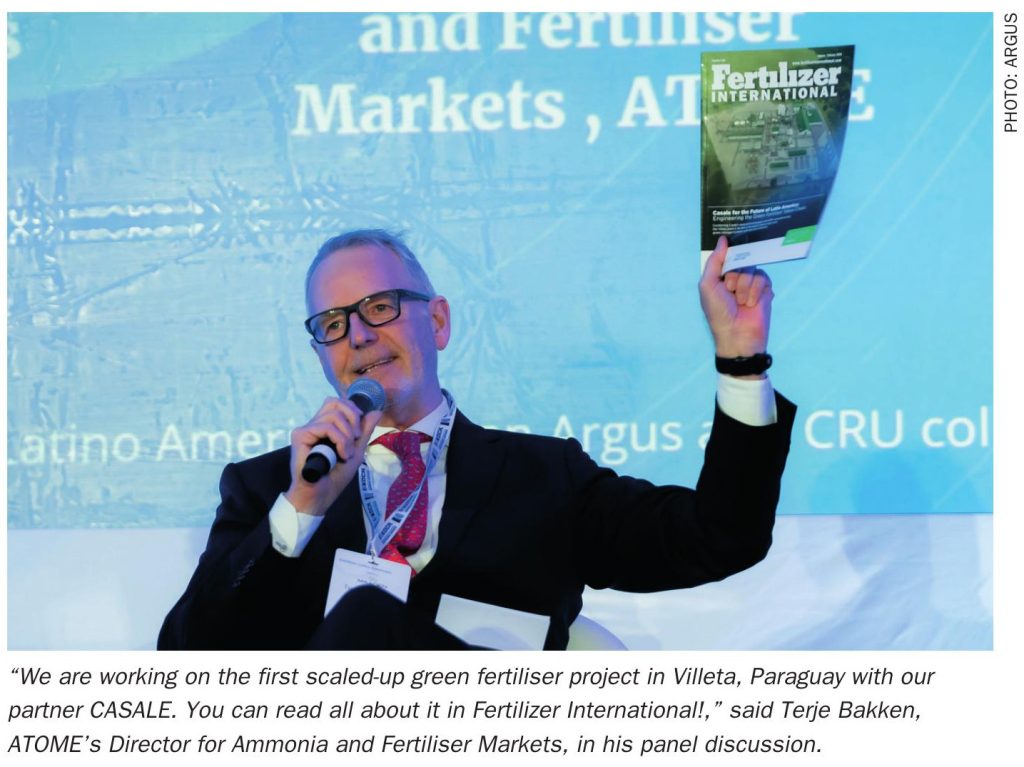
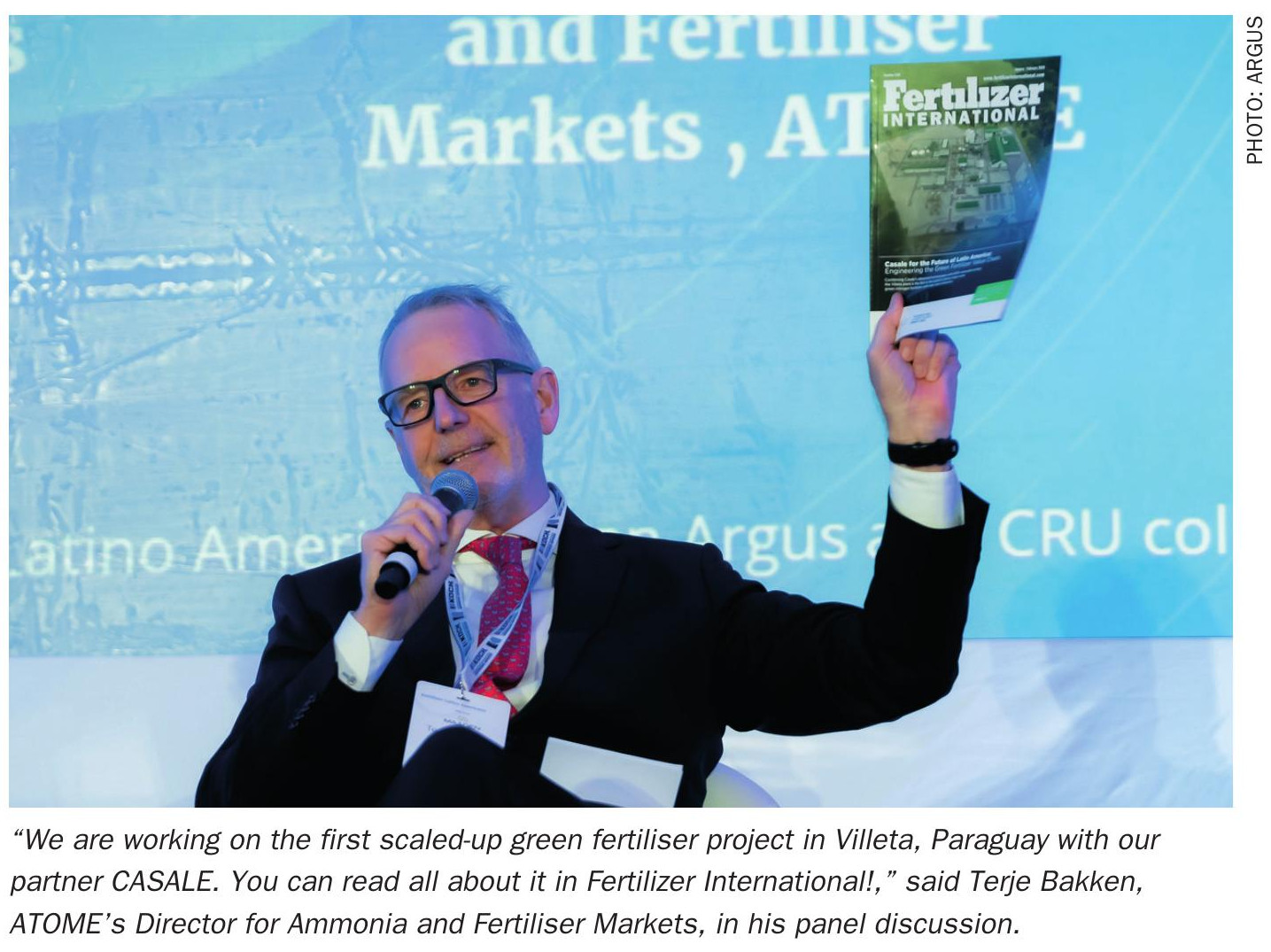
Terje Bakken, ATOME’s Director for Ammonia and Fertilizer Markets, brandished a copy of Fertilizer International magazine on stage to make his point.
“We are working on the first scaled up green fertiliser project in Villeta, Paraguay, together with our partner CASALE,” Bakken said. “You can read all about it in Fertilizer International. It’s on the front page!”
Bakken said the Villeta project was close to financial close.
“That’s what we’re focusing on,” he said. “My boss Olivier Mussat [ATOME’s CEO] was meant to be here, but he is busy doing the final investment decision,” adding: “It takes time to develop projects. It’s like running a marathon, but now we’re inside the stadium, so it’s a number of days until we are crossing the line.”
Bakken continued: “In order to cross the line, the stars need to be aligned. The challenges are: it’s the demand side, it’s the sourcing side, the energy side, it’s the cost side – that’s the cost of the project not only the cost of production,” he said.
Being in Mercosur (Paraguay, Brazil, Argentina), an important region for global agriculture, was also helpful, in Bakken’s view.
“We didn’t start by asking for big green premiums,” he said. “We are a manageable, small-scale operation with a local source of energy. We will be a local producer of nutrients in the middle of a market dependent on imports.”
The $1.1 billion Uberaba project in Brazil was a textbook case of power shoring, suggested Lieven Cooreman, CEO, Atlas Agro Brasil.
“Why? Because we are bringing a hard-to-abate sector into a country where the renewable grid is 88%,” said Cooreman. “Where there is a very low levelised cost of renewable energy and we’re also helping a country, Brazil, be strategically less dependent on nutrient imports.”
Creativity in sharing the green premium was necessary, Cooreman said:
“I need to offer the Uberaba product at import price parity,” he said. “Due to the energy matrix, the capex involved, it’s really important to push the green premium down the value chain, so we can monetise it maximally through the companies involved, such as packaged goods companies – the final customer – where the premium on the end product is a minor percentage and much more palatable.”
Paolo Bonucci, CASALE’s Commercial Division Head, emphasised the company’s wide-ranging expertise as a technology provider and its strengths from combining this with EPC (engineering, procurement and construction) capabilities.
“Our technology portfolio ranges from hydrogen to green, blue and grey ammonia, to nitric acid, to all the complex fertilisers like calcium ammonium nitrate,” he said. “Basically, the technologies that will be applied at Villetta and hopefully also for Atlas Agro.”
He added: “Villetta is an example of a one-stop shop. CASALE can provide the technology going all the way up to the full EPC for the project that’s awaiting the final investment decision.”
Global trade – navigating new realities
Day two opened with discussion of new global trading realities – specifically tariffs and duties and how to navigate these.
Milton Sato, Fertistream’s Head of Global Market Intelligence, saw ammonium sulphate emerging as a cheaper alternative to more volatile urea. This had spurred development of large-scale international trade flows.
“Ammonium sulphate is a by-product of the caprolactam process, so the cost of production is marginal and in China farmers don’t use much, so most ammonium sulphate production is for export,” he said. “So that’s the dynamic – a traditional by-product that’s a cheap alternative to expensive urea.”
On CBAM (carbon border adjustment mechanism) implementation in the EU, Sato said: “From January this year, CBAM started to roll out. So, what happened was that buyers started to front-load imports from Q1 2026 into December [instead].”
Current policy uncertainty on CBAM was also having an effect, in his view, as importers don’t wish to make the wrong decision on cost.
“So, what we see now is that the importer does not have much visibility on the actual CBAM cost because the EU is discussing whether they are eligible or not,” Sato said.
He was generally bullish looking ahead at early market prospects in 2027. He linked this to the effects of policy developments in the EU, China and the US on prices.
“In my team, based on the next three months, we see more bullish factors across nitrogen, phosphate and potash,” summed up Sato. “These policies tend to push up prices because any barrier to trade increases the cost of access.”
Spotlight on Brazil – production and policy update
The day’s other panel discussion focused on policy affecting domestic fertilizer production in Brazil.
Jose Carlos Polidoro of Brazil’s agriculture and livestock ministry provided an update on Brazil’s National Fertilizer Plan. His key takeaways were:
• Firstly, that Brazil has an action plan to be a world leader in the ‘new fertilizer industry’ by 2030.
• Secondly, with growing demand, Brazil is expected to become the second/ third-largest global fertilizer market globally by 2035.
• Thirdly, the resulting increase in consumption will be largely met by biostimulants, green fertilizers and fertilizers with high agronomic efficiency.
Brazil is preparing for this and taking action as part of the country’s National Fertilizer Plan 2025-2029. The objectives are to:
1. Improve the business environment and reduce capex costs for investment in Brazil.
2. Create a ‘new fertilizer industry’ based on energy efficiency, low carbon technologies, bio-inputs and high-tech materials.
3. Encourage public-private partnerships for fertilizer production, e.g. Petrobras.
The overall objective of the national fertilizer plan is to reduce Brazil’s external dependency on fertilizers from 85% to 50% by 2050. On an individual nutrient basis, the ambition by 2050 is to reduce external nitrogen dependency from 93% to 50%, external phosphate dependency from 72% to 34%, and external potash dependency from 98% to 45%.
National fertilizer production was around 7.21 million tonnes in 2024, around 17% of total supply. Brazil plans to increase this to 19.6 million tonnes by 2030, or 35% of supply. This is likely to require $25 billion of extra investment in domestic fertilizer capacity during this decade.
Phosphates at a market inflection point?
FLA’s final day began with a fireside chat with Wafaa Settar, the Chief Strategic Marketing Officer of OCP Nutricrops. “I lead on strategic marketing at OCP Nutricrops where my role is to connect farmer realities with soil science,” she said.
Prior to her 15-year career with OCP, Wafaa worked in the washing powder industry for more than a decade. There were surprising similarities.
“Making granular fertilizer is not that different from producing laundry powder. It requires precision formulation, additives, coatings, inhibitors,” she said
“So that experience shaped how I feel about fertilizers today – not only as commodities but as engineered solutions. It naturally led me to my current role where my focus is how nutrient formulations translate into tangible value for the farmer and the food system,” she added.
Phosphates were at a pivotal moment, in Settar’s view.
“The market is at an important inflection point. For a long time, it was viewed through supply and demand cycles, cost, production capacity, the logistic. Those factors still matter, but today they are not enough to explain market dynamics,” she said.
“We are seeing growing pressure on soils, on phosphorus use efficiency in cropping systems that are still below 20-30%. At the same time expectations on sustainability are much higher now,” Settar added.
“Regulators, retailers and shoppers are asking for better nutrients, better efficiency and a lower environmental footprint. While farmers are increasingly looking for solutions that help stabilise yield, improve crop quality and reduce agronomic and commercial risk, so it’s not just the product price per tonne,” she said.
Phosphorus is also wrongly classified as a starter nutrient by some.
“It’s widely received as a nutrient that’s mainly needed for early growth starting at planting stage to secure establishment. That view is incomplete,” Settar said.
Phosphorus actually plays a critical role throughout the crop cycle, she suggested.
“It’s also involved in nutrient use efficiency and stress resilience. Phosphorus has a key role to play during the reproductive cycle and stages such as flowering and fruit set, where the plants energy demand gets higher,” Settar said.
The separation of nutrients and the presence of calcium are both important yet often overlooked factors.
“We are a strong believer in nutrient separation and improving alignments with soil chemistry and crop timings,” Settar said. “When you apply the right nutrient at the right time you get the most of each because nutrients may compete with each other when you apply generic fertilizer.
“Good quality phosphorus fertilizers naturally contain calcium whose benefits are rarely discussed. Calcium is really key in cell wall strength, fruit firmness and stress tolerance, particularly during flowering and fruit development,” she added.
Summing up, Settar said: “The focus is shifting from how much we produce, to how well we produce and quality across the whole value chain. Yield will always matter, but today’s farmers are increasingly rewarded for consistency and marketability, not just volume.”
Well-designed fertilizers contributed to this.
“What we need as an industry is a strategic shift that starts to recognise phosphorus not as a starting nutrient, not as a commodity anymore, but at the level of performance. With the presence of calcium, you have a stronger plant structure, improved quality, and tolerance to stress and drought,” Settar concluded.
Shipping state of play
The final panel discussion of FLA 2026 turned the spotlight on shipping fertilizers to Latin America and the current state of play. The rise in ammonium sulphate supply out of China has been notable in 2025.
“I want to focus on Chinese ammonium sulphate a topic everyone has been seeing for the last year. Looking at volumes from China, what we’re seeing is affordability and availability increasing a little bit,” said Julia Santos, Senior Market Data Analyst at Kpler.
“The new trade coming from China is also using bigger vessels. What we’re seeing is a decrease in Handysize vessels and an increase in the bigger size Supramax and Panamax classes,” Santos added.
The main characteristics of shipping fertilizers from China were long haul distances and higher cargo volumes, said Viviane da Rocha Goncalves, Head of Dry Cargo Brazil at D/S Norden.
“Long haul voyages with their higher fees are the perfect business for the ship owners, who bring ships in with fertilizer to Brazil to discharge and send them out to China filled with grain,” she said. “But when you consider the lineups, the port congestion [for Panamax ships], they can become more expensive because of it.”
Consequently, the shipping of fertilizer to Brazil in larger vessels – Panamax instead of Handysize – is not necessarily cheaper overall, in her view:
“The message I want to bring to the room today is that when we have Panamax ships and cheaper cost of freight, does that mean we have cheaper final costs for your receivers – [when] they are going to face more congestion competing with other commodities. Handysize ships might cost more, but you may be able to discharge them faster [or] change to a different port that has the flexibility to receive them.”
China is becoming one of Brazil’s biggest fertilizer supplies accounting for 28% of the current shipping line up by origin, reported Arthur Neto, Partner at Alphamar.
For fertilizer supply currently [end-January], port congestion is not a problem in Brazil, with the exception of the port of Francisco Do Sul. Neto was not expecting this situation to last, however.
“We have roughly 2.2 million tonnes of cargo expected to arrive in the next 60 days,” he said. “So the good times are expected to be over soon, with further congestion in ports in the upcoming months.”
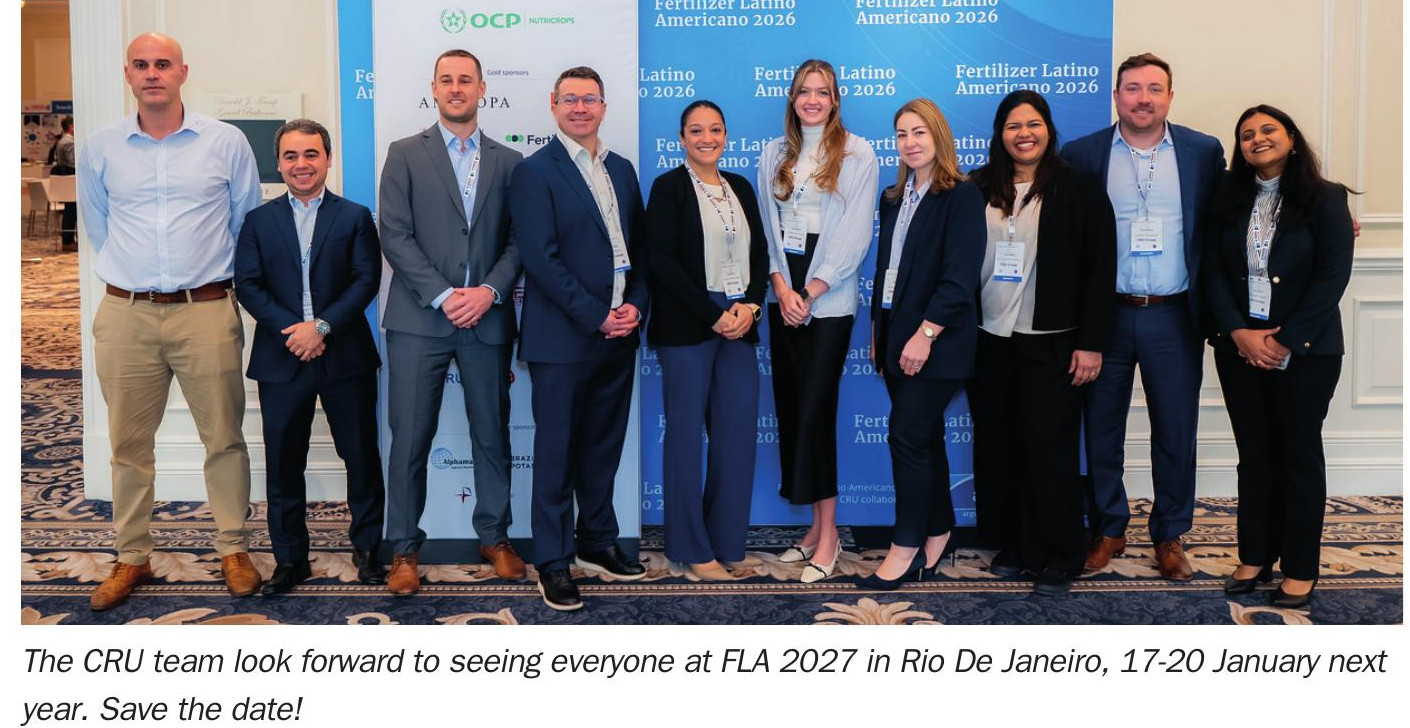
Fertilizer Latino Americano 2027 – save the date!
The 2027 Fertilizer Latino Americano Conference, hosted by CRU in collaboration with Argus, will take place in Rio de Janeiro, Brazil, 17-20 January 2027. Register your interest today at: fertilizerlatinoamericano.events.crugroup.com/register2027