Europe
24 February 2026
Unlocking floating green hydrogen: an interview with Gas Solutions' Lachlan McKenzie
Written by Thomas Willatt
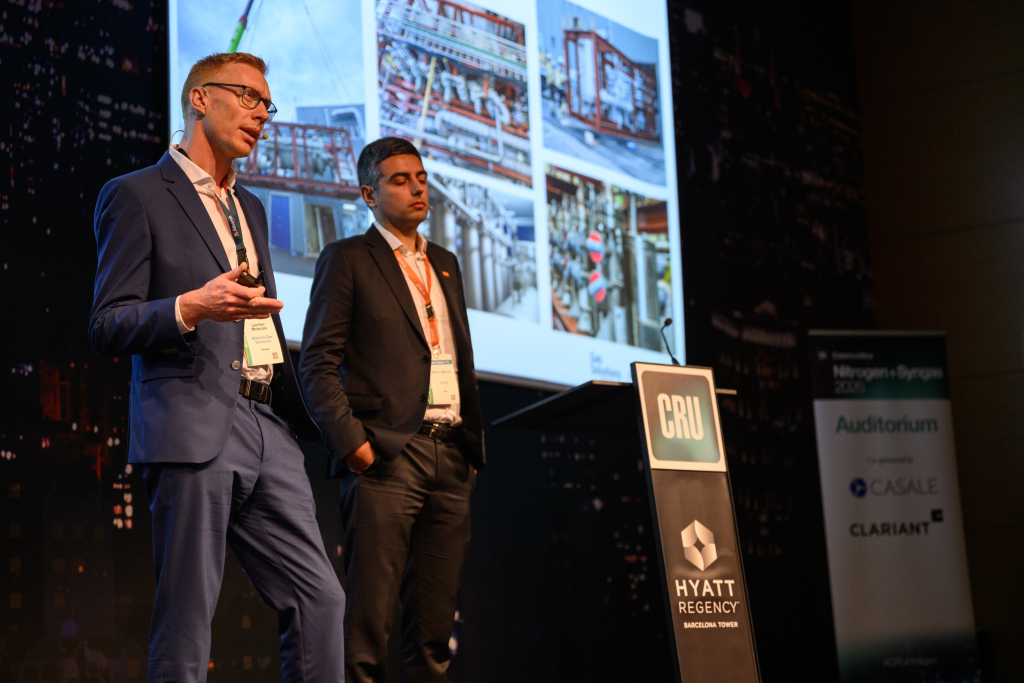
The promise of a global green hydrogen economy is immense, but its realisation is hindered by a fundamental challenge: the monumental task of building the necessary infrastructure for production, storage, and transport. However, a presentation at the recent Nitrogen + Syngas conference by Gas Solutions and BASF outlined a novel approach to this problem, focusing on the use of green ammonia as a hydrogen carrier, which can be converted back into hydrogen at the point of need using an innovative floating facility.
The collaboration has already yielded impressive results. A pilot plant (part of the development program between Gas Solutions and Höegh Evi), supported by the Norwegian government, has successfully completed its activation phase and startup, achieving its design target of 97% ammonia conversion. The smooth activation and the alignment of real-world performance with simulation data have validated the integrated design.
BASF provides the core chemical technology with its SYNSPIRE® ARC catalyst portfolio. This advanced family of catalysts includes cost-effective Nickel-based options for high-temperature cracking and a highly active Ruthenium-based catalyst that boosts conversion at lower temperatures. By combining these in an optimized, multi-layer system—a design perfected using their proprietary SYNSPIRE® ARCsim simulation tool—they can achieve maximum process efficiency.
Gas Solutions, leveraging its deep expertise in marine gas processing solutions and Floating Storage and Regasification Units (FSRUs), has engineered the system to operate in a challenging offshore environment. They have designed a compact, robust, and cost-efficient multi-stage adiabatic reactor system with integrated heat management, specifically tailored for the limited space and dynamic conditions of a floating vessel. This approach promises to sidestep the long permitting processes and land-use constraints of terrestrial facilities, offering faster deployment and greater asset flexibility.
Following their presentation, we sat down with Lachlan McKenzie, R&D and Innovation Project Manager at Gas Solutions, to discuss the innovative technology, the challenges of taking it offshore, and the path to commercial scale.
N+S: Thank you for joining us, Lachlan. Your presentation with BASF was fascinating. How would you define the core innovation you’re working on? Is it the new catalysts, the floating element, or the combination of the two?
Lachlan McKenzie: That’s a really good question. The innovation is the complete package. It’s never just one thing, right? It’s the system. Many solutions presented by our colleagues in the industry are based on traditional, land-based SMR (Steam Methane Reforming) systems. We are taking a different approach because our solution is floating, which introduces a unique set of challenges. We still face the same difficulties with high temperatures and difficult materials, but we have the additional aspect of the floating environment, meaning the system has to be exceptionally compact and robust. So, the innovation is in balancing all these different variables to land on something that is effective, efficient, and, not least, cost-effective.
N+S: The partnership between Gas Solutions and BASF seems central to this. How did that collaboration originate?
Lachlan McKenzie: The project in its current form has been going for a little over three years. It’s a joint development project with several key partners. BASF is obviously a critical partner, bringing their catalyst expertise. We selected all our partners, including our test site Sustainable Energy here in Norway, based on who had the best available technology and a willingness to contribute to our particular development. We found BASF to be the best partner in this with excellent technology and a willingness to join the project as a fully integrated partner.
N+S: In your pilot deployment, you used BASF’s SYNSPIRE® Ammonia Reforming catalyst portfolio. Can you tell us about the process of evaluating and selecting the optimal catalyst series for this unique application?
Lachlan McKenzie: That was done in very close cooperation between BASF and ourselves. It goes back to your original question about balancing compact performance with an optimised solution. We used BASF’s in-house simulation tool, which was presented earlier, to find the best configuration. There are a whole lot of variables to tune—temperature, pressure, number of reactors, and so on. It was an iterative, collaborative process to select the optimal design for both the pilot and the full-scale system.
N+S: What were the key trade-offs you had to consider between factors like catalyst cost, thermal efficiency, and operational flexibility?
Lachlan McKenzie: Everything’s a trade-off. The catalyst is a critical part of the system, but it’s just one part. We have to consider and optimise all the other aspects: the operating pressure, the materials, the burner, the conversion rate, and any downstream purification system. A decision made at one end has consequences for the entire system, so you have to look through those consequences to make sure you don’t cause yourself problems down the line. It’s about finding that sweet spot.
N+S: The floating aspect is a clear extension of Gas Solutions’ existing technology for LNG, which is applied on FSRUs worldwide. What have been the most significant challenges in moving from cryogenic gas handling to the high-temperature environment of ammonia cracking?
Lachlan McKenzie: That’s right, this is a step forward for us, moving towards the hydrogen economy. We are used to working at the cryogenic end of things, and this is moving to the other end of the scale. We had some challenges with sourcing the right high-temperature equipment. So, when we were able to announce that we had achieved ‘cracked-gas’ before Christmas last year, it was an important milestone on a road we started more than three years ago.
N+S: Now that you’ve successfully started up the pilot, what is the focus moving forward to scale the solution for commercial deployment?
Lachlan McKenzie: With the successful startup and catalyst activation last year, the focus now is on long-term qualification and scaling up. We are doing these in parallel. Start-up is one thing, but the system has to last. We are doing long-term testing to prove the technology and its reliability. At the same time, we are scaling up the design so that it’s ready for the commercial market, which will need capacities in the hundreds of thousands of tonnes of ammonia per year. We are leveraging the knowledge gained from the pilot to ensure we have a commercial-scale solution that is qualified and ready to go.
N+S: What potential impact do you see this technology having on the green hydrogen supply, particularly in regions like Europe?
Lachlan McKenzie: We see use cases particularly in Europe, with the RePowerEU goals for 2030 – and 2030 is not very far away. A key advantage of our floating solution is the potential for a more rapid time-to-market, partly due to a faster permitting process compared to land-based solutions. We are confident that our technology can be a critical key to helping the EU reach its goals. By using the existing ammonia infrastructure for shipping and transport and leveraging our knowledge of re-gasification systems, we believe this floating concept can be a key to unlocking and enabling hydrogen to be available for industry in Europe, quickly, safely, and effectively.
N+S: Finally, you mentioned the successful activation was a testament to the team’s work. What was the feeling when the system started producing hydrogen as planned?
Lachlan McKenzie: The smooth activation process—with no temperature runway or pressure drop issues—was a result of the close cooperation and the power of the digital simulations and tools that BASF has developed. It was a testament to the team and the years of work that had been put in. Now, we’re looking forward to moving past that stage, proving the operational envelope of the system, finding the limits, and proving that we can deliver hydrogen to the right quality over time, making it completely qualified and ready for deployment.