
The outlook for urea
Although the urea market has weathered the pandemic relatively well, a significant amount of new capacity is due to come on-stream in the next year or so, and could keep prices depressed unless more Chinese capacity closes.


Although the urea market has weathered the pandemic relatively well, a significant amount of new capacity is due to come on-stream in the next year or so, and could keep prices depressed unless more Chinese capacity closes.
The Belarusian Potash Company (BPC) has agreed new annual potash supply contracts with India and China.

We profile a selection of the leading players in India’s large and dynamic domestic fertilizer industry.

ICIS, the independent commodity intelligence company, provides an overview of the nitrogen market. The world supply of urea looks set to outpace market demand in 2021, as several new projects come on-stream. Global ammonia demand, in contrast, is expected to rebound strongly this year after a difficult 2020. The flurry of recent green ammonia projects announcements is another significant market development.
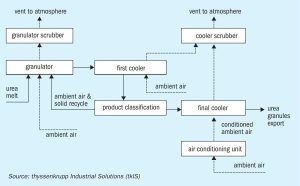
Globally, thyssenkrupp Industrial solution (tkIS) has engineered and built nine urea granulation plants during the last 10 years. Based on this experience, Benedict Jass, Marc Wieschalla and Ivo Mueller of tkIS describe two different cooling concepts for urea granules – fluid bed cooling and bulk flow cooling – and their contrasting advantages and disadvantages.
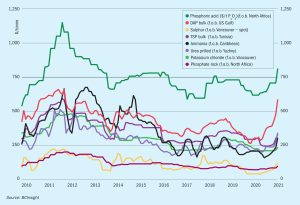
Market Insight courtesy of Argus Media

We highlight recent advances in ammonia and dust scrubbing systems for urea plants from Stamicarbon, thyssenkrupp Industrial Solutions and Toyo Engineering Corporation.
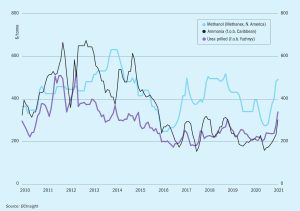
The ammonia industry faced a difficult February, due to extremely cold weather conditions in the northern hemisphere. In the US, production outages resulting from winter storm Uri affected up to 7 million t/a of capacity.
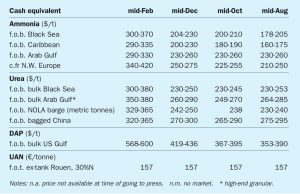
Market Insight courtesy of Argus Media
Copenhagen Infrastructure Partners (CIP) has unveiled plans to build Europe’s largest power-to-ammonia facility at the Danish port of Esbjerg, based on electricity from offshore wind turbines. The company said the plant will consist of 1GW of electrolysis capacity, capable of supplying sufficient hydrogen to produce 300,000 t/a of ammonia, and that the ammonia will be used as both as agricultural fertiliser and as fuel for the shipping industry. Excess heat generated in the process would be used to provide heating for around one third of local households in communities around the plant, to be sited on the west coast of Denmark. The company has signed a memorandum of understanding for the project with companies from both the agriculture and shipping sectors, including Danish Crown, Arla, DLG, Maersk and DFDS Seaways. CIP anticipates that it would cost approximately $1.2 billion to build the facility. They are currently seeking investors for the project and expect that the investment decision would be reached by 2023. The plant could enter commercial operations in 2026.