Market Outlook
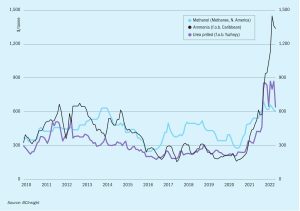
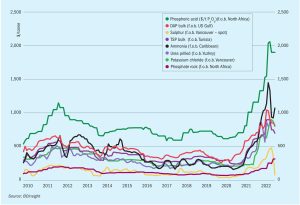
The ammonia market has entered 2022 looking very different to last year, with early January Pivdenny prices $875/t higher on a mid-point basis than they were at the start of 2021, and the likelihood of further gains ahead.
Market Insight courtesy of Argus Media
Stamicarbon offers advanced scrubbing technologies for fertilizer granulation plants and prilling towers. This article describes the technology and experience with the second operational MMV scrubber, which is installed at the Dakota Gasification Company’s (DGC) urea granulation plant, and highlights the successful pilot test with its JV scrubbing technology.
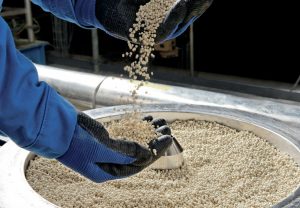
The consistency and integrity of fertilizer granules are key when producing a high-quality product for crop nutrition. Granulation aids help achieve this by increasing crush strength, improving size distribution and reducing recycling volumes during manufacturing. Christina Konecki of Arkema-ArrMaz outlines how their performance can be properly evaluated.
Market Insight courtesy of Argus Media
Conventional fertilizers can be transformed into enhanced efficiency fertilizers (EEFs) using coating agents and inhibitors. Greater use of EEFs, by preventing nutrient losses and avoiding excess nutrient supply, can help global agriculture become more sustainable, as Urvi Mathur of Neelam Aqua explains.
Yield, quality and profitability are the primary focus for the modern potato grower. But these objectives need to be balanced against the need to reduce the environmental impacts that result from cultivating the world’s fourth-biggest food crop. Fertilizer International talks to David Marks of Levity Crop Science about how its unique approach to product development is helping farmers adopt more sustainable agricultural practices.
New innovations and the latest equipment options from FEECO International, Casale, thyssenkrupp Fertilizer Technology and Eirich are helping to perfect the fertilizer finishing process.
Market Insight courtesy of Argus Media
A detailed rain and wastewater concept is an important part of a urea plant to meet current stringent environmental standards. Wastewater can originate from the process reaction or from outside the process equipment. In order to optimise the wastewater system of a urea plant, both the amount and type of contamination need to be known. With this knowledge, non-contaminated rainwater as well as process drains can be kept separate as much as possible to minimise the amount of wastewater to be treated, saving costs and energy. Wastewater treatment concepts from thyssenkrupp Industrial Solutions and Toyo Engineering Corporation are described.