
Fertilizer Industry News Roundup
Yara International has approved a project to partly convert its Pilbara plant near Karratha in Western Australia to green ammonia production.

Yara International has approved a project to partly convert its Pilbara plant near Karratha in Western Australia to green ammonia production.

The fertilizer industry’s leading engineering, procurement and construction (EPC) companies, by setting zero incident safety goals, are making construction sites across world safer. In this article, we highlight the safety advantages of modular construction and digital approaches to safety at construction sites.

Topsoe has agreed to supply an initial 500 MW of industrial-scale, solid oxide electrolyser cells (SOEC) to First Ammonia, a US company aiming to produce green ammonia for transportation fuel, power storage and generation, as well as fertilizer, at sites in northern Germany and the southwestern United States. The companies envisage that over the lifetime of the agreement some 5 GW of SOEC electrolysers will be supplied, potentially replacing almost 5 bcm of natural gas and eliminating the emission of 13 million t/a of CO 2 emissions. The facility to manufacture the electrolyser cells will be built in Herning, Denmark, and has recently received a final investment decisions from Topsoe’s board.
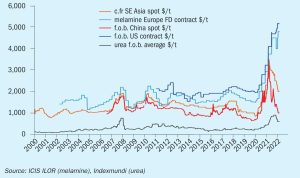
The latest improvements to melamine process technology now make it even easier to integrate a melamine plant with an ammonia and urea fertilizer complex. Guido Canti of Eurotecnica and Marc Wieschalla of thyssenkrupp Uhde discuss the benefits of plant integration.

Industry focus on technologies to reduce the carbon intensity of ammonia and methanol production has been intensifying. In this article thyssenkrupp Uhde, Proton Ventures, Toyo Engineering Corporation, Stamicarbon, BD Energy Systems and KBR report on some of their latest technology developments towards decarbonisation.

Venkat Pattabathula, a member of the AIChE Ammonia Safety Committee, reports on the American Institute of Chemical Engineers’ Safety in Ammonia Plants and Related Facilities Symposium, held at the Hyatt Regency in Chicago, USA, on 11-15 September 2022.

Maire Tecnimont subsidiary MyRechemical has been awarded a basic engineering contract for a waste to methanol and hydrogen plant to be located in Empoli, Tuscany. The scope of work includes the basic engineering design of the plant and the provision of necessary documentation to start the plant’s public authorisation process with the Tuscany region. The basic engineering phase is expected to be completed by the end of 2022. Once completed, the plant will process 256,000 t/a of non-recyclable waste and will produce 125,000 t/a of methanol and 1,400 t/a of hydrogen. The plant will use MyRechemical’s chemical conversion technology which allows the recovery of waste that cannot be mechanically recycled, or other types of unsortable dry waste. The carbon and hydrogen in the waste are converted via gasification into synthesis gas, which is used to produce low-carbon methanol and hydrogen.
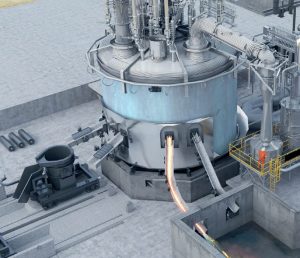
Maire Tecnimont’s innovation and licensing company Stamicarbon has been selected as the licensor for a urea project in sub-Saharan Africa, its first license in the region. Stamicarbon will deliver the process design package for the front-end engineering and design for a 4,000 t/d urea melt and granulation plant. The urea melt plant with a pool reactor will use Stamicarbon’s MP Flash design, a melt concept with improved energy efficiency, entailing a significant reduction of steam consumption. The minimal equipment items result in a significant reduction of the footprint and the overall capital cost of the plant. Less equipment also allows for a reduction in maintenance costs and OPEX savings.

Optimisation of the nitric acid process depends on good process visualisation tailored to the specific process parameters of the plant, improvements in combustion efficiency, reduction of N2 O emissions and the optimal use of platinum group metals.

Most nitric acid is used for production of fertilizer nitrates and ammonium nitrate explosives, but it is also used in polyamides, polyurethanes and aniline dyes as well as a number of industrial processes including ore treatment. High ammonia prices have pushed nitric acid prices to record levels this year, but growth predictions remain robust.