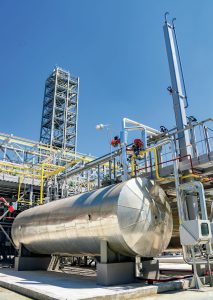
Methanol demand for olefins production
Olefins production from methanol, particularly in China, has come to dominate the methanol market over the past few years. However, environmental and market concerns complicate the outlook there.
The devastating effects of the Covid-19 pandemic continue to be felt around the world. At time of writing, nearly 4 million cases have been recorded, and at least a quarter of a million people have died, with the suspicion of many more, either from accidental or deliberate undercounting. Figures for excess deaths above a normal seasonal baseline show that places such as Turkey, Ecuador and Indonesia have probably been far worse affected than the official statistics show. There are nevertheless finally hopeful signs that Europe, so far the worst affected region, is beginning to follow the pattern of East Asia and Oceania and that cases are falling. The infection also seems to have peaked in North America, though in the US there is a long tail of infections. Elsewhere, cases are still rising in countries such as Brazil and Mexico.
The UK’s Department for Business, Energy and Industrial Strategy has awarded £28 million ($36 million) of government funding to five demonstration projects for low carbon hydrogen production, as part of a larger stimulus package to cut industrial carbon emissions. The projects targeted for funding include:
The Global Gas Flaring Reduction Partnership (GGFR) is a World Bank sponsored programme to end wasteful and CO2 - intensive flaring of natural gas from oil production and stranded shale wells, and has been looking to small-scale methanol and GTL projects as a way of utilising this gas for productive ends.
The impact of coronavirus on both supply and demand continues to provide considerable uncertainty to the market. With much of Hubei province on lockdown, and a corresponding reduction in ammonia demand for DAP production, Chinese imports appear to be down, pushing more ammonia onto the international market and creating generally bearish sentiment.
At the time of writing this editorial, the World Economic Forum was having its usual annual meeting in the Swiss resort of Davos. Prior to this year’s meeting, as usual the WEF had produced its annual Global Risks Report to serve as a talking point for the meeting. While some of the risks were as usual political and economic, from proliferation of weapons of mass destruction and the “retreat from multilateralism” to growing inequalities of wealth in the developed world and “domestic political polarisation”, for the first time in the organisation’s history, the top five global risks in the report ranked by likeliness – which looks at potential global pitfalls over the next 10 years – were environmental. Perhaps with the pictures of Australia’s bush fire season fresh in their minds, the 750 experts ranked extreme weather events as the most likely, but climate change, biodiversity loss and sustainability in agriculture all ranked highly.
Haldor Topsoe and Sasol have announced that they have entered into a collaboration agreement to jointly license their GTL technologies. For many years, the two companies have worked together on numerous GTL projects and technologies, and Topsoe’s Syn-COR™ syngas generation technology and Sasol’s Fischer-Tropsch technologies have been licensed for several world-scale GTL ventures. Under the new collaboration agreement, the companies will continue to offer these core technologies, but will now also provide Topsoe’s hydroprocessing and hydrogen technologies. This gives potential customers access to a single-point licensing offering that covers the entire value chain from gas feed to liquid fuels. As single-point licensors, Sasol and Topsoe will offer customers all necessary technology licenses for a complete GTL solution and in addition provide basic engineering, catalysts, and hardware.
‘Green’ methanol means many things to different people. It encompasses low carbon emissions methanol manufacture at scale, recovery of material through waste gasification and conversion to methanol and power to liquid (e-fuel) methanol via electrochemistry and sometimes a combination of all of the above. Each route has a place in reducing the overall carbon footprint of production and subsequent use of methanol, driven by both governmental incentives or societal demand. In this article Andrew Fenwick of Johnson Matthey reviews the various routes to manufacture.
thyssenkrupp Industrial Solutions (tkIS) offers and builds Power-to-X plants and can provide all processes of the value chain, from water electrolysis and CO2 recovery to green ammonia, green methanol and green SNG. Renewable methanol production, which combines the application of carbon capture and utilisation with chemical energy storage, is a particularly promising sustainable solution.
US agricultural demand is expected to pick up in 1Q 2020, and farm inventories are low.