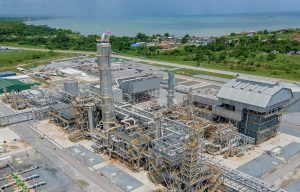
Syngas project listing 2021
A round-up of current and proposed projects involving non-nitrogen synthesis gas derivatives, including methanol, hydrogen, synthetic/substitute natural gas (SNG) and gas- and coal to liquids (GTL/CTL) plants.


A round-up of current and proposed projects involving non-nitrogen synthesis gas derivatives, including methanol, hydrogen, synthetic/substitute natural gas (SNG) and gas- and coal to liquids (GTL/CTL) plants.
The Chemical & Process Technologies business unit of thyssenkrupp Industrial Solutions is celebrating a milestone in 2021. It is one hundred years since engineer and entrepreneur Friedrich Uhde founded his own plant engineering company in a barn at his parents-in-law’s farm in Dortmund-Bövinghausen on April 6th, 1921. Now, in this centenary year, the origins of the firm are to become visible in its name again: thyssenkrupp is changing the business unit’s name to thyssenkrupp Uhde.
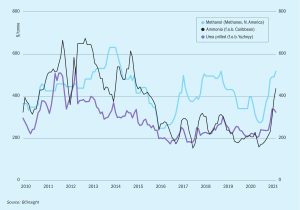
February saw ammonia prices jump due to a series of plant outages, including EBIC in Egypt, and several plants in North America, including two on Trinidad; the 760,000 t/a Nutrien 4 plant and 500,000 t/a Tringen 2 plant, both due to gas shortages, as well as Yara and BASF’s 750,000 t/a unit at Freeport, Texas.

The ammonia industry has always dealt with fluctuations in supply and demand as well as volatile feedstock and energy costs. The unexpected global pandemic that started in 2020 has injected a higher degree of uncertainty for ammonia manufacturers’ operating costs and product demand for fertilizer. W. Poe of AVEVA discusses how advanced process control systems can help ammonia producers turn economic uncertainty into a competitive advantage.

A recent report from BloombergNEF (New Energy Foundation) looking ahead to 2050 argues that green hydrogen can be cheaper than natural gas. It finds that ‘green’ hydrogen from renewables should become cheaper than natural gas (on an energy-equivalent basis) by 2050 in 15 of the 28 markets modelled, assuming scale-up continues. These countries accounted for one-third of global GDP in 2019. In all of the markets BNEF modelled, ‘green’ hydrogen should also become cheaper than both ‘blue’ hydrogen (from fossil fuels with carbon capture and storage – CCS) and even ‘grey’ hydrogen from fossil fuels without CCS. The cost of producing ‘green’ hydrogen from renewable electricity should fall by up to 85% from today to 2050, the report predicts, leading to costs below $1/kg ($7.4/MMBtu) by 2050 in most markets. These costs are 13% lower than BNEF’s previous 2030 forecast and 17% lower than their previous 2050 forecast. Falling costs of solar photovoltaic (PV) electricity are the key driver behind the reduction; BNEF now believes that PV electricity will be 40% cheaper in 2050 than they had thought just two years ago, driven by more automatic manufacturing, less silicon and silver consumption, higher photovoltaic efficiency of solar cells, and greater yields using bifacial panels.

Gas availability and pricing continues to affect ammonia and methanol output from Trinidad, while Venezuela struggles with sanctions and political instability.
Judging by the pages of the project announcements in our news section, you’d be forgiven for thinking that the ammonia and methanol industries were all running off hydrogen generated from electrolysis, and that we had already entered an era of ‘clean’ chemical generation which did not require fossil fuels as a feedstock. Of course, while companies can naturally be forgiven for wanting to put the best public face on their green credentials, it does obscure the fact that for the moment 99% of syngas generation comes from natural gas, coal, and some coke or naphtha.
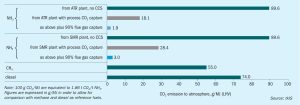
Reducing the carbon footprint in the synthesis of chemicals is a new global challenge as the world works towards providing sustainable products designed to minimise their environmental impacts throughout their whole lifecycle. This article looks at the role of blue technologies as part of a roadmap towards the decarbonisation of fuels and chemicals.
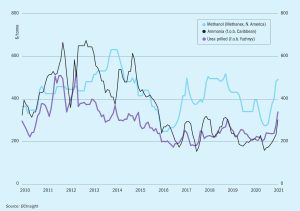
The ammonia industry faced a difficult February, due to extremely cold weather conditions in the northern hemisphere. In the US, production outages resulting from winter storm Uri affected up to 7 million t/a of capacity.
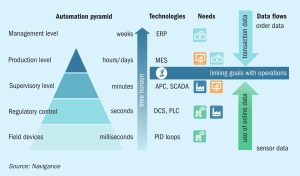
As industry trends add pressure to optimise processes, new digital technologies for roundthe-clock, data-driven decision-making can help plants boost production efficiency without time-consuming manual analysis or large-scale investment. Here, Dr S. Werner of Navigance explores their potential and shares the difference they are already making.