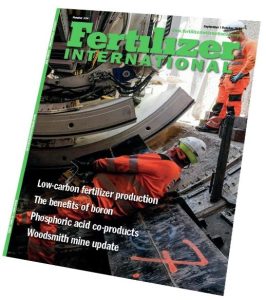
These are the good times
2021 is turning out to be a very good year for profits and earnings. Take Nutrien and Yara International, for example, the fertilizer sector’s two biggest companies by market capitalisation.

2021 is turning out to be a very good year for profits and earnings. Take Nutrien and Yara International, for example, the fertilizer sector’s two biggest companies by market capitalisation.
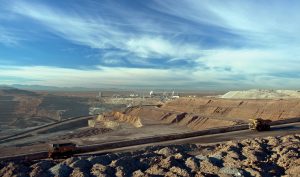
Boron is a key micronutrient required by fruit and vegetables and crops such as corn, cotton, rice, soybean and sugar cane. The agricultural importance of boron and the wide range of products on the market are described.

In an exclusive, broad ranging interview, Wendall Boehlje, technical sales agronomist at U.S. Borax (part of Rio Tinto), talks to Fertilizer International about the launch of two new agricultural market products by U.S. Borax earlier this year.
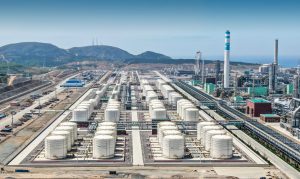
China is the world’s largest importer of sulphur, mainly to feed domestic phosphate production. Sour gas in Sichuan and new refinery production, coupled with rationalisation in the phosphate sector are all leading to reduced imports, while new smelters are increasing sulphuric acid production and reducing the need for pyrite-based and sulphur burning acid production.
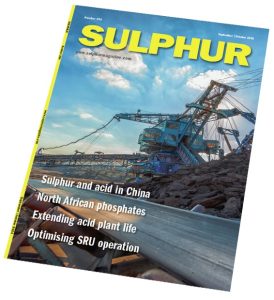
Mining giant BHP’s decision this August to dispose of its oil and gas assets to Woodside Petroleum (see Industry News, page 11) in a deal estimated at $29 billion is certainly eye-catching. But it is also part of a larger pattern of divestment of fossil fuel assets by oil and gas companies who have dominated the industry for decades. It follows divestment by investors, institutional and otherwise, as efforts to tackle climate change consistently point towards a future where we will be using gas, and especially oil, far less – indeed, where many are talking about achieving ‘net zero’ carbon emissions by the middle of the century or shortly thereafter.

Ammonia and sulphur, as essential raw materials, underpin and drive fertilizer production costs. A steep and sustained rally has seen prices for both commodities reach new heights in recent months.
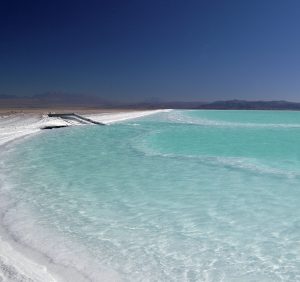
The delivery of nitrogen in nitrate form can deliver superior yields and quality in arable, fruit and vegetable crops. Because of this, production and consumption of the principal nitrate fertilizers – ammonium nitrate (AN), calcium ammonium nitrate (CAN), urea ammonium nitrate (UAN), potassium nitrate (NOP) and calcium nitrate (CN) – continue to grow.

In 2019, the EU fertilizer market was valued at around e17 billion, with France, Germany and former member state the UK together representing 40 percent of this total.
The International Fertilizer Association (IFA) says that Svein Tore Holsether has been elected as its new chair of the Association. IFA said in its press release that the selection of Holsether, the president and CEO of Yara International, is a continuation of the industry’s commitment to sustainability.
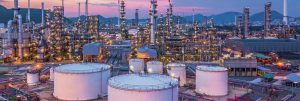
With demand for conventional fuels projected to peak and fall over the next decade, some refiners are looking to petrochemical production as a way of diversifying their product slate.