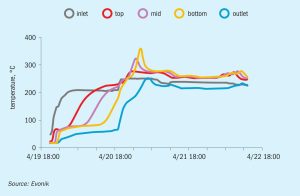
Reaping the rewards of recycling
Evonik explores the development of catalyst reuse and how recycled hydroprocessing catalysts can be successfully applied in tail gas treating units to deliver cost and performance gains.


Evonik explores the development of catalyst reuse and how recycled hydroprocessing catalysts can be successfully applied in tail gas treating units to deliver cost and performance gains.
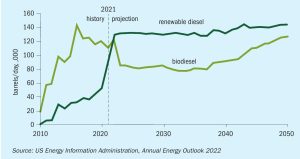
The production of renewable fuels by retrofitting existing refineries and their infrastructure is witnessing exponential growth. The impact on the existing amine, sour water and sulphur recovery units is inevitable. Based on several case studies, Worley Comprimo discusses the various options available to holistically review the sulphur block to determine the impact and mitigation of processing bio-feed.
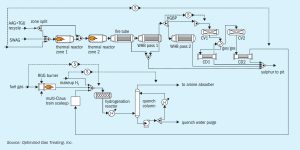
SO2 breakthroughs remain an ever present threat to the successful operation of reductive, quenchamine-based tail gas clean-up units (TGUs). Optimized Gas Treating presents a case study which demonstrates how SulphurPro's detailed reaction kinetics and mass transfer rate model can be used to analyse integration techniques and mitigation methods.
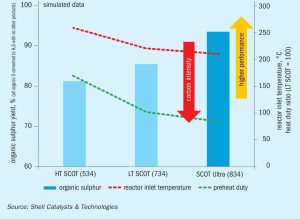
Decreasing the carbon intensity of sulphur recovery is one of the many actions that operators can take to help meet their climate ambitions. It is also becoming increasingly rewarding financially because of the rising cost of carbon emissions. In this article, G. Kidambi of Shell Projects & Technology demonstrates the potential to cut the carbon intensity of tail gas treating units by more than 50% through swapping to the latest SCOT ULTRA amine solvent and catalyst technologies.
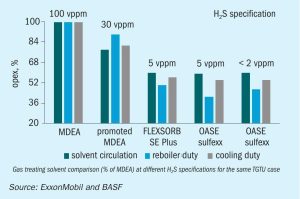
The removal of hydrogen sulphide (H2 S) has become increasingly important as the oil and gas industry moves towards more efficient and sustainable production of lower emission clean fuels. BASF and ExxonMobil* have jointly developed a proprietary amine, OASE® sulfexx™ , to help refiners and gas processors achieve sulphur removal targets while reducing their carbon footprint via lower energy consumption. This new solvent technology is suitable for low and high pressure applications and shows superior performance characteristics over generic and promoted MDEA formulations, as well as sterically hindered amines such as FLEXSORB™ SE and SE Plus.
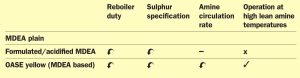
BASF has developed a new generation of promoter system compatible with MDEA solutions named OASE® yellow. The new promoter system increases the selectivity and capacity of the amine solvent, resulting in improved performance of tail gas treating units and allowing the processing of more sour crudes. A. Kern and G. Vorberg of BASF discuss two case studies demonstrating the benefits of OASE yellow.

The Sixth Annual MESPON Forum took place 7-10 October at the Rosewood Hotel Abu Dhabi, where the global sour gas and sulphur community gathered for four days of networking, learning, and collaboration. This year’s theme highlighted new trends, innovations and best practices in the field of sour gas processing that enhance operations.