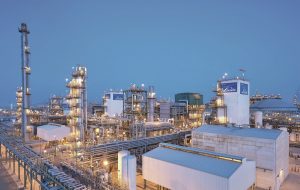
SulGas 2021
This year’s SulGas conference, covering sulphur recovery and gas treating with a special focus on India and southeast Asia, was run as a virtual event from February 1st to 3rd 2021.


This year’s SulGas conference, covering sulphur recovery and gas treating with a special focus on India and southeast Asia, was run as a virtual event from February 1st to 3rd 2021.
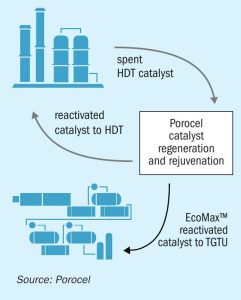
EcoMax™ tail gas catalysts offer a sustainable and cost effective choice for tail gas catalysts. They are made from spent hydroprocessing catalysts, which reduces the environmental and socioeconomic impacts of sourcing fresh cobalt and molybdenum and therefore supports operators’ sustainability goals. B. Visioli of Porocel (a part of Evonik) discusses the benefits of catalyst reuse from hydroprocessing for tail gas treating.
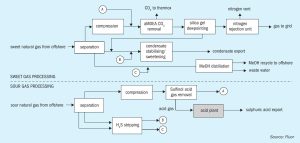
M. Baerends of Fluor reports on the conception, engineering, construction, commissioning and start-up of a new sulphuric acid plant that replaced an existing acid plant at a European sour gas processing terminal. This highly complex gas processing facility handles sour gas from an off-shore field, containing H2 S that must be removed to meet transmission grid specifications. Various issues encountered, their resolution by the joint owner, Fluor and Topsoe team, and plant operating results are discussed.
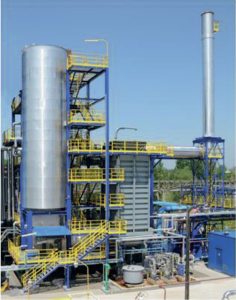
Wet sulphuric acid technology when used as tail gas treatment for a Claus unit, or in place of a Claus unit with amine-based tail gas unit, brings many benefits if there is a market for the sulphuric acid and steam. A new alternative is to have a WSA unit in combination with a Claus unit and to recycle the acid to the Claus unit for higher sulphur recovery efficiency.
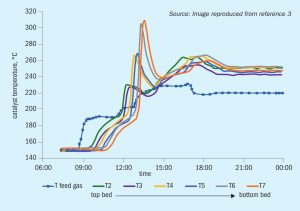
Euro Support’s new generation, titania-based low temperature tail gas catalyst shows a marked robustness to the start-up procedure compared to its common alumina-based counterparts. Dr B. Hereijgers of Euro Support discusses the promising lab results.
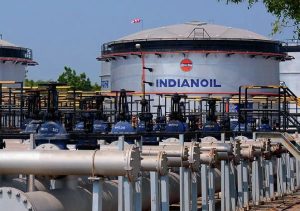
Storm Uri which blanketed the southern states of the US with snow, and led to widespread power outages in Texas, has had a major impact upon US Gulf Coast and Southern-Midwest refined products supply. Most Gulf Coast refineries were shut down or forced to operate at reduced rates. IHS Markit estimated that more than 5.2 million bbl/d of Gulf Coast capacity and 730,000 bbl/d in PADD 2 was impacted by the winter weather at its height, and close to 20% of lower 48 US natural gas production was shut-in in the first half of February. A drop in crude oil production of between 2.2 and 4 million bbl/d was estimated.

No one in this industry should ever need a reminder that commodity markets are cyclical. The corollary of that is – every once in a while – markets can, and will, abruptly change direction.

The year 2020 will be remembered as an uncertain, demanding and challenging year. When faced with a global pandemic, companies have adopted new approaches and remote inspection, monitoring and training using the latest digital tools has been key for the successful completion of projects. Stamicarbon, Casale and KBR share some of their experiences of the past year.

NOx emissions from chemical processes such as steam methane reforming contribute to air pollution. The chemical industry is required to take steps to lower such emissions. Technology, developed for related industries, can be designed and optimised to reduce NOx emissions from steam methane reformers. Emission control experts can use a combination of modelling and experience to guide plant operators in recommending and designing optimum, sometimes tailor-made solutions. In this article different options are discussed including low NOx burners, selective catalytic reduction, selective non-catalytic reduction and high emissivity ceramic coatings.
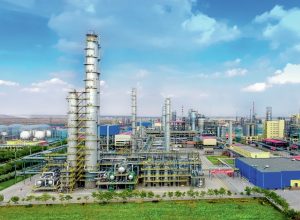
Johnson Matthey (JM) has secured a multiple licence for China’s Ningxia Baofeng Energy Group’s latest project to develop five of the largest single train methanol plants in the world. Located at Baofeng’s Ordos City complex in Inner Mongolia, the five plants each have a planned capacity 7,200 t/d. Under the agreement Johnson Matthey will be the licensor of all five plants and supplier of associated engineering, technical review, commissioning assistance, and catalyst. The plants will take synthesis gas as a feed and use JM radial steam raising converters in a patented series loop. Within the design, there is potential for 1-2% more feedstock efficiency over the life of the catalyst. Thanks to JM’s methanol loop synthesis technology, the plants will provide enhanced energy savings along with low OPEX, CAPEX and emissions. When complete, the plants will represent JM’s 13th operating license in China for a mega-scale plant (>5,500 t/d) and the fourth JM methanol design licensed by Ningxia Baofeng Energy.