
Nitrogen + Syngas 2022
CRU’s Nitrogen + Syngas conference returned to a face to face meeting for the first time in two years at the end of March this year.

CRU’s Nitrogen + Syngas conference returned to a face to face meeting for the first time in two years at the end of March this year.
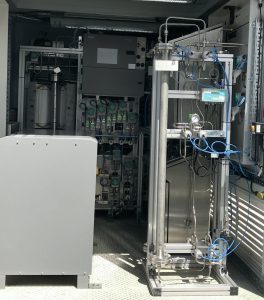
Ammonia synthesis catalysts have seen major improvements over the last 100 years, and they are highly optimised with respect to activity, thermal stability, and poisoning resistance. Improving such catalysts even further requires a deep understanding of their structure and the impact of different parameters on performance. Clariant, Johnson Matthey and Topsoe report on their studies and developments in ammonia synthesis catalysts.

Switzerland-based EuroChem Group AG says it has entered into exclusive negotiations to acquire the nitrogen business of the Borealis group, after having submitted a binding offer. One of Europe’s leading fertilizer producers, Borealis operates fertilizer plants in Germany, Austria and France, as well as more than 50 distribution points across Europe. It supplies 3.9 million tonnes of fertilizer products per year, including 800,000 t/a of technical nitrogen solutions and 150,000 t/a of melamine via the Borealis LAT distribution network. It is a market leader in melamine, with its operations in Austria and Germany supplying primarily the woodworking industry. EuroChem says that melamine and technical nitrogen solutions represent important new business lines for the company to expand its nitrogen-based product portfolio in Europe.

New innovations, services and latest technologies to improve the operation and reliability of steam methane reformers from AMETEK Land, Kontrolltechnik, BD Energy Systems, Koch Engineered Solutions, and Quest integrity.
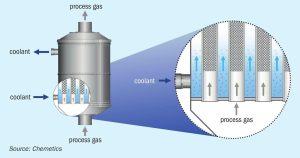
With climate change looming there is an increased focus on reducing the environmental footprint of the production of fertilizers. The use of renewable energy/green hydrogen is one way to make the fertilizer industry more environmentally sustainable. In this article, Rene Dijkstra of Chemetics introduces the Green Fertilizer Complex. This practical solution integrates an oxygen-based sulphuric acid plant using the Chemetics’ patented CORE-SO2™ process with a green hydrogen and ammonia facility to deliver low cost, low emission, and carbon-free phosphate (MAP/DAP) and/or sulphate (AMS) based ammonia fertilizers.
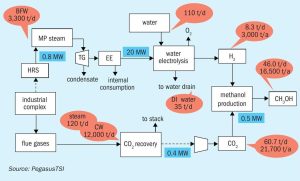
Ricardo L. Sepulveda of PegasusTSI reviews options to decrease the CO2 footprint of a fertilizer industrial complex and illustrates the technical and economic feasibility of utilising clean energy from a sulphuric acid plant in a fertilizer complex to produce green hydrogen, which in turn can be used to produce green methanol or green ammonia.
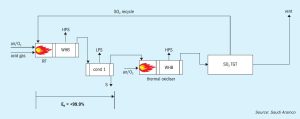
A new cost-effective alternative sulphur technology, providing a simple and robust process to achieve an overall sulphur recovery efficiency of 99.9+% is being developed by Saudi Aramco. J. P. O’Connell and I.A. Alami of Saudi Aramco discuss the new technology, its benefits and current stage of development.

State-of-the art technologies offered by thyssenkrupp, Casale and Stamicarbon are helping make nitrates production more secure and sustainable.
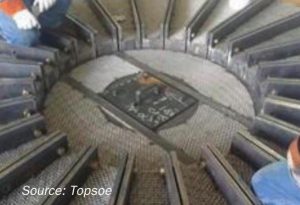
The production of syngas from hydrocarbon feedstock uses a number of catalytic steps to increase efficiency and maximise conversion while minimising energy consumption. In this article we report on the latest developments in water gas shift catalysis from Johnson Matthey, Clariant and Topsoe, and shift converter design from Casale.
The International Fertilizer Association (IFA) has signed a memorandum of understanding with the United Nations Food and Agriculture Organisation (FAO) over collaboration to support the FAO’s vision of transformative change and innovation in agriculture. Svein Tore Holsether, IFA Chair, signed the agreement at a live virtual signing in December together with FAO deputy director general Beth Bechdol. The agreement outlines collaboration to further shared goals and objectives with regard to the promotion of sustainable food and agriculture. Both parties will work together to raise awareness about the International Code of Conduct for the Sustainable Use and Management of Fertilizers (Fertilizer Code), promote education and knowledge transfer and continue their successful collaboration on fertilizer statistics.