Magazine: Nitrogen+Syngas

People

thyssenkrupp AG has announced the appointment of Nadja Håkansson as the company’s new Chief Executive Officer effective from May 1, 2024. Håkansson, has held various management positions at Siemens and Siemens Energy and has over 18 years of national and international experience in the areas of supply chain management, operations, sales and corporate management. Most recently, as Senior Vice President Region Africa for Siemens Energy, she was responsible for the company’s overall portfolio development in the African market. She holds a Master of Science in Industrial Engineering and Management from the Institute of Technology at Linköping University, Sweden.

Ammonia combustion for large furnaces

Ammonia has been recognised as an advantageous hydrogen and energy carrier. This article focuses on the use of ammonia as fuel in steam reformers and ammonia crackers in order to reduce or completely eliminate direct CO2 emissions. Ammonia combustion knowledge is especially important for ammonia crackers with respect to the recycling of unconverted ammonia. Air Liquide is constructing an industrial scale pilot plant in Antwerp, planned to be operational in 2024, that will be used to demonstrate ammonia cracking and combustion in a process furnace with a multiple burner configuration.

Problem No. 72: Reuse of off-spec wastewater

Every urea plant is also a water plant as the overall reaction starts with two molecules of ammonia and one molecule of carbon dioxide resulting in one molecule of urea and one molecule of water. Further water is added to the process via the steam ejectors in the evaporation section. All this water, which is contaminated with ammonia, carbon dioxide and urea plus possibly other contaminants like formaldehyde, methanol, oil, etc is collected in an ammonia water tank and then sent to a wastewater treatment section. The purpose of the wastewater treatment section is to reduce the ammonia, carbon dioxide and urea levels to acceptable levels. First the wastewater is treated in a first desorber column, where LP steam is used to strip off the ammonia and carbon dioxide, reducing the ammonia content from approx. 6-8 wt-% ammonia to approx. 1 wt-% ammonia. Nothing happens with urea in the first desorber as temperatures are too low to hydrolyse the urea back to ammonia and carbon dioxide. This takes place in the next step, in the hydrolyser, which can be quite a large counter current column operating with MP steam at approx. 23 bar (Stamicarbon design) or a horizontal deep hydrolyser operating at approx. 33 bar (Saipem design, refer to figure). Downstream of the hydrolyser there is another desorber column to strip off the remaining ammonia and carbon dioxide. Nowadays, boiler feed water quality can be realised by modern wastewater treatment. But at higher plant loads the operating margin in the wastewater treatment can become too small leading to higher ammonia and urea levels during certain operating conditions… n

Europe’s nitrogen dilemma

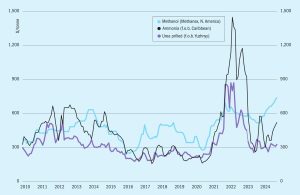
Nitrogen magazine, as it originally began life in It has been a tough few years for the European nitrogen industry, and between covid, gas price spikes and Russian sanctions, not all companies have weathered the storm. Now that the initial shock of the sky-high ammonia prices that the closure of the Black Sea and the cutting off of almost 40% of Europe’s gas supplies has passed, and the world gas and ammonia markets have largely adjusted to the new reality, prices are coming back down. But it seems that in its wake it may leave quite a different European nitrogen industry from the one that existed in 2019.