
Market Insight
Market Insight courtesy of Argus Media

Market Insight courtesy of Argus Media

The International Fertilizer Association (IFA) elected Svein Tore Holsether as its new chair on 14th June. He replaces Mostafa Terrab, the chairman and CEO of OCP Group. IFA said Holsether, who is the president and CEO of Yara International, would continue the fertilizer industry’s commitment to sustainability.
Preliminary engineering work has started on a renewable powerto-fertilizer plant in Kenya.
One year on from the launch of its Farm to Fork Strategy, the European Commission is still failing Europe’s farmers, says Igor Shmidt, EuroChem Group’s head of public affairs.

During this time of disruption, keeping connected and informed has never been more important. While the in-person events the industry usually relies on are not possible, CRU’s virtual Sustainable Fertilizer Production Technology Forum, 20-23 September, offers exceptional information sharing and networking opportunities.

In 2019, the EU fertilizer market was valued at around e17 billion, with France, Germany and former member state the UK together representing 40 percent of this total.
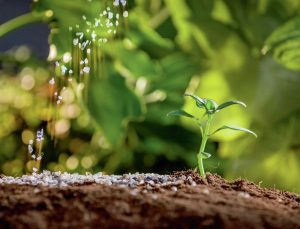
Polysulphate is an affordable, easy-to-use, multi-nutrient fertilizer with a low environmental impact. ICL’s chief agronomist, Patricia Imas, highlights the crop benefits of this natural and high-value product.

The crushing and grinding of mined phosphate rock and potash ore is a vital preparatory step for subsequent beneficiation and chemical processing. Although often overlooked, the efficiency of downstream P & K fertilizer production is heavily reliant on successful particle size reduction upstream.

We highlight the large-scale nitrogen projects that are currently under development across the globe – with a focus on ammonia and urea technology licensors and engineering contractors.

The European Union is seeking to create a climate-neutral and circular economy through its flagship Green Deal policy. The fertilizer industry can support these objectives by adopting inhibitor treatment technology (ITT) and controlled-release fertilizers (CRFs) based on biodegradable polymers. These two innovations have a vital role to play in improving nitrogen use efficiency and the shift towards more sustainable resource use, says Dr Matthias Potthoff of thyssenkrupp Fertilizer Technology.