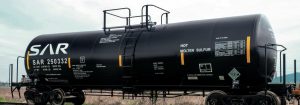
Handling liquid sulphur
Liquid sulphur presents unique challenges in its handling and transport compared to solid sulphur.

Liquid sulphur presents unique challenges in its handling and transport compared to solid sulphur.
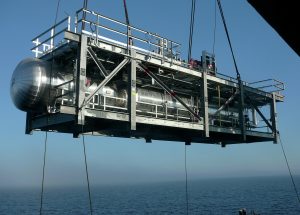
As Comprimo celebrates its 100th anniversary, we explore the group’s history from its earliest days in the Netherlands in the 1920s to its current status as a global leader in gas treatment and sulphur recovery technology.
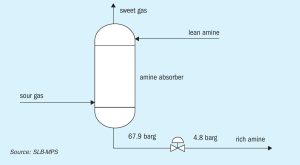
Aparna Saiju and Nishevitha U G of SLB-MPS explore the concept of energy optimisation using power recovery turbine (PRT) technology in amine sweetening units, focusing on its potential benefits, implementation strategies, and environmental implications.

A plant operating a spent acid decomposition furnace as part of its sulphuric acid production facility desired to increase acid production primarily by processing additional spent acid while making minimal modifications to the plant equipment and operations. The Messer solution entailed introducing oxygen in two steps, both as an enrichment to the combustion air and by direct injection into the furnace. The resulting performance improvements exceeded the project objectives for acid production and spent acid decomposition, without increasing NOx emissions. This paper provides a summary of the system start-up and tuning and presents the resulting improvements and lessons learned.
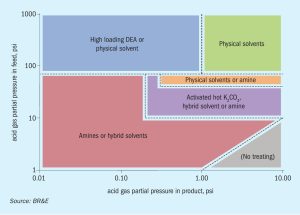
Ganank Srivastava of Bryan Research & Engineering examines ways to reduce carbon footprint in sour gas facilities.
While the events of the past few years have been difficult for Europe on many fronts, including a wholesale realignment of its energy sources with the restriction of access to Russian oil and gas, the effect on Europe’s sulphur production seems likely to be just as profound.

Casale, Saipem, Stamicarbon & Toyo Engineering Corporation showcase a selection of innovative technologies that have recently been brought to the market.

The reliability of primary reformers is a key issue for syngas plants. Quest Integrity describes the damage mechanisms and material limitations that impact the reliability of reformer outlet systems and the improvements that may be implemented.
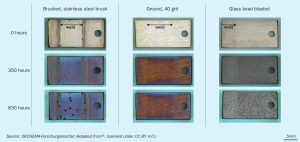
Industrial plants using synthesis gas at elevated temperatures risk metal dusting attack on the equipment, which are typically made of steels or Ni-based alloys. Parameters which impact the metal dusting risk are discussed and factors affecting the material selection and processing are described. One important focus is surface preparation, showing that grinding (40 grit) improves the metal dusting resistance compared to glass bead blasting and brushing. The surface treatment outweighs the impact of welds or the manufacturing route.
A review of the current slate of plans for green and blue ammonia production.