
Optimising phosphoric acid supply chains
Prayon’s Marc Sonveaux outlines how chemical beneficiation can transform current phosphate industry supply chains.


Prayon’s Marc Sonveaux outlines how chemical beneficiation can transform current phosphate industry supply chains.

NextChem (Maire) is awarded a three-year engineering and technology services contract by Satorp in Saudi Arabia to improve energy efficiency and carbon footprint

Days 2 and 3 of the CRU’s 38th Nitrogen+Syngas 2025 Expoconference turned to the technical sessions, organised in three parallel streams covering: green ammonia technology, nitric acid and ammonium nitrate, plant operations and reliability, urea technology, digitalisation, carbon capture, emissions reduction and sustainable fertilizer production, and fertilizer finishing.
10th February, 2025 – sessions as reported by Richard Hands from Barcelona CRU’s 38th Nitrogen+Syngas 2025 Expoconference has begun in Barcelona with three strands covering business development, technical innovations and practical operator training, the latter comprising case studies for analysing hazards associated with green ammonia production. Heading up the business development session, Marti Leppälä, Secretary […]

High energy storage costs for renewable-based technologies are likely to make European long term carbon prices considerably higher than their present levels.

Carbon Recycling International (CRI), which operates a geothermally powered green methanol plant at Svartsengi, 40km southwest of Reykjavik, had to evacuate its site in late November when a 3km fissure opened in the earth a few kilometres away and lava began spilling across adjacent land. Satellite photos of the area taken on November 24 show a large field of molten and cooled lava to the north, west, and south of Svartsengi, though the plant itself remained undamaged. CRI’s Iceland facility runs on CO2 , water, and renewable electricity from the Svartsengi geothermal power station. CRI says the low-carbon energy source allows it to produce 4,000 t/a of methanol with a greenhouse gas footprint just 10–20% that of conventional methanol.

While there is still a considerable push for use of biomass waste as a lower carbon feedstock for chemical production via gasification to syngas, biological processes such as fermentation are increasingly gaining traction as an alternative.
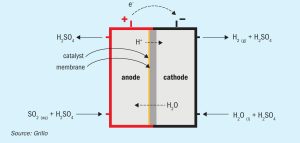
New concepts focused on the transfer and combination of existing sulphur and sulphuric acid technologies to support decarbonisation of the sulphuric acid industry are being investigated. In this article three research projects are discussed: sulphur dioxide depolarised electrolysis for green regeneration of spent acid, use of renewable heat and catalyst to the splitting process from sulphuric acid to SO2 for reduction of fossil fuel consumption, and sulphur as an energy vector.
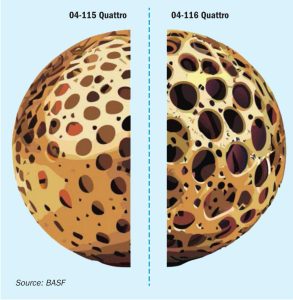
Due to ever stricter legislation towards lower SO2 emissions, superior catalyst shape and composition has become ever more important. Jochen Willersinn of BASF SE explains how BASF’s high-performance catalyst O4-116 Quattro combines the benefits of an increased surface area with a superior caesium-promoted active phase composition enabling significantly lower ignition and operating temperatures and thus reducing SO2 emissions.
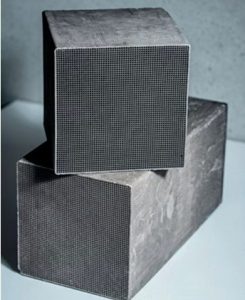
This study introduces a new platinum-promoted honeycomb catalyst for sulphur dioxide oxidation, designed to enhance energy efficiency and reduce emissions in sulphuric acid production. Compared to conventional vanadium oxide based catalysts, the platinum-based catalyst demonstrates higher catalytic activity, lower ignition temperature, and significantly reduced toxicity.