Fertilizer Industry News Roundup
QatarEnergy has announced the construction of a new world-scale ammonia-urea production complex at Mesaieed Industrial City in Qatar.
We highlight recent production advances and innovations in nitrogen fertilizer production from Casale and Stamicarbon, two global leaders in process technology.
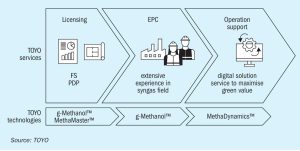
TOYO has recently introduced new proprietary urea technologies to its technology portfolio including a novel dust scrubbing system with integrated wet electrostatic precipitator (WESP) for ultimate clean-up of granulation or prilling exhaust air, to achieve urea dust emissions of less than 5 mg/Nm3 . Takuhiro Minato of Toyo Engineering Corporation explains how the new system works.
Stefano Cicchinelli and Carmen Perez of Stamicarbon (MAIRE) explore the latest advancements in tertiary abatement technologies, their implementation in nitric acid plants, and the implications for the fertilizer industry.
Part 1 of this series on stripper efficiency issues provided a brief history of the CO₂ stripping process and discussed how the invention of the HP CO₂ scrubber back in the 1960s revolutionised urea technology. In part 2 we take a look at how high liquid load can affect stripper efficiency.
Refinery sour water strippers are an often overlooked resource of low GWP ammonia. Martin A. Taylor and Charles L. Kimtantas of Bechtel Energy Technologies and Solutions, Inc. (BETS) show the results of a study on reusing an existing SWS as one of the major systems in a SWSPlus unit for the recovery of ammonia for sale. Relative cost factors will compare a complete SWSPlus unit versus reusing an existing SWS.
Transporting sulphur as a dry bulk solid can lead to it breaking into small particles which create dust. Over the years, various forming processes have been developed to try and minimise dust formation and produce the strongest, most resilient formed sulphur particles.
This troubleshooting case study describes an incident at one of the sulphur recovery units at BPCL Kochi Refinery, India. Following a maintenance turnaround of the unit in 2022, unusually high H2 S and SO2 were observed at the outlet of the Claus section. This created an additional load on the tail gas reactor, which led to frequent plugging in the quench column and frequent outages in the tail gas unit, creating environmental and reliability issues in the unit. The activities to identify the root cause of the incident are described and the measures to solve the problem are shared.
The refining industry continues to pivot towards Asia, with knock-on effects for sulphur output.
Casale, Saipem, Stamicarbon & Toyo Engineering Corporation showcase a selection of innovative technologies that have recently been brought to the market.