Sulphur 426 Sep-Oct 2026
17 September 2026
Modernising sulphur combustion
SULPHUR FURNACE RETROFITS
Modernising sulphur combustion
Improved atomisation, air-side mixing and modular burner inserts can increase the reliability, flexibility and capacity of sulphur furnaces, while minimising modifications to existing equipment. Florian Kistl of CS Combustion Solutions discusses practical retrofit routes to modernise sulphur combustion in existing sulphur furnaces.
Sulphur furnaces are long-life assets. In many plants the furnace shell, refractory lining and combustion-air infrastructure remain serviceable long after the original burner technology has become an operational constraint. For operators using conventional sulphur guns with pressure atomisers or rotary-cup burners, a targeted retrofit can therefore offer a more attractive alternative to a major furnace rebuild.
The objective is straightforward: improve sulphur atomisation and combustion-air mixing while retaining as much of the existing installation as possible.
When the burner becomes the bottleneck
Sulphuric acid producers are often under simultaneous pressure to increase plant availability and capacity while controlling maintenance expenditure. This is particularly relevant in older sulphur-burning plants, where the furnace may have substantial remaining life but the burner system creates recurring operating problems. Poor atomisation can contribute to:
- unburnt sulphur carry-through;
- refractory hot spots;
- unstable combustion;
- high sulphur pressure;
- frequent repair and adjustment of nozzles and spray guns.
The retrofit question is therefore not necessarily whether to replace the furnace, but how to remove the limitations of the burner system without creating an extensive brownfield investment.
Depending on the existing design and the underlying constraint, options can range from replacing atomiser tips and sulphur lances to installing a complete new burner assembly.
For multi-gun furnaces, a newer approach introduces project-specific burner inserts within the existing windbox, retaining much of the original air-side infrastructure.
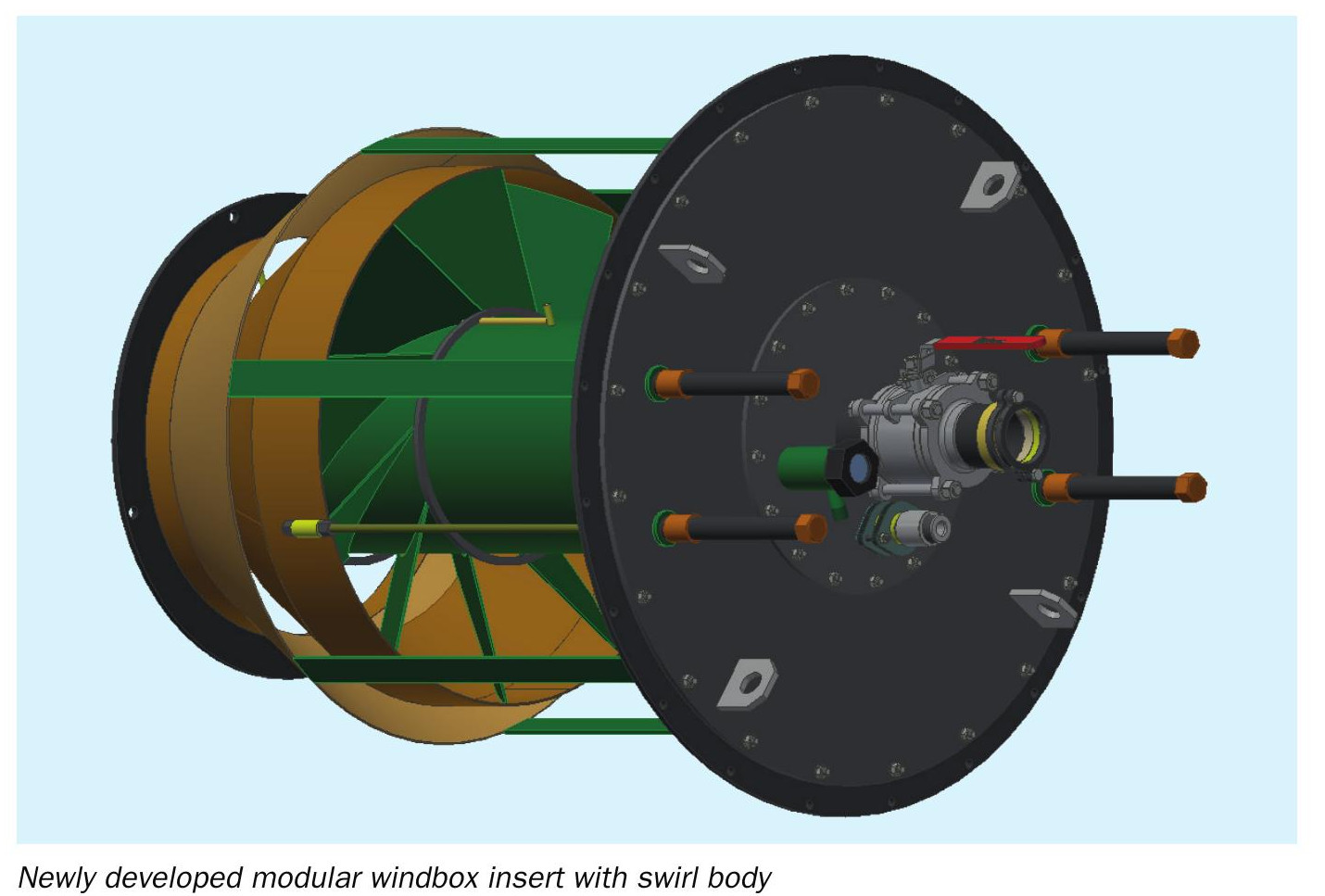
The appropriate route should be determined by the actual operating limitation. Where droplet formation is the principal issue, an atomiser and lance upgrade may be sufficient. Where air distribution, flame shape or mechanical reliability are also limiting performance, the burner and windbox arrangement should be assessed as an integrated system.
For plants seeking additional capacity, the review must extend beyond the furnace to include the combustion-air blower, waste heat boiler and downstream conversion and downstream absorption sections. This staged approach avoids unnecessary scope while ensuring that a limited retrofit is expected to resolve a plant-wide constraint.
Why conventional sulphur guns can become restrictive
Conventional sulphur guns commonly use pressure atomisation, forcing liquid sulphur through relatively small passages at high pressure to create a spray cone. In practice, atomisation quality is closely linked to sulphur pressure and flow rate. Lower operating loads can therefore reduce spray quality, while contamination or changes in sulphur condition can increase plugging risk and shorten nozzle life.
Typical pressure-atomiser systems may require sulphur pressures of approximately 8 to 20 barg. By comparison, CS ultrasonic atomisers typically operate at 2 to 5 barg. The lower pressure requirement reduces energy consumption of the sulphur supply system and provides more flexibility when integrating a retrofit into an existing plant.
More important, the technology changes how droplets are formed. Smaller droplets provide substantially greater surface area for a given sulphur mass, reducing the time required for heating, evaporation and reaction.
At one sulphuric acid plant in the African Copperbelt, replacement of conventional pressure atomisers with ultrasonic nozzles and optimised swirl bodies reduced measured droplet size from approximately 400 micrometres to 110 micrometres. Following the revamp, the plant is expecting elimination of sulphur droplet carry-through to the waste heat boiler and catalyst beds.
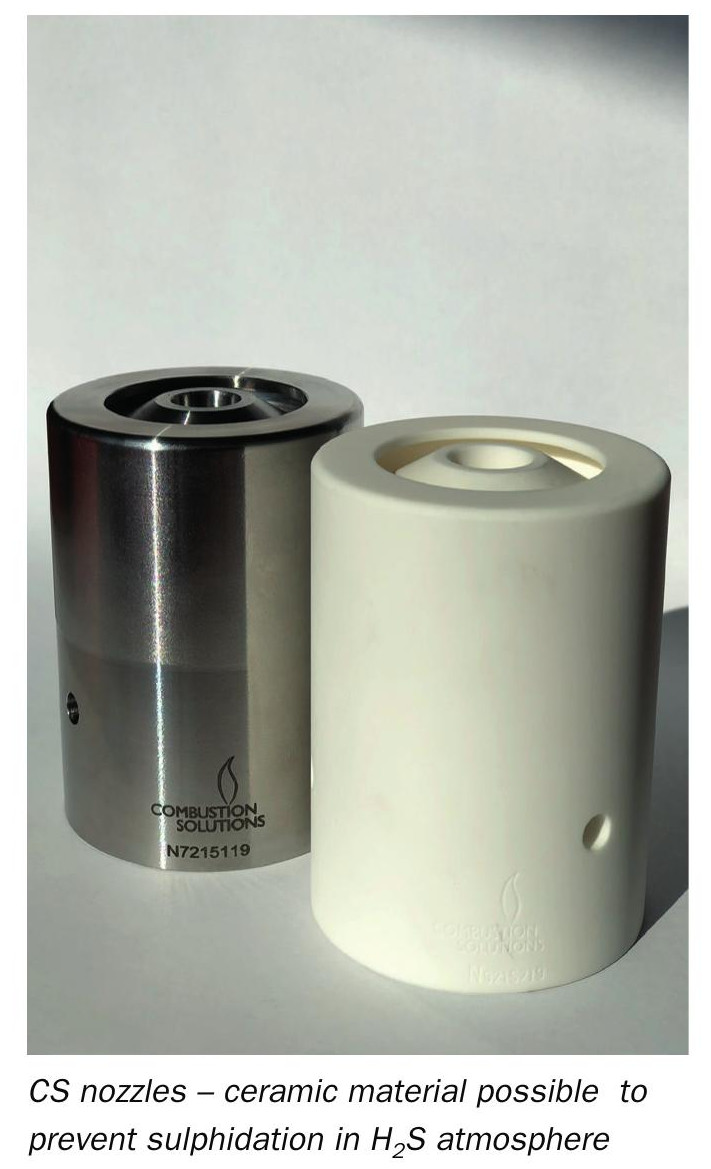
The nozzle architecture also changes the plugging mechanism. With ultrasonic atomisation, sulphur and the atomising medium are mixed externally. The nozzle does not rely on the fine internal sulphur passages typically associated with pressure atomisers, making plugging technically unlikely and enabling a wider operating range. A single CS nozzle can normally be controlled from approximately 20% to 100% of nominal capacity, with continuous operation possible up to 110%.
Case evidence: pressure-atomiser retrofit
At an African Copperbelt sulphuric acid plant, conventional sulphur guns with pressure atomisers were replaced with ultrasonic nozzles and revised air-side mixing elements.
The project delivered:
- an increase in production from 2,200 t/d to 3,000 t/d;
- a reduction in droplet size from about 400 to 110 micrometres;
- elimination of sulphur carry-through to downstream equipment; and
- a more uniform furnace temperature distribution.
Before the revamp, the plant had experienced frequent nozzle plugging, high spare-part consumption and significant unplanned downtime.
Rotary-cup burners: a different retrofit case
Rotary-cup burners present a different set of operational challenges. Rotating components and drive systems introduce mechanical maintenance requirements in a hot, sulphur-bearing environment. Flame geometry can also be difficult to adapt when furnace conditions or production requirements change.
Where two rotary-cup burners are installed, the arrangement can occupy significant space without necessarily providing practical online redundancy.
A Belgian sulphur dioxide plant illustrates an alternative approach. Two rotary-cup burners were replaced by a single burner equipped with two Ultrasonic Atomizers. Sulphur throughput increased from 16 t/h to 20 t/h.
The new configuration removed rotating burner components and enables the individual sulphur guns to be isolated and removed while the furnace continued operating at reduced capacity. The spray angle could also be matched to the existing furnace and checker-wall geometry.
Upgrading atomisation is only half the battle
A finer spray alone does not guarantee a successful retrofit. Sulphur droplets must meet the combustion air with the appropriate velocity, momentum and distribution. The interaction between droplet size, spray angle, swirl, residence time and furnace geometry determines whether sulphur is converted rapidly and whether heat release is distributed evenly throughout the combustion chamber.
This is why air-side modifications can be as important as the atomiser itself.
In previous CS revamps, swirl bodies and CFD-supported changes to furnace mixing have been used to improve sulphur and combustion-air distribution. At one reference site, the combustion system was combined with revised mixing elements and a new vector wall. The objective was to improve mixing while reducing the pressure loss associated with the original baffle arrangement.
The result was a more uniform temperature field and lower air-side pressure drop.
For operators, poor mixing can manifest in several ways:
- localised refractory overheating;
- sulphur carry-through to the waste heat boiler;
- deposits;
- elevated downstream pressure drop; and
- restricted plant load.
Improving the burner should therefore be approached as a combustion-system retrofit, rather than simply as a nozzle replacement.
A modular insert approach for multi-gun furnaces
Many existing sulphur furnaces use several guns arranged through a shared wind-box. Historically, upgrading these systems could require substantial modifications to the windbox, furnace front and combustion-air distribution.
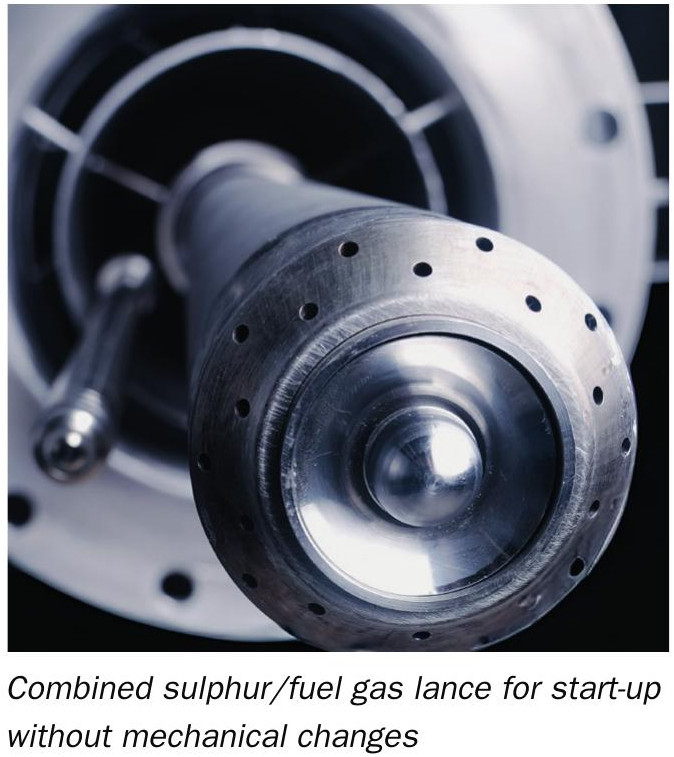
To reduce this scope, CS Combustion Solutions has developed a modular burner-insert concept specifically for multi-gun installations.
The principle is to introduce modern atomisation and controlled swirl within the existing mechanical circumstances, rather than redesigning a functioning furnace around a new burner. Each insert is engineered for the specific project. The existing air duct can normally remain in place, while the windbox casing requires only limited modification, principally to enlarge the opening for the swirl insert.
The furnace opening is assessed on a case-by-case basis and may also be retained where geometry permits.
The existing refractory lining can generally remain in service. Its condition is assessed during the retrofit engineering phase, and local defects can be repaired during the same shutdown if required. This is especially important for older furnaces: a burner upgrade should not automatically lead to full refractory replacement where the existing lining remains suitable.
Within the insert, combustion-air swirl can be adapted to the actual furnace geometry. During commissioning, the swirl setting is mechanically adjusted to achieve the most suitable flame shape and mixing behaviour for the existing chamber, then fixed for normal operation.
This avoids unnecessary moving components while still allowing the retrofit to be tuned to the individual furnace.
The insert architecture is a new development, but it is founded on ultrasonic atomisation and swirl principles already proven in operating retrofit references. The design objective is consistent across projects: minimise modifications to the existing plant while introducing the atomisation and air-management performance required for modern operation.
Plant availability can be more valuable than efficiency alone
For many operators, the strongest economic driver is not a modest gain in energy efficiency, but the avoidance of unplanned shutdowns. A sulphur burner problem can force the entire acid plant out of service, and lost production can rapidly outweigh the cost of replacement parts.
At the Copperbelt plant, the operator reported approximately 30 days of unplanned furnace shutdown per year before the revamp and more than $200,000 spent on nozzle tips and guns in less than two years.
A more robust atomisation system can address several sources of intervention at once:
- lower susceptibility to plugging can reduce nozzle-related stoppages;
- finer droplets and improved mixing can reduce the risk of unburnt sulphur reaching the waste heat boiler;
- more uniform heat release can help protect refractory; and tect refractory; and
- wider turndown capability can give operators greater flexibility to match plant load without compromising atomisation quality.
These improvements can also lead to higher production output. Where sufficient margin exists in the furnace volume, waste heat boiler, blower, converter and downstream acid plant, increases of approximately 20–30% may be achievable without changing the combustion chamber itself.
Such opportunities must always be assessed on a plant-specific basis, but they can turn a reliability-focused retrofit into a capacity project.
When avoided downtime, reduced maintenance expenditure and additional production are considered together, relatively short payback periods may be possible. Depending on plant condition, lost-production value and retrofit scope, payback periods in the range of 12 to 24 months can be achievable.
Case evidence: rotary-cup replacement
At a Belgian sulphur dioxide plant, two rotary-cup burners were replaced by one burner fitted with two ultrasonic atomisers.
The retrofit delivered:
- an increase in sulphur throughput from 16 t/h to 20 t/h; 16 t/h to 20 t/h;
- elimination of burner-side rotating components;
- improved maintenance flexibility; and
- flame geometry matched to the existing furnace and checker wall.
Planning the retrofit around the shutdown
The commercial attractiveness of a retrofit depends heavily on execution. A typical assessment begins review of:
- furnace drawings and refractory details;
- sulphur and combustion-air process data;
- piping and instrumentation information; and
- the geometry of the existing windbox and furnace openings.
Computational fluid dynamcis (CFD) can be used where furnace geometry or operating history indicates that mixing, hot spots or residence time require closer assessment.
Once the concept is defined, detailed engineering and fabrication can proceed before the plant is taken offline. For the modular insert concept, project lead times are intended to remain within a few months, depending on scope.
With mechanical preparation completed in advance, installation can normally be scheduled within a regular major maintenance shutdown, avoiding the need for a separate extended outage.
Commissioning then becomes an optimisation exercise rather than a reconstruction project. Sulphur and atomising-medium flows are established, airside swirl is mechanically adjusted to suit the furnace, flame behaviour and temperatures are verified, and the final setting is fixed for operation.
Modern performance without rebuilding the furnace
The most effective sulphur-combustion retrofit is not necessarily the one that replaces the most equipment. In many plants, the better solution is to retain a sound furnace and modernise the components that determine atomisation, mixing and operational flexibility.
For conventional sulphur-gun installations, ultrasonic atomisation can provide lower sulphur pressure, significantly finer droplets, wide operating range and low tendency to plugging. For rotary-cup systems, the same technology can remove rotating burner components and simplify redundancy arrangements.
The modular burner-insert approach extends these benefits to multi-gun furnaces while deliberately minimising changes to the existing windbox, air duct and refractory.
For operators facing recurring burner maintenance, sulphur carry-through, limited turndown or a need for additional capacity, this provides a practical alternative to a major furnace rebuild: improve the combustion system where it matters, integrate the solution around the existing asset, and use the next planned turnaround to bring an older furnace closer to modern operating performance.