Nitrogen+Syngas 401 May-Jun 2026
Additives for free-flowing automotive grade urea


AUTOMOTIVE GRADE UREA

Additives for free-flowing automotive grade urea

The European automotive sector needs around two million tonnes of urea annually for SCR applications, but stringent aldehyde limits mean formaldehyde-based urea cannot be used for diesel exhaust fluid production. thyssenkrupp Uhde Fertilizer Technology (UFT) has developed a series of formaldehyde-free additives, UFT®Add, which keeps solid urea free-flowing during transport and storage, enabling compliant automotive grade urea production.

What is automotive grade urea?

Automotive grade urea (AGU) is a high-purity form of urea used to make diesel exhaust fluid (DEF). It is used in selective catalytic reduction (SCR) systems in diesel vehicles to reduce nitrogen oxide (NOx) emissions. Urea intended for SCR application must adhere to the highest purity standards, as specified in ISO standards. The stringent limit on the permitted aldehyde concentration disqualifies fertilizer grade urea granules or prills containing formaldehyde.

To meet these stringent requirements, DEF must be prepared either by diluting urea solution produced in a urea synthesis plant or from formaldehyde-free prills or granules.

Using diluted aqueous urea solution (32 wt-% urea) only requires additional storage and transportation capacity, as its volume is approximately three times greater than that of solid urea. Transporting diluted aqueous urea solution over long distances is therefore expensive and is only economical within a radius of 300 to 400 km from the production plant.

The major advantage of solid AGU product is that the supply chain can be reduced to a minimum. Additional provisions in the urea plant to enable the production of DEF solution such as tanks, piping, or instrumentation become obsolete. Compared to DEF solution only a third of the tonnage has to be stored and transported. The final dissolving of the urea in deionised water poses only a minor step in the supply chain and is already well established for formaldehyde-free prilled AGU.

However, the challenge lies in ensuring that solid urea does not cake and remains a free-flowing product during transport and storage. Achieving this in granulation or prilling without using formaldehyde has been a significant issue until now. Untreated urea is prone to caking, breaking and general attrition. This greatly limits the ability to store the product in bulk or for extended duration and risks that the product does not reach its destination intact.

The UFT® Add process

To overcome these challenges, UFT, in cooperation with suppliers of fertilizer additives, has developed a series of formaldehyde-free additives UFT®Add, including their process application to produce granular and prilled AGU. UFT®Add replaces formaldehyde during granulation or prilling and ensures the process keeps running smoothly. Urea treated with UFT®Add does not cake and remains easy to handle, even after longer storage time. The product arrives at its destination as free-flowing automotive grade urea, making it a game-changer for the urea industry. Urea treated with UFT®Add is compliant with the purity requirements for SCR as well as the new more stringent health and safety regulations and REACH certification in the European Community for the substitution of formaldehyde.

Application of UFT®Add is simple, requiring only a small add-on to existing plants, which can be installed while the plant is in operation. With UFT® Add, operations can switch between AGU and regular fertilizer production without downtime. Formaldehyde injection is stopped and replaced by UFT®Add. During a short transition period a product containing ever decreasing levels of formaldehyde is produced. As UFT®Add is also suitable for fertilizer applications, no loss of production occurs during this transition period. After reaching a formaldehyde level <15 ppm in the solid urea, export of the product to a dedicated AGU storage can begin.

After the planned amount of AGU has been produced, UFT®Add injection is stopped and fertilizer grade production with formaldehyde can be resumed without interruption.1

This enables manufactures to run timewise variable AGU production campaigns in their existing fertilizer plants without loss of production, meeting a ramp-up for entering into the market.

UFT® Add is not harmful to health or environment and generates no VOC emissions.

UFT® Add for granulation and prilling

UFT® Add for granulation is delivered as a powder. The additive solution is prepared by continuously dissolving the UFT® Add in an aqueous urea solution originating in the plant. The additive solution is then injected upstream of the granulator (Fig. 1).

Utilisation of UFT® Add in granulation requires a compact, easy to install add-on mixing unit and small storage for the solid UFT®Add. UFT®Add for granulation is suitable for AGU, cattle feed and fertilizer applications.

UFT®Add for prilling is delivered as a ready-to-use aqueous solution. The solution is injected upstream of the prilling bucket with a simple dosing pump (Fig. 2).

Utilisation of UFT®Add in prilling requires a dosing pump and a storage container for the liquid UFT®Add. UFT®Add for prilling is suitable for AGU and fertilizer applications.

The specific application rate for UFT®Add in granulation and prilling is significantly lower than for formaldehyde additives.

Special grade granules and prills need to be stored separately from standard fertilizer granules and prills to avoid contamination with formaldehyde.

Granules and prills treated with UFT®Add can be stored conventionally in piles, although packaging in big bags of at least 1 tonne extends shelf life and reduces the risk of contamination from external sources.

Case study 1: Granulation

In May 2025 Fertiglobe and UFT performed a commercial trial of UFT®Add at the EFC1 granulation plant in Ain Sokhna, Egypt. Fertiglobe is a leading producer of urea products, providing high quality urea on a global scale.

Test setup

In preparation for the trial UFT delivered a prototype dosing skid to EFC1. The installation of the skid went swiftly and without complications, thanks to its simplicity and the professional team at EFC1. The compact system was easily connected to the plant by flanges and basic piping a couple of days before the trial.

Plant performance and observations

The trial began by stopping the injection of formaldehyde additive (UF) and starting the injection of the continuously prepared UFT®Add solution. The decreasing formaldehyde content was continuously monitored. As soon as the requirements for AGU were met, the product was collected on a separate pile.

After everyone had familiarised themselves with the new system, stable plant conditions were achieved and more than 2,000 tonnes of on-spec granular AGU were produced.

After conclusion of the trial, addition of UFT®Add was stopped and injection of formaldehyde resumed in a seamless transition.

Product quality and handling

The product remained in decent condition during bulk storage. Only a few easily breakable agglomerates were observed after four months of storage.

Case study 2: Prilling

tkUFT performed a trial for the replacement of UF85 with UFT®Add in an industrial prilling plant.

Plant performance and observations

At the beginning of the trial, dosing of UF85 was stopped and injection of UFT®Add started. The formaldehyde concentration dropped to <15 ppm after 18 hrs.

During the trial the physical product quality remained comfortably within the requirements set by the plant owner.

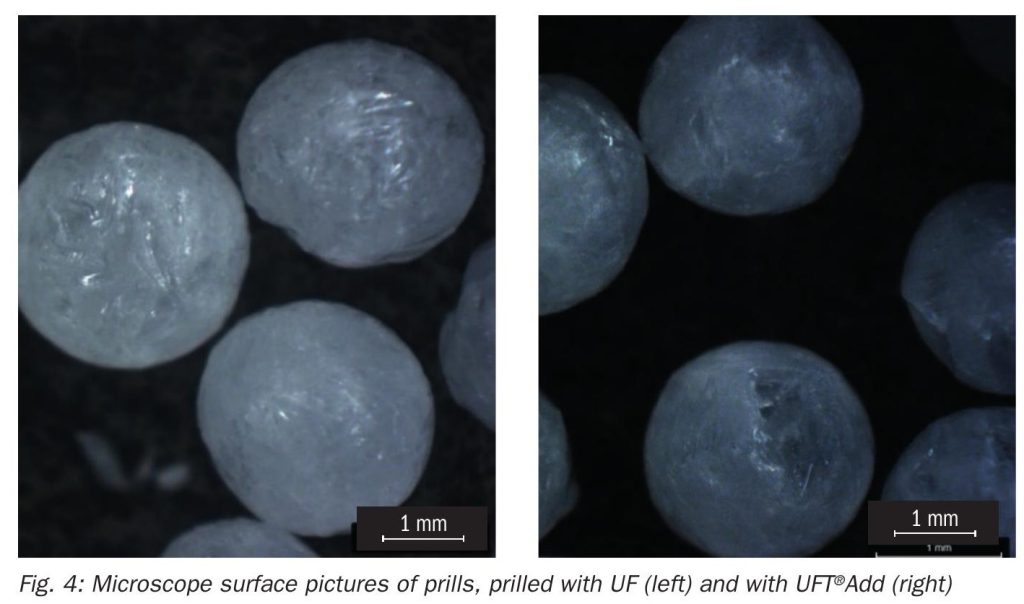
Investigation of the prills by microscopic analysis revealed that prills prilled with UFT®Add have a smooth and clear surface, comparable to prills prilled with formaldehyde (Fig. 4).

Product quality and handling

Prills produced with UFT®Add exhibit physical properties comparable to those of prills produced with UF, particularly in terms of crushing strength and impact resistance. No additional benefit from subsequent coating was observed.

The product in the bulk hall, coated and uncoated, remained in good condition, except for the product treated with the additional component. Even better results were obtained for product which had been filled into the big bag after 24 h curing in the bulk hall. After several weeks the product remained free flowing with only a few, easily breakable agglomerates.

Conclusion

The results of the industrial scale tests carried out in Fertiglobe granulation plant EFC1 and in an industrial prilling plant show that it is possible to replace formaldehyde as additive, while maintaining satisfying process parameters. Urea granules and prills treated with UFT®Add maintain a final product quality comparable to standard UF treated products, while being suitable for a wider range of urea grades including fertilizer, optional stabilised, automotive and for cattle feed. The dosing systems for the application of UFT®Add can be added and implemented without modification of the existing plant in operation. Finally, seamless transition between product grades is possible with UFT®Add technology.

Latest in Innovation