Asia
8 April 2026
Southeast Asia Fertilizer Association launched in Bali
Written by Natalie Noor-Drugan
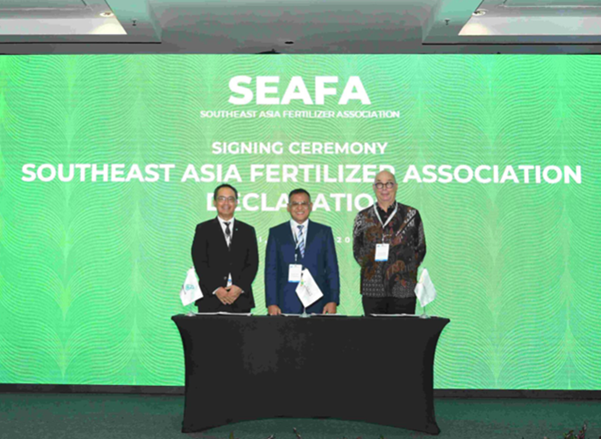
Three leading regional fertilizer producers have come together to create the Southeast Asia Fertilizer Association (SEAFA). The new association formally announced its formation at an industry conference in Bali on 1 April 2026.
The founding members are Pupuk Indonesia (Persero) of Indonesia, Petronas Chemicals Group Berhad of Malaysia, and Brunei Fertilizer Industries (BFI) of Brunei Darussalam. Under the founding agreement, Brunei Darussalam will host the association’s secretariat.
Pupuk Indonesia has been appointed as SEAFA’s first chairman, with Petronas Chemicals Group serving as Co-Chairman. The chairmanship will rotate annually between the association’s members.
Regional cooperation in a volatile market
The association has been established to promote cooperation among ASEAN fertilizer producers and strengthen the Southeast Asian fertilizer industry’s standing on the global stage.
The association says it will be able to present a more unified voice on fertilizer market and policy developments. This includes strengthening food security in the region and supporting low-carbon, sustainable agricultural production, said Rahmad Pribadi, chief executive of Pupuk Indonesia.
A major impetus for SEAFA’s formation is the region’s increasingly complex agricultural challenges, according to Pribadi. “Facing these challenges requires better information, greater awareness, and a shared sense of responsibility from all of us,” he said in a statement on 2 April 2026.
Pribadi also cited escalating geopolitical tensions in the Middle East as a key driver behind the initiative, warning of volatile supply chains and shifting energy needs affecting the agricultural sector. “As global dynamics continue to evolve, it is important for us to keep moving adaptively — to remain agile while ensuring every step remains grounded in the principles we uphold,” he said.
Southeast Asia faces mounting challenges in agriculture, including emissions linked to rice cultivation, which account for around 1% of the global carbon dioxide emissions. The association aims to promote best practices among farmers in the region, particularly in rice production, said Dr Harri Kiiski, chief executive of BFI.
The group will also focus on safeguarding fertilizer supply across the region and supporting a more stable market environment, including for urea in the Asia Pacific region.
Ambitions beyond the founding three
Beyond supply chain resilience, SEAFA is designed to serve as a platform for strategic collaboration, covering knowledge sharing, innovation in sustainable production practices, low-carbon technology development, and the digitalisation of fertilizer supply chains.
In the longer term, the association is open to expanding membership to fertilizer producers across other ASEAN member states, with the aim of strengthening the region’s industry and increasing ASEAN’s contribution to global fertilizer supply stability and food security.
Image courtesy of Pupuk Indonesia.