Fertilizer International 531 Mar-Apr 2026
19 March 2026
Next-generation evaporation units in phosphoric acid plants
PHOSPHATES & POTASH INNOVATION
Next-generation evaporation units in phosphoric acid plants
Co-developed and patented by GEA and Yara International, the ATMOS process is an advanced heat integration technology for concentrating wet-process phosphoric acid. It combines double effect evaporation with high efficiency fluorine scrubbing to deliver significant improvements in energy performance and environmental control. In this article, Aziz Chbeir and Azza Kioua present findings from the validation of ATMOS at industrial and pilot scales. These show a 40% reduction in specific steam demand during phosphoric acid concentration, along with a similar reduction in cooling water consumption, and the ability to recover fluorine as fluorosilicic acid.
Background and Objectives
Fertilizer-grade phosphoric acid is typically produced via the dihydrate (DH) route. In this process, the weak acid (26-32% P2O5) obtained from the reaction-filtration step is concentrated to 49-54% P2O5 through steam driven evaporation. Conventional single effect units require about two tonnes of steam and six tonnes of cooling water per tonne of P2O5. This high thermal load conflicts with decarbonisation goals, increases fuel costs, and makes it harder to comply with stricter fluoride emission limits.
In traditional evaporators, fluorine and silica rich vapours are also condensed without heat recovery. This leads to low energy efficiency, scaling risks, high cooling requirements, and costly condensate treatment. ATMOS transforms this step into an energy integrated, low emission operation that can be retrofitted to existing plants.
Process concept and thermal integration
The ATMOS process applies double effect evaporation. It does this by reusing the existing evaporator as the second effect and adding an upstream atmospheric evaporator with an integrated washing column.
In the first effect, green or partially clarified acid is concentrated to 35-40% P2 O5 at about 110-120 °C and atmospheric pressure. The resulting vapours, which contain high levels of HF and SiF4 , pass through a two stage scrubbing system:
1. A primary absorber using diluted H2SiF6 to capture most of the HF and SiF4 .
2. An alkaline polishing stage to capture remaining HF and SiF4 .
The purified vapours obtained then provide the heating medium for the second effect evaporator. This operates under vacuum (around 0.1 bar) and at 80–90 °C to produce 49–54% P2O5 acid. Valuably, replacing live steam with recycled vapours in this second effect cuts fresh steam demand by 40–46%, depending on rock quality and the level of site integration.
Pilot and semi industrial validation
Two evaporators in series were successfully demonstrated at Yara’s Siilinjärvi phosphoric acid plant in Finland. The system showed stable hydraulics, level control, and temperature profiles under realistic variations in feed composition and throughput.
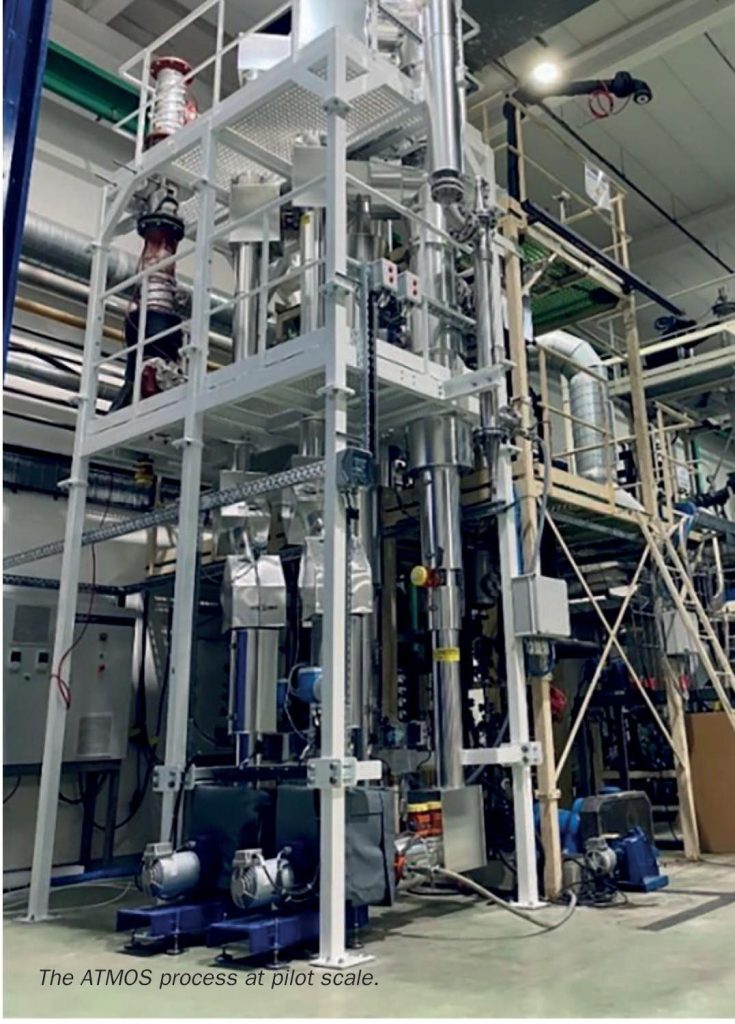
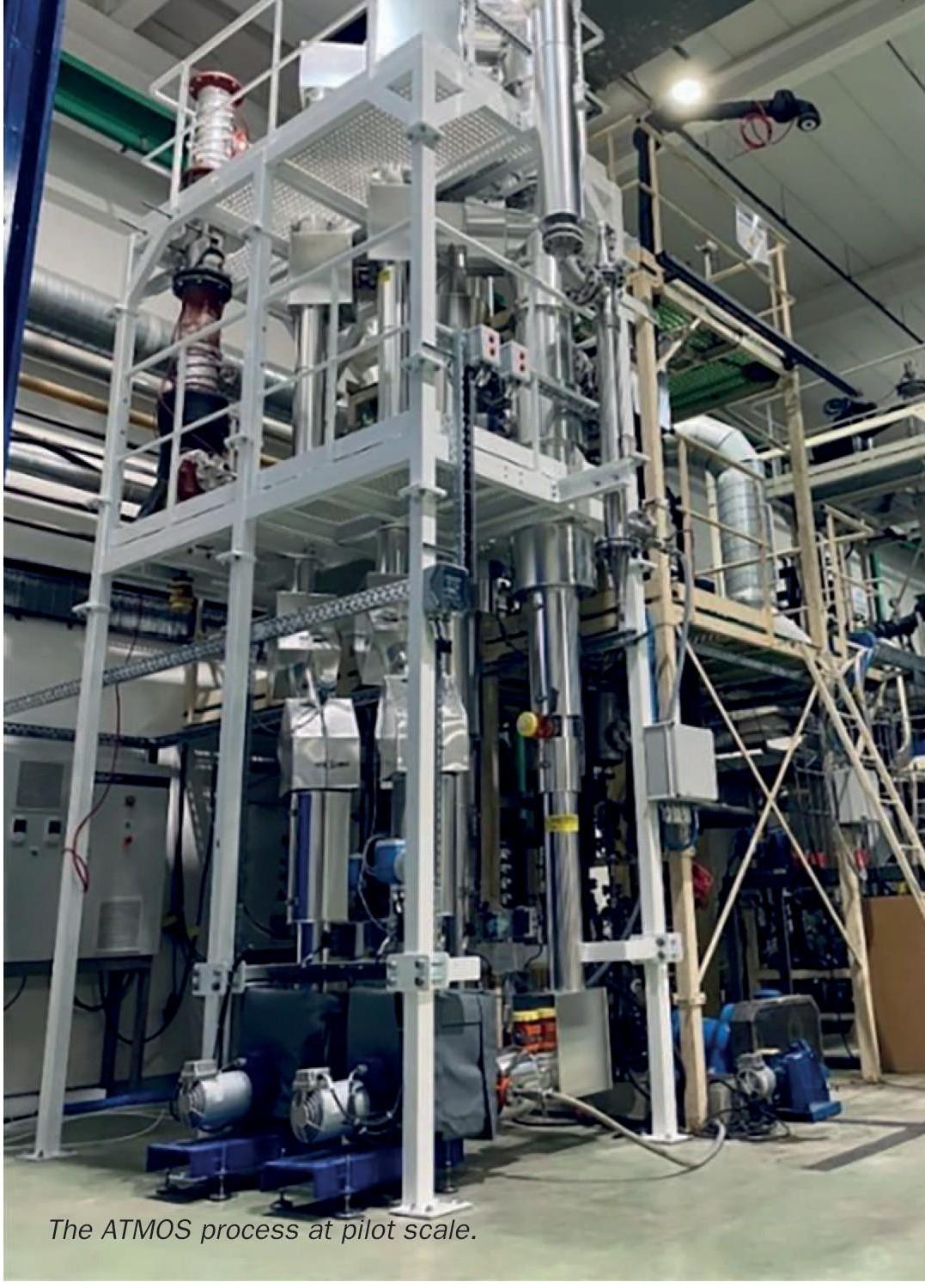
A semi industrial ATMOS pilot was also operated at the GEA Test Center. This ran continuously for three days using water scrubbing followed by an optimised alkaline polishing stage to maximize SiF4 and HF capture and prevent SiO2 formation.
The stability of heat transfer coefficients in the acid heat exchanger and in the condenser throughout the trial indicated effective scaling control. Condensate analyses confirmed that dissolved silicon stayed well below amorphous SiO2 solubility limits. This demonstrated the low fouling risk from the process – and proved that fluorine rich vapours can be reused as a clean thermal medium when gas-liquid contact and pH are properly controlled.
Performance gains and environmental impact
ATMOS reduces specific steam consumption in the dihydrate concentration step from about 2.0 to 1.2 tonnes of steam per tonne of P2O5 , representing a 40% cut in thermal energy demand. The same proportional decrease in cooling water use enables capacity debottlenecking by easing the load on cooling systems.
The multi-stage scrubbing system used in the ATMOS process improves fluorosilicic acid recovery by up to 20% compared to a single stage water scrubbing. This reduces gaseous fluorine emissions and limits the need for neutralising dilute condensates. Lower off-gas fluorine levels and higher conversion to liquid products support compliance with stricter stack and water discharge limits.
Improved energy efficiency, meanwhile, reduces indirect CO2 emissions from steam generation, supporting climate reduction targets. Overall, the combined steam savings, lower cooling duty, and recovery of fluorosilicic acid reduce operating costs and improve the life cycle footprint of phosphate fertilizers.
Retrofit strategy and implementation
ATMOS is designed for retrofits. The existing evaporator becomes the second effect, while a new atmospheric evaporator and washing columns are added upstream. Column configuration is adapted to site emission limits and targeted fluorosilicic acid recovery, balancing investment with environmental performance.
Mechanical complexity remains moderate thanks to operation of the new equipment at atmospheric pressure. This supports compact layouts and manageable capex for brownfield projects.
The main implementation requirement is a planned shutdown to reroute vapour and condensate lines and connect the existing evaporator as the second effect. This needs to be aligned with plant turnaround scheduling.
Material selection for the first effect evaporator and washing system is critical due to its high operating temperature, fluorine content, and acidity. Elsewhere, alkaline consumption in the polishing scrubber, which depends on primary absorber performance and targeted residual fluorine levels, can be minimised through proper process control.
Conclusions
Overall, the ATMOS process developed by GEA and Yara International offers a mature and economically attractive solution for modernising phosphoric acid concentration, delivering substantial reductions in steam use, cooling demand, and fluorine emissions.
CRU Phosphates+Potash Expoconference 2026
Aziz Chbeir of Yara International and Azza Kioua of GEA Process Engineering will be presenting on ‘ATMOS: A new Energy and Environment Saving in Phosphoric Acid Concentration Process’ at the conference in Paris on Tuesday 14 April at 15:30–16:00. Register now at: events.crugroup.com/phosphates/register