Nitrogen+Syngas 400 Mar-Apr 2026
19 March 2026
Hybrid cryogenic technologies for high-purity CO2
DECARBONISATION
Hybrid cryogenic technologies for high-purity CO2
The selection of the post-combustion carbon capture technology to be implemented for a decarbonisation project is a crucial element during the early feasibility phases and it is strongly affected by the characteristics of the plant on which it has to be installed. F. Ferrari, E. Disarò, P. Felici and A. Orsetti of NextChem highlight the comparative advantages of absorption technologies and the alternative opportunities of using a cryogenic configuration to reach the desired carbon capture rate.
The IEA’s Net Zero Scenario requires global carbon capture, utilisation, and storage (CCUS) capacity to reach over 1 gigaton (1,000 Mt) of CO2 annually by 2030. This is a massive acceleration from current levels, highlighting the necessity of substantial efforts in the direction of implementing new carbon capture facilities that can eliminate between 90% and 99% of CO2 emissions from industrial facilities.
This article provides a comparative analysis of two main post-combustion carbon capture technologies (i.e. absorption and cryogenic), focusing on their technical principles, operational challenges, economic implications and selection criteria.
Absorption carbon capture
Chemical absorption methods are the most mature option for extracting CO2 from low-concentration gas streams, offering a robust and scalable solution. Within this category, amine-based carbon capture is recognised as the most referenced technology. A prime example of its effectiveness is in post-combustion CO2 capture, where carbon dioxide is removed from flue gases after complete combustion of fuel.
Amine-based capture systems are typically structured into three main sections: flue gas pre-treatment, CO2 absorption, and solvent regeneration; each section plays a critical role in ensuring the overall effectiveness and stability of the process.
The two main columns, i.e. the absorber and the regenerator, are the most critical for the performance and cost structure of the amine-based capture system.
Advantages
Absorption technologies can be considered the most used and widespread solution. Industrial applications for post-combustion amine carbon capture technology range from very large capacities equivalent to 4,776 t/d (e.g. Petra Nova plant in Thompsons, USA) to a wide spectrum of flue gas qualities including very low carbon dioxide concentrations lower than 2 mol-% (e.g. Casalborsetti plant in Ravenna, Italy).
The technology’s maturity significantly reduces the risks of adoption, including in industrial sectors that have not previously implemented such units. Moreover, the technology can reach a very high capture rate reaching potentially up to 98% of CO2 removed from the flue gas in conventional industrial plant such as steam methane reforming plants for hydrogen production.
Challenges
The process involves the use of formulated amine-based solvents, which are subject to degradation in presence of oxygenates therefore raising environmental concerns that shall be adequately addressed in design of the unit.
The additional issue is represented by the corrosivity of the solvent that requires a dedicated material selection of the asset to ensure the long-term operation of the unit but also might impact on the associated capex.
The main challenge for amine carbon capture units is represented by the thermal energy demand necessary for solvent regeneration that dramatically affects plant opex.
This element is less critical in those contexts where low pressure steam might be available in the complex, but can be an issue when the upstream facilities do not have additional waste heat to be recovered and dedicate to the regeneration of the carbon capture section, such as in power plants or cement factories.
Cryogenic carbon capture
Cryogenic carbon capture involves a physical separation process based on the differences between the boiling points and the transition from gas to solid phase for the components in the mixture.
Thanks to the high recovery rates and high CO2 purity downstream of the carbon capture unit, in recent years cryogenic technologies has been gaining a considerable attention and multiple licensing companies have been proposing both conventional and non-conventional solutions.
However, to overcome bottlenecks in conventional technologies, the possibility to combine two or more CO2 separation methods ensures a better performance (usually identified as hybrid processes).
In particular, the most promising solution would leverage on the possibility to combine an adsorption step, using a pressure swing adsorption unit (PSA) specifically dedicated to CO2, plus a cryogenic section to ensure its separation in liquid phase from the other molecules.
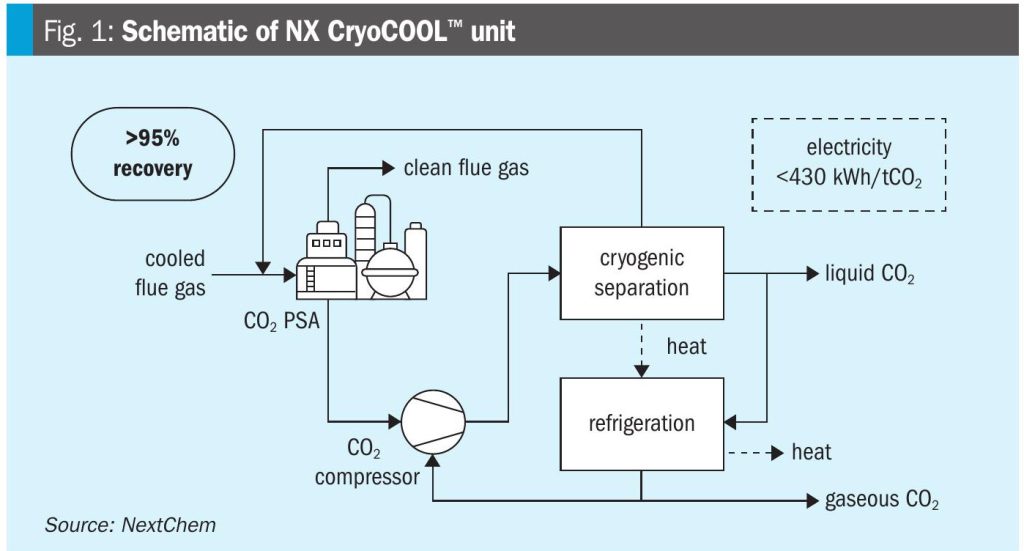
NextChem has developed its own proprietary configuration, commercially identified by the name NX CryoCOOL™ , which is characterised by a strong thermal efficiency through the minimisation of thermal losses and the maximisation of the available frigories utilisation.
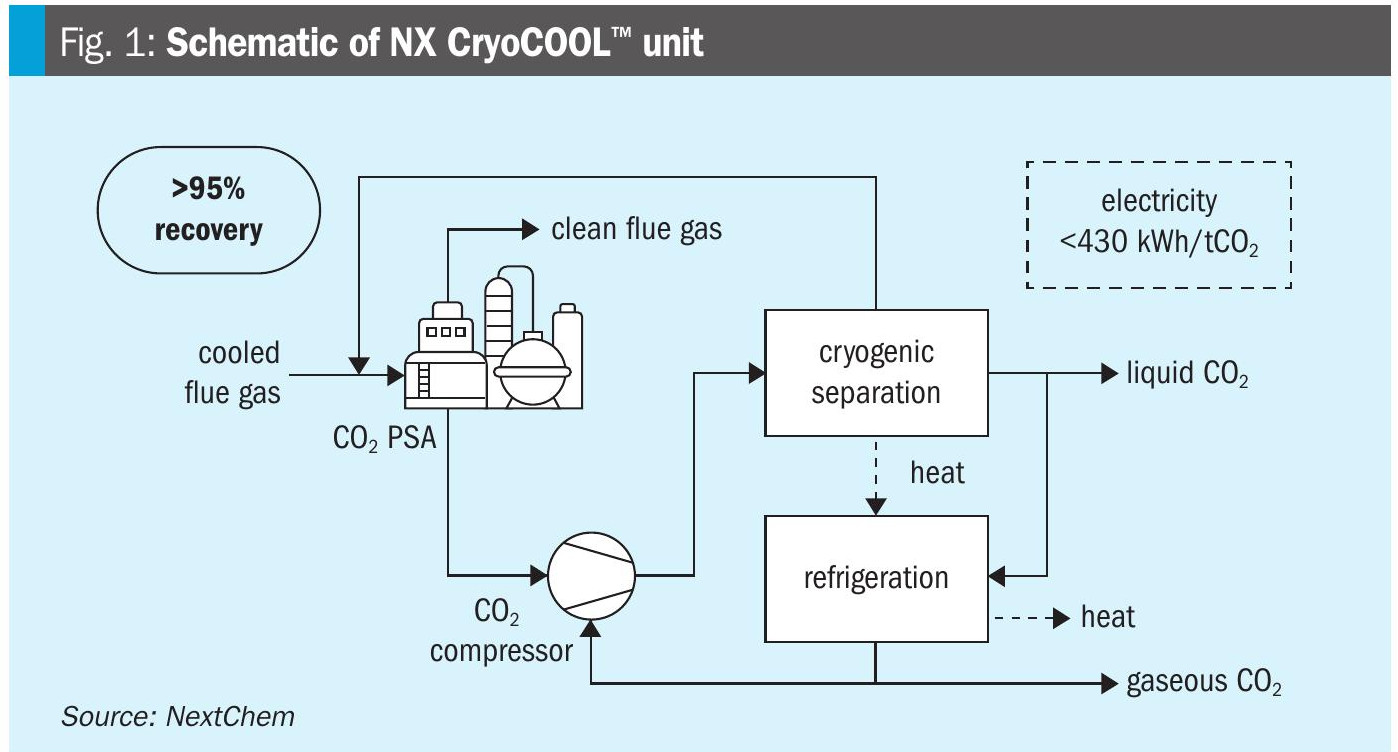
As shown in the simplified scheme in Fig. 1, the compressed and cooled flue gas is delivered to a CO2 PSA unit where the feedstock is separated in a concentrated CO2 stream and in a nitrogen-rich flue gas stream.
The tail gas from the PSA is then compressed in a dedicated machine to reach the pressure level that ensures the generation of the necessary frigories through the Joule-Thompson effect.
The incondensable gases are then separated in the cryogenic section to be recycled back to the PSA and reach the maximum achievable CO2 recovery.
The purified CO2 stream is either separated in the cryogenic section in liquid phase or vaporised to recover additional frigories for CO2 condensation, therefore reducing the specific consumption per tonne of CO2 captured.
Advantages
Hybrid cryogenic configurations for carbon capture can be considered a combination of very consolidated technologies, therefore, even if its application has not yet been fully implemented at industrial capacity, the associated technological risk should be considered minimal.
On the other hand, the technology offers the opportunity to provide a fully electrified solution that does not necessarily require complex heat integrations with the upstream assets to ensure its operability, while the absence of any solvent does not create any issue on the eventual presence of degradation component that might be critical for environmental authorities.
The additional advantage of this solution is the possibility to achieve very high CO2 purity without the need for major purification steps downstream of the unit.
Challenges
The necessity to reach cryogenic temperatures requires the utilisation of a refrigerant and it is therefore energy intensive due to the high electrical demand from the associated compressors.
This element can be partially mitigated if the CO2 is to be delivered in gaseous phase, therefore allowing for a partial recovery of the frigories by flashing the product stream, but still requires all the necessary assets to manage the refrigeration.
The complexity of specialised equipment together with the insulation required for the cold service have a dramatic effect on the unit capex. The combined effect of the opex and capex constraints usually limits the opportunity to install such a cryogenic configuration on post-combustion carbon capture when the CO2 concentration is above 15 mol-%.
Qualitative technical comparison
Based on NextChem experience in performing multiple feasibility studies in different industrial sectors, a technological comparison of the two technologies is qualitatively summarised in Table 1.
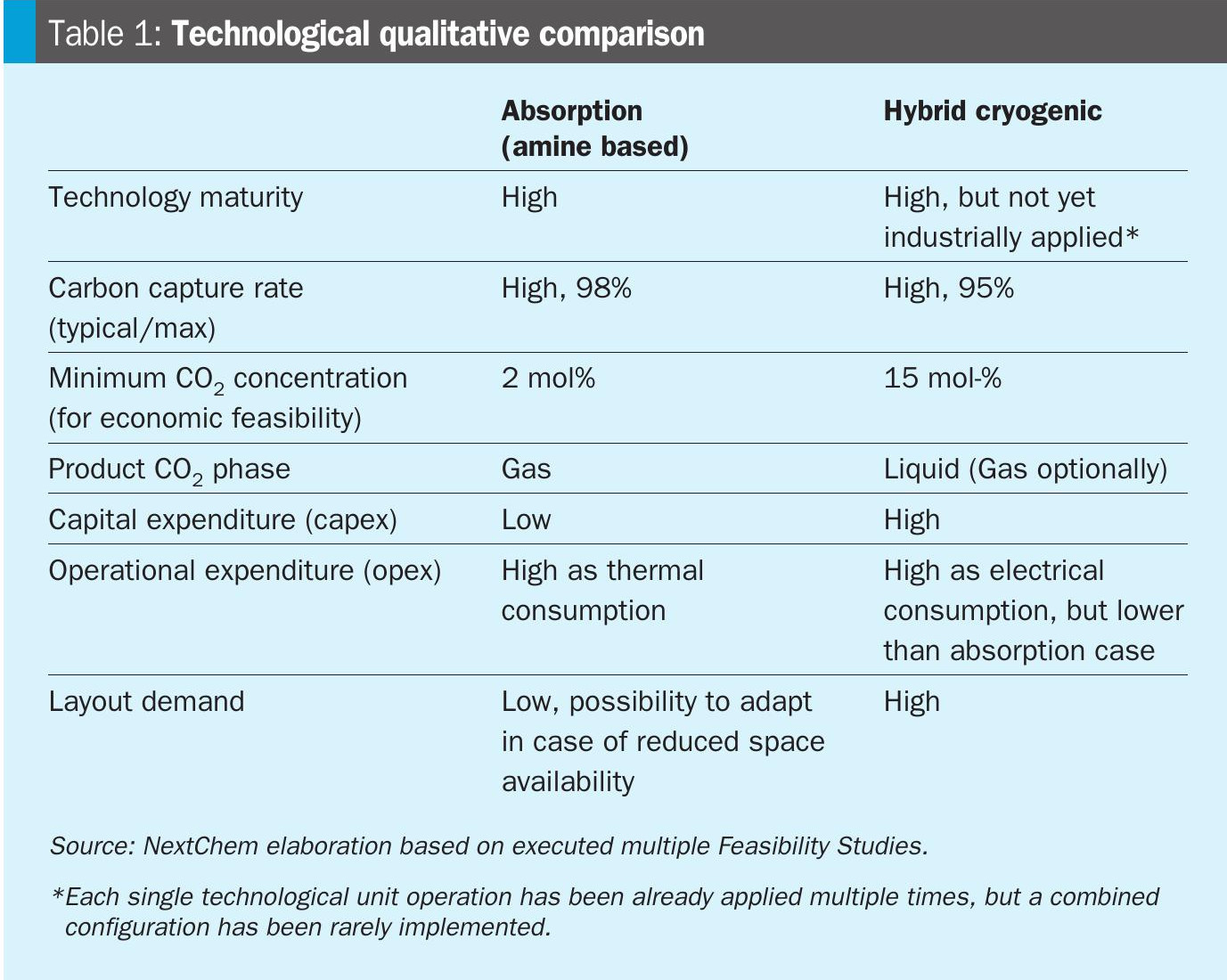
The qualitative evaluation might suggest a slight preference for absorption technologies, mainly due to the high capex required for cryogenic configurations unless a significant advantage on the associated opex is present.
The results of more analytical evaluation highlight the following points for further attention when selecting the technology to be applied:
- The CO2 concentration in flue gas should be the first parameter checked to exclude, a priori, the possibility of adopting a specific technology. For example, if the concentration is below 15 mol-%, only absorption solutions may be technically or economically feasible.
- The product phase should be addressed ex ante, because the need to deliver the product in liquid form may substantially increase the additional capex/opex of the selected technology, requiring the installation of a dedicated liquefaction section.
- The availability of utilities – such as low-pressure steam for amine regeneration – and the potential high cost of electricity are critical drivers that should be factored into the technology comparison; in some cases, they can overturn a solution’s apparent capex advantage because of substantially higher opex.
To provide a fair comparison between the two technological solutions, a comparison is made with the following starting elements:
- CO2 concentration at 15 mol-%;
- CO2 to be delivered in liquid phase.
To align the overall analysis between the two technologies, the hypothesis is to couple a conventional licensed absorption solution with NextChem CO2 liquefaction technology NX CLIQ™– the basis for the hybrid solution that combines a cryogenic configuration with CO2 PSA is NX CryoCOOL™ technology.
Configurational comparison
Starting from the emission point, both technologies share configurational similarities for the initial gas conditioning stage: Flue gas undergoes cooling in a quencher, a direct-contact column where recirculated water reduces the gas temperature to levels suitable for downstream processing.
In the case of the absorption technology, upon exiting the quencher, the cooled flue gas is directed through a blower to ensure sufficient pressure to overcome only the pressure losses across the absorber. In the case of a hybrid cryogenic it is necessary to foresee a compressor/ blower, which raises the pressure high enough to allow the CO2 PSA to adequately perform the target carbon dioxide separation from flue gas.
Downstream of the CO2 separation stage both technologies require a subsequent step in which the CO2-rich stream is compressed to enable the subsequent cryogenic separation.
The topological configuration is almost equivalent, but the main difference is represented by the quality of the stream to be treated because downstream of the regenerator in the absorption case the CO2 is almost pure, while in the hybrid case the tail gas from the CO2 PSA is only partially concentrated because the final separation from incondensables is performed within the cryogenic section in the liquefaction column.
This compositional difference necessitates overdesign of the affected equipment, meaning the hybrid configuration requires larger pieces of equipment than those needed for the liquefaction unit downstream of the absorption carbon capture section.
All these elements, together with the need to install specialised heat exchangers, cryogenic equipment, and insulation materials, typically lead to higher capex for the hybrid configuration. This increase may be partially offset when calculating total investment cost if some items can be modularised (e.g., the PSA), thereby reducing overall construction costs.
Operational comparison
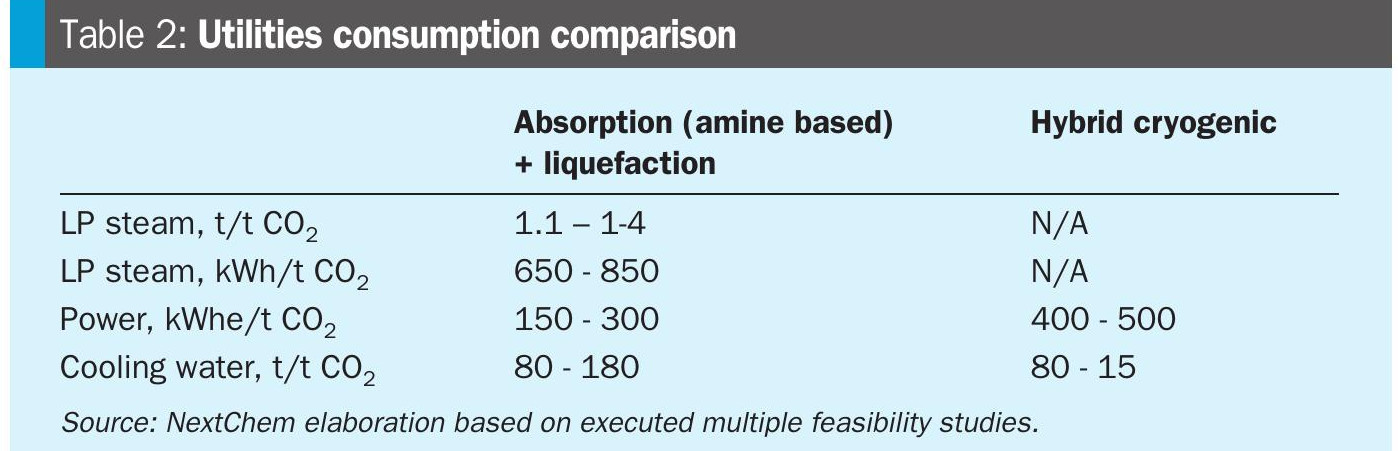
The comparison between the two options is not complete without accounting for the differing operating consumptions required by each technology. Although the hybrid configuration requires larger equipment in the cryogenic section, the energy needed to regenerate an aminic process is the most critical factor affecting the competitiveness of the absorption technology.
As shown in Table 2, the absorption technology coupled with a liquefaction section has specific consumption that is substantially higher than that required by the cryogenic solution. Therefore, in some regions the 20-year opex may offset the higher capex.
KPIs for technology selection
When selecting a carbon capture technology, the following parameters should be considered:
- Carbon capture rate(%): CO2 captured from flue gas
- CO2 purity (%): Achievable as requested by the downstream users/off-takers
- Energy consumption (kWh/ton CO2): Total energy required (thermal and electric)
- Unit flexibility: Capability of the technology to be integrated with the upstream system
- Capex
- Opex
- Layout
When a post-combustion carbon capture unit is installed as a revamp of an existing plant, the ability to properly integrate the new equipment into the current system is the key factor in ensuring the feasibility of the new configuration.
Conclusions
By analysing the different options when selecting the post-combustion carbon capture technologies to be applied, it is revealed that each approach has distinct advantages and challenges depending on the industrial application.
Absorption technologies are the most mature solution for large-scale plants especially at low carbon dioxide concentration, offering a high carbon capture rate but demanding significant energy input and careful solvent management.
Hybrid cryogenic technologies provide the opportunity for achieving high-purity CO2 and might be the preferred option to minimise the system opex, especially if the flue gas is concentrated in CO2 and the product must be delivered in liquid phase.