Fertilizer International 531 Mar-Apr 2026

18 March 2026
CRU Phosphates+Potash 2026 Expoconference guide
CONFERENCE PREVIEW
Technical programme highlights
Technical programme highlights
A selection of abstracts from the conference’s technical programme.
RevoCaP: enabling Europe’s phosphorus independence
EasyMining
EasyMining’s patented Ash2Phos technology provides a proven, scalable process for recovering phosphorus from sewage sludge ash (SSA) to produce the fertilizer product RevoCaP. EasyMining is bringing this innovation to market through two pioneering plants.
RevoCaP fully complies with EU fertilizer regulations and supports the European Green Deal’s objectives of circularity, resource efficiency, and reduced dependency on critical raw materials. With the first Ash2Phos plant soon to enter operation, RevoCaP will be available at industrial scale for the European market. It has also gained full approval for use in organic farming under Regulation (EU) 2018/848.
A cost-effective approach to SOP production
Ballestra
Potassium sulphate (SOP) is a premium fertilizer that provides essential potassium and sulphur and is ideal for chloride-sensitive crops. Ballestra S.p.A. has developed a novel wet-route process for SOP, as a more sustainable alternative to the Mannheim production. This innovative production method is based on a water-based reaction between potassium chloride (KCl) and ammonium sulphate ((NH4 )₂SO4 ). It operates at room temperature, eliminates emissions, avoids HCl formation, and generates a secondary liquid fertilizer (N+K+S) alongside high-purity crystalline SOP. This state-of-the-art technology offers significant energy savings, improved operational safety and environmental benefits, while delivering pure SOP that meets market standards.
Pushing the boundaries of innovation in phosphate production
Technophos
Phosphates are essential to modern life. Yet, this finite, non-renewable resource faces critical challenges. With only one third global phosphate resources economically viable under conventional methods, innovation is no longer optional – it is an imperative. Technophos, an R&D and innovation centre offering advanced alternative processes, aims to transform low-grade ores and industrial waste into high-value products such as feed-grade dicalcium phosphate (DCP) and high-purity phosphoric acid. These technologies tolerate impurities, allow the valorisation of by-products, and achieve excellent recovery rates, proving that sustainability and profitability can coexist. Our capabilities span laboratory feasibility, pilot validation, and semi-industrial demonstration, ensuring reliable scale-up for complex projects.
Food- and electronic-grade phosphoric acid made easy
Sulzer
This presentation focuses on Sulzer’s advanced technologies – OptimEXT™ liquid-liquid extraction and fractional melt crystallisation – and their role in producing food-grade and electronics-grade phosphoric acid, efficiently and economically. Approximately 90% of phosphoric acid is used in fertilizer production in ‘crude’ merchant-grade form. Yet, its transformation into high-purity grades is essential for industries such as food and semiconductors. The wet process route, while dominant globally, faces significant purification challenges. We will show how Sulzer’s OptimEXT™ technology, utilizing Kühni™ agitated columns, achieves superior separation efficiency for food-grade phosphoric acid. In addition, a multi-stage melt crystallisation process for ultra-high purity electronic-grade acid will also be described.
Vertical roller mills (VRM) for high efficiency phosphate rock grinding
Loesche
Vertical roller mills (VRMs) are an ideal solution for grinding phosphate rock, reducing operating costs, improving flexibility, and delivering high and stable product quality. In this case study, two former petcoke VRMs were reconditioned for phosphate rock grinding. After a deep process analysis and mechanical and electrical auditing, both mills were reconditioned and relocated for use in grinding phosphate rock at different industrial fertilizer plants. Since their commissioning, both installations have operated successfully, in terms of output and product quality, at optimised energy consumption.
Advanced process solutions for potash and phosphate production
Haver & Boecker Niagara
Haver & Boecker Niagara provides fully integrated process solutions for phosphate and potash that are proven in large-scale reference projects worldwide. In phosphate crushing and screening, we have delivered more than 86 Niagara vibrating screens, each of these having a capacity of 150 tonnes per hour (t/h). Successful installations include the basic engineering for a phosphate ore crushing and screening plant with a capacity of 5,500 t/h, and the design of a potash crushing and screening plant with three lines offering a capacity of 800 t/h each. Haver & Boecker Niagara have also supplied a complete loading terminal for potash that satisfies the customer’s 480 t/h production requirements.
How to increase potash production and yield
Derrick Corporation
The use of Huck Bolted screens in potash processing often results in high circulating loads, excessive overgrinding, and reduced recovery rates. This paper highlights the transformative role of high-frequency multi-deck vibrating screens, like Derrick’s SuperStack® , in overcoming these limitations. Drawing on case studies from potash plants in Saskatchewan, results show significant improvements in classification efficiency (up to >95%), reduced power consumption, lower reagent usage, extended equipment lifespan, and enhanced mineral recovery. Fine screening not only optimises flowsheets and reduces operational costs but also contributes to sustainability by minimising energy use and plant footprint.
SSP plant upgrades to meet emissions targets and eliminate effluent
Armatec
Ferchem Fertilizers and Chemicals Co, one of the largest producers of single superphosphate (SSP) fertilizer in Egypt and the Middle East, have installed three new gas scrubbing systems designed by Armatec Environmental Ltd. These SSP plants now have stack emissions that comply with local and international environmental standards. The systems are designed to cope with the inevitable silica deposits that result from SSP gas scrubbing. To comply with tighter Egyptian government regulations on fluoride emissions (<5 mgF/Nm3 ), they were designed with a removal efficiency greater than 99.99%. The systems also reduce or eliminate liquid effluent and recycle up to 100% of fluorosilicic acid (FSA) back to the process.
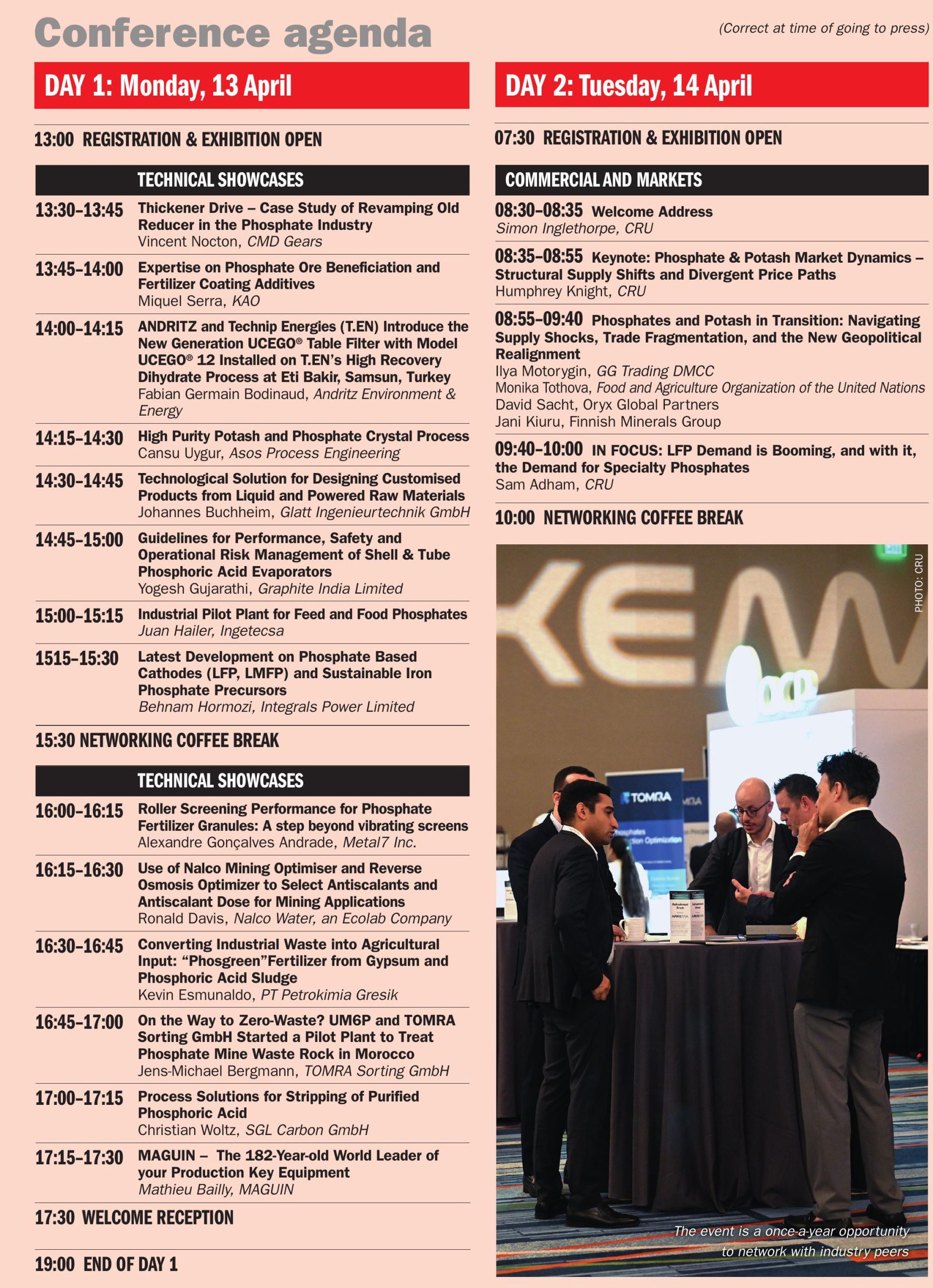
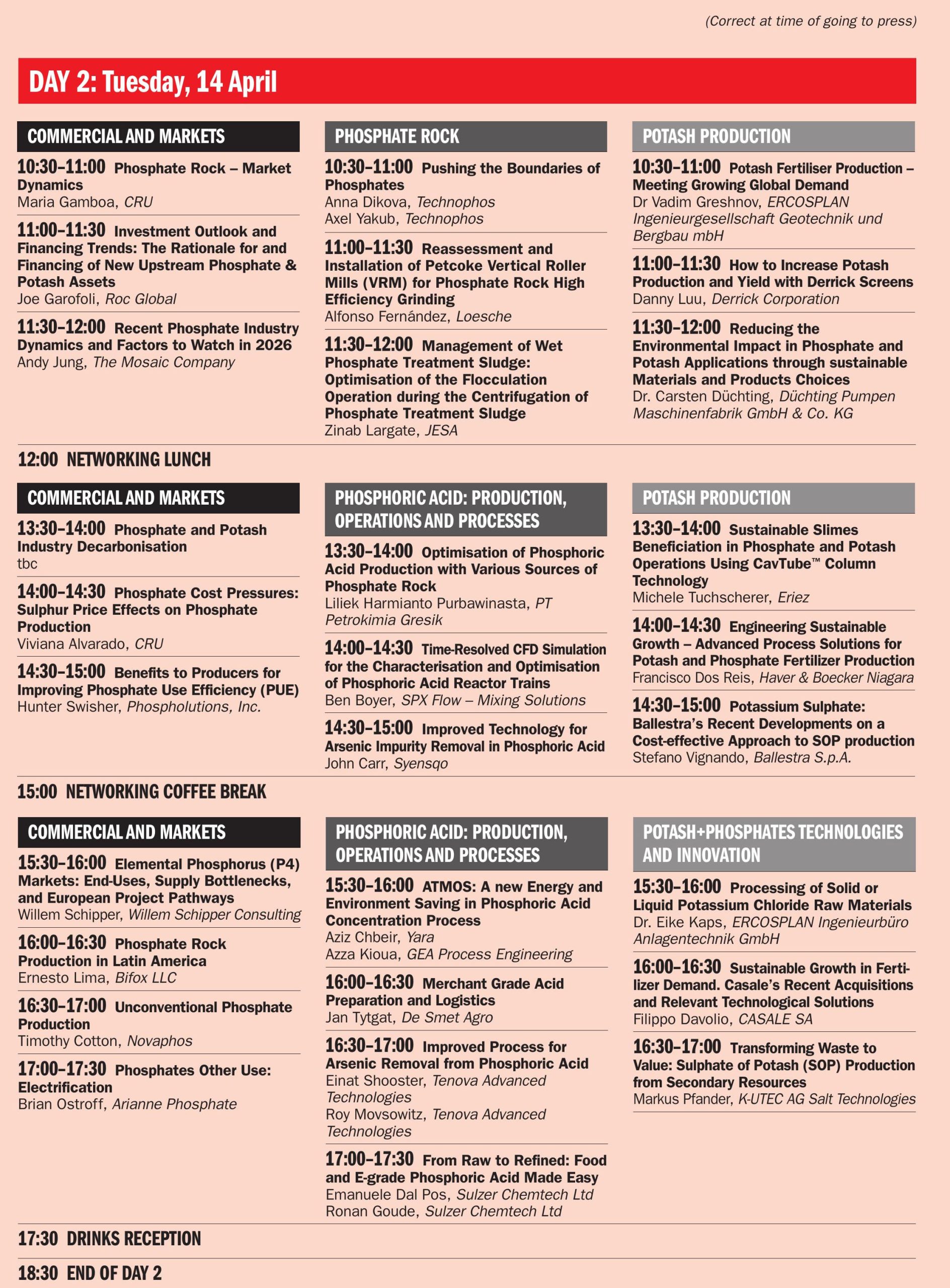
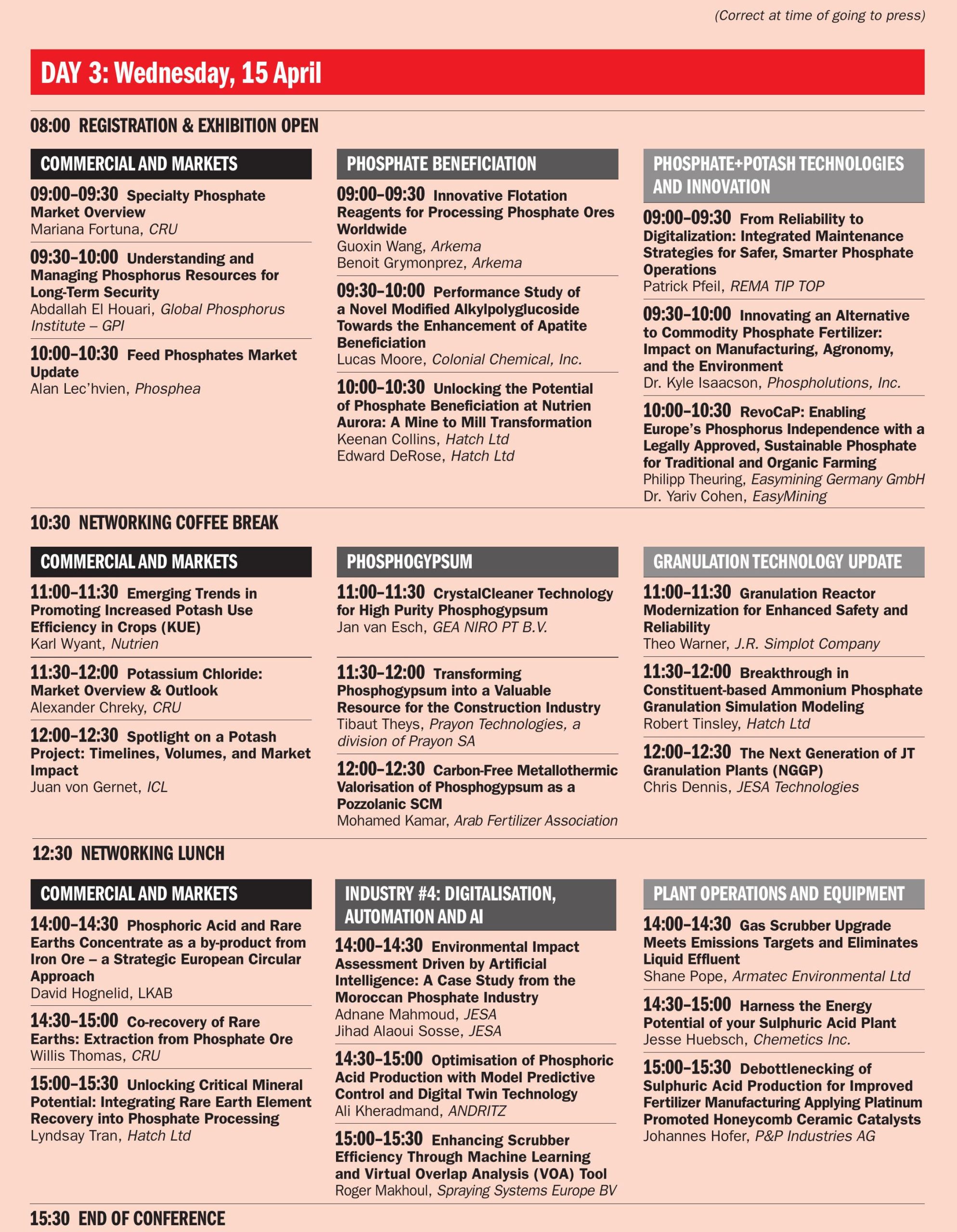
Conference agenda
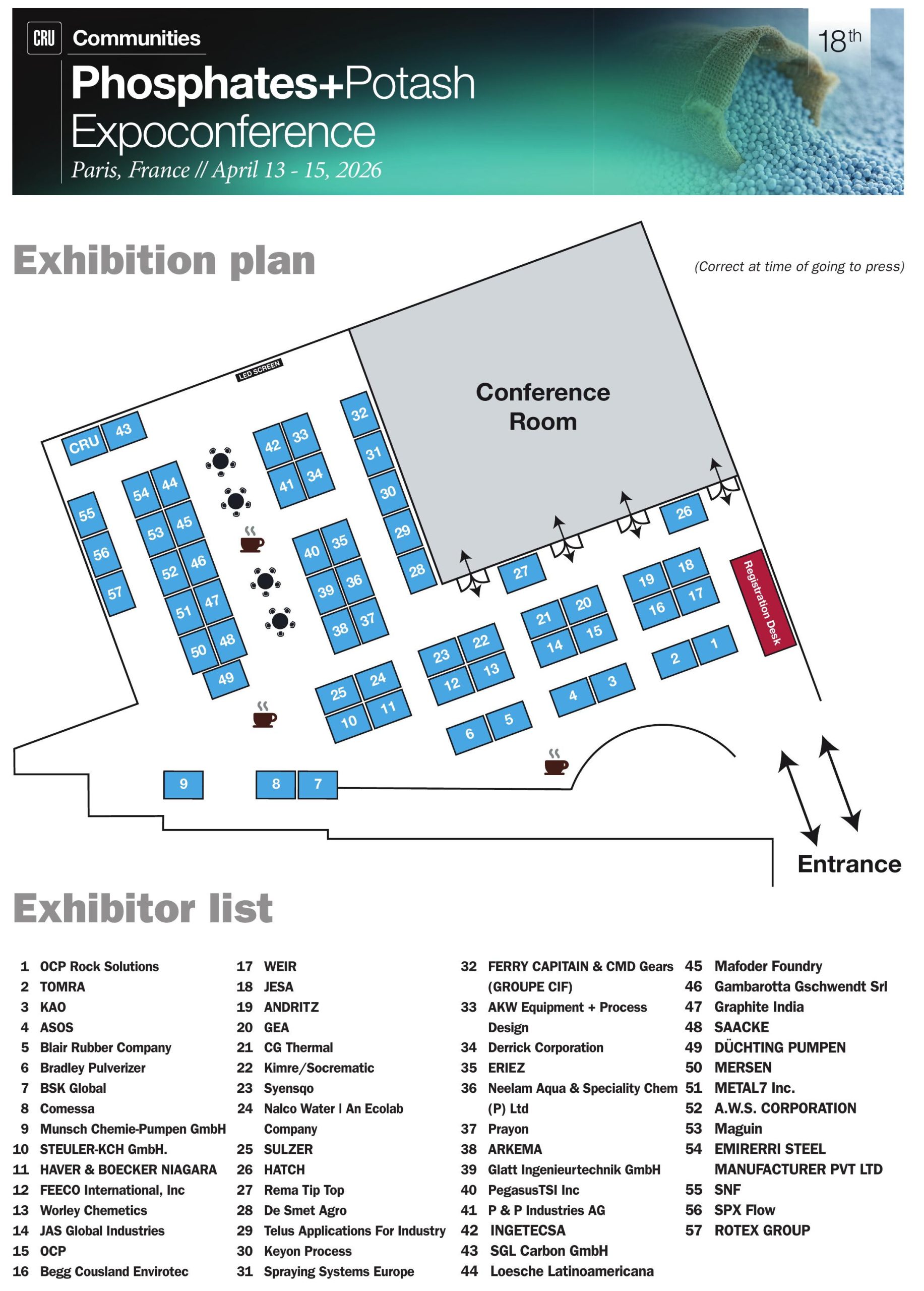
Exhibition plan & exhibitor list