Sulphur 422 Jan-Feb 2026

New phosphate project


IRAQ

New phosphate project

Iraq’s Ministry of Industry and Minerals confirmed on Wednesday its intention to proceed with the construction of a new phosphate plant in Al-Qaim district, Anbar province, to use 10 billion tonnes of phosphate reserves. The ministry also revealed the expected production volume and the total value of the project. Ministry spokesperson, Duha Al-Jubouri, told the Iraqi News Agency (INA): “This project aims to revive this sector after the near-total destruction of the phosphate plant due to terrorist operations.” She explained that “the project is being implemented in partnership with the private sector and is considered one of the mega-projects that reflects the significant potential Iraq possesses.”

Al-Jubouri added that the project’s production capacity will be 500,000 t/a of triple superphosphate (TSP) fertilizer and 1.0 million t/a of diammonium phosphate (DAP) fertilizer. She explained that “the project is based on strategic assets, as the western Anbar desert contains one of the largest phosphate reserves in the world, estimated at about 10 billion tons,” noting that “the total cost of the project is about $2 billion.”


Latest in Agricultural

Feedstock allocation for fourth phosphate plant

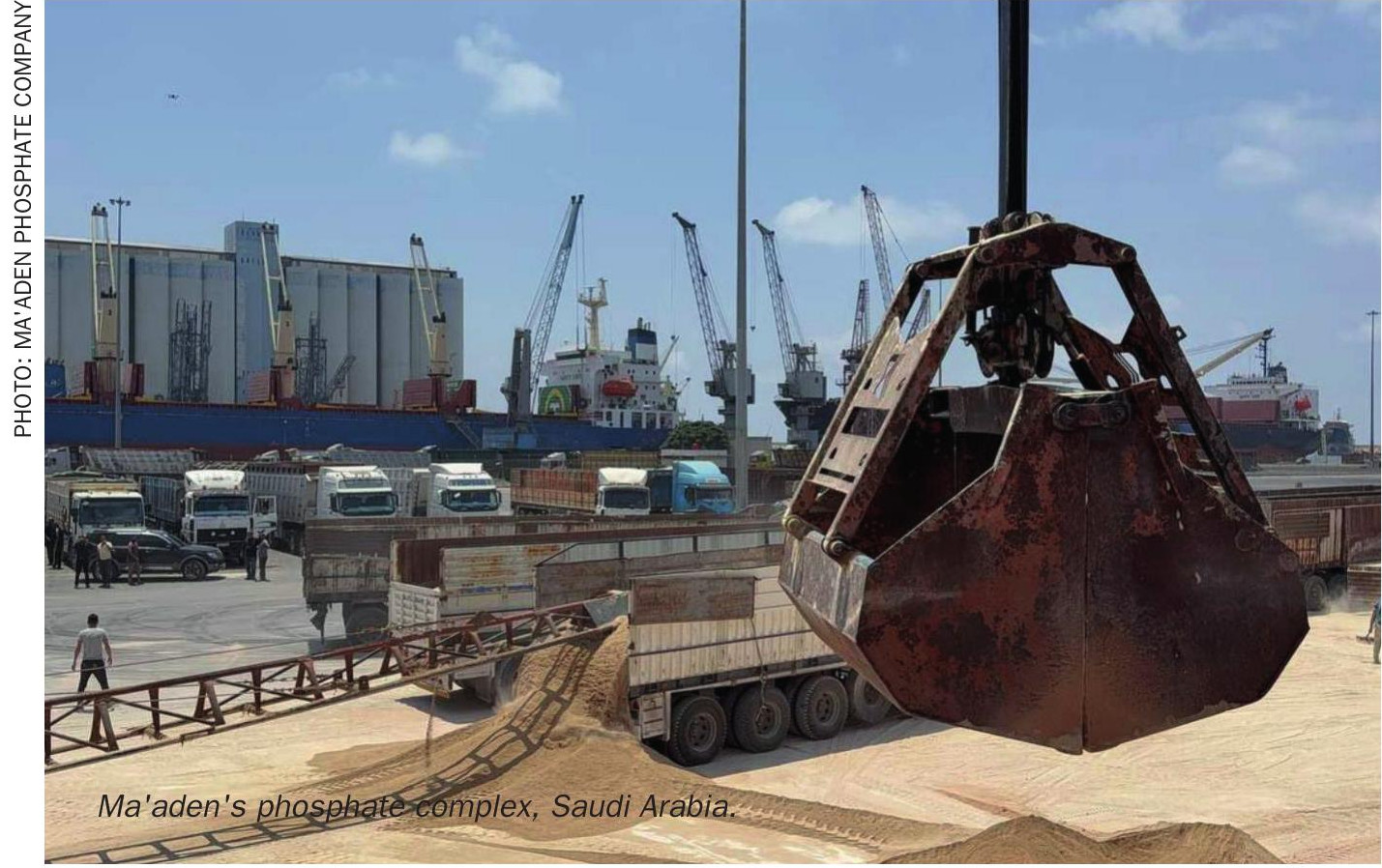
The Saudi Arabian Mining Company (Ma’aden) says that the Ministry of Energy has approved the allocation of feedstock for its fourth phosphate project. This project aims to produce approximately 1.1 million t/a of ammonia and increase the production of phosphate and specialty fertilizers by about 2.5 million t/a, raising the company’s total production capacity to nearly 12 million t/a. This will further solidify Ma’aden’s position as one of the world’s largest producers of phosphate fertilizers, according to a company statement. Ma’aden will now commence engineering studies and obtain the necessary approvals.

Phosphate investment deal

Syria’s Geological and Mineral Resources Authority has signed an agreement with Teryaq, a subsidiary of Serbia’s Exlixir Group, aimed at exporting 1.5 million t/a of phosphate by the end of 2026. The agreement marks a significant step in Syria’s efforts to expand international partnerships and optimise its mineral resources for economic gain. Elixir Group owns the largest phosphoric acid plant in Europe and operates three fertilizer plants in Serbia.

Chatham Rock Phosphate sells Australian subsidiary

Chatham Rock Phosphate has agreed to sell its wholly-owned Australian subsidiary Avenir Makatea Pty Ltd to Austure Industries Pty Ltd for A$1.4 million, including A$900,000 in cash over a 24-month period, and a 20% shareholding in Austure Phosphate AU Pty Ltd, a newly-formed subsidiary of Austure, to establish a mono- and dicalcium phosphate manufacturing plant in Cloncurry. Colin Randall, Chatham Executive Director has been appointed a Director of Austure Phosphate AU Pty Ltd.

Safi floods likely to impact phosphate supply from OCP

Flash floods in the Moroccan port city of Safi killed at least 37 people in December and injured many others, with knock on effects also likely to impact exports from phosphate producer OCP. Jorf Lasfar is the phosphate giant's main export hub for phosphate fertilizers and phosphoric acid, while Safi exports smaller volumes of phosphoric acid, TSP and animal feed products. Phosphate rock exports are largely concentrated at the port of Casablanca further north. OCP produces around 420,000 t/a triple superphosphate and 1.63 t/a phosphoric acid at Safi, as well as around 62,000 t/a dicalcium phosphate and 70,000 t/a monocalcium phosphate.