Fertilizer International 528 Sep-Oct 2025
New crop-specific blending plant


GERMANY

New crop-specific blending plant

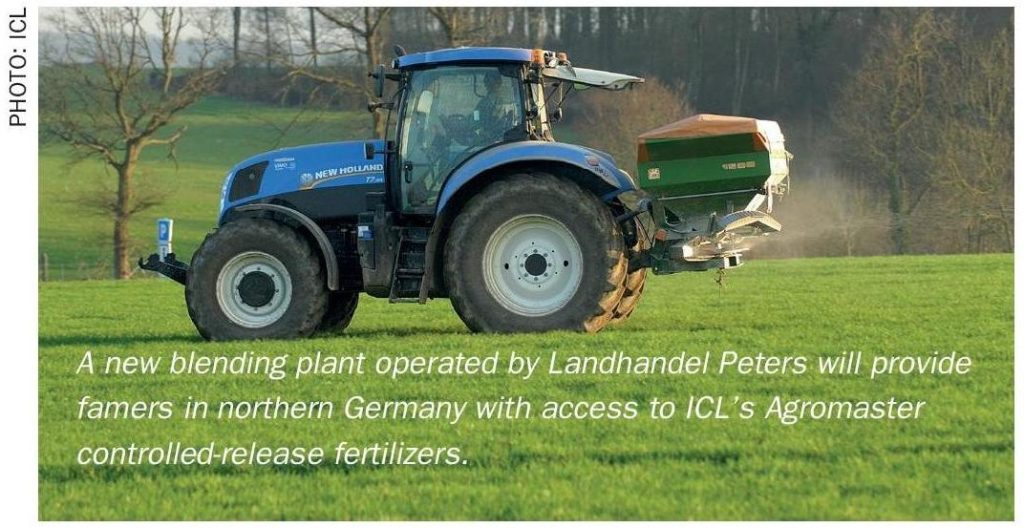
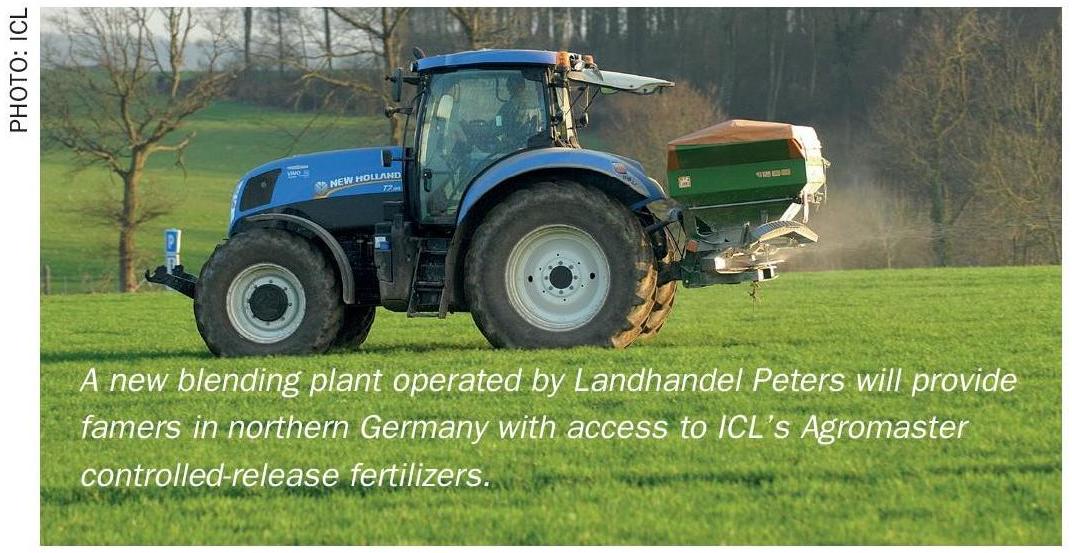
The opening of a new fertilizer blending plant in August will provide farmers in northern Germany with better access to high-quality controlled-release fertilizers (CRFs), thanks to a new collaboration between ICL and Landhandel Peters.
The new Winsen/Luhe plant enables Landhandel Peters to produce crop-specific fertilizer mixtures on site and on demand. Whether for asparagus, potatoes, soft fruit, maize or vegetables, these blends are fine-tuned to meet the soil and crop requirements of farmers. The overall aim is to provide farmers with fast, flexible service backed by trusted technical expertise.

The new blends produced by Landhandel Peters will incorporate ICL’s Agromaster CRF technology. Unlike conventional uncoated fertilizers, Agromaster delivers nutrients gradually over time, matching the uptake needs of the plant throughout its growth cycle. This means farmers can fertilize their crops less frequently, reducing the number of treatments, while confidently meeting their crop nutrient requirements over the entire growing season.

The use of CRFs also helps protect against nutrient losses through leaching, volatilisation and denitrification – making it a more efficient and environmentally responsible fertilizer choice.

The Agromaster formulations blended at the Winsen/Luhe plant will contain between 35-60% coated nitrogen, depending on crop demand. By improving nitrogen use efficiency, growers can typically achieve equal or higher yields using fewer nutrient inputs, says ICL, a win for both productivity and sustainability.

In lighter soils, Agromaster also helps to reduce potassium losses and avoid phosphorus fixation, both of which are common challenges in this region of northern Germany.

Stephanie Preller, marketing specialist at ICL Growing Solutions, said: “With faster delivery, individual nutrition specifications, and top-tier product performance, the blending plant offers a powerful new tool to support productive, sustainable agriculture in northern Germany.”


Latest in Europe

Equinor backs out of blue hydrogen project

Norwegian oil and gas major Equinor says that it is no longer pursuing its planned H2M Eemshaven blue hydrogen project in the Netherlands, citing policy uncertainty and insufficient funding. The project was a joint venture between Equinor and Linde, and would have produced hydrogen from natural gas piped from Norway, with a capacity of 210,000 t/a of hydrogen beginning in 2029. Around 95% of the carbon dioxide produced would then be piped back to offshore storage sites near the Norwegian coast. Equinor had received a grant of €162 million for the project from the European Innovation Fund last summer. However, uncertainties over whether the project would receive carbon credits under the EU’s RED III directive, and a lack of local hydrogen infrastructure at Eemshaven meant that the project was unable to secure offtake agreements.

Avalon seeking permits for hydrogen plant

Avalon Renovables says that it has begun the administrative process to obtain environmental permits for the company’s planned Arquillo green hydrogen plant at Jerez de la Frontera. The plant is one of eight green hydrogen plans planned as part of the Bays of Algeciras and Cádiz Project (PBAC), with pipeline tie-ins to the future green ammonia plant in Campo de Gibraltar. The plant will include a 47 MW solar voltaic power plant called Arquillo, feeding 35 MW of electrolysis capacity, with an estimated output of 4,900 t/a of hydrogen.

Cancellation for green ammonia project

Hy2Gen has been forced to end plans for a green ammonia plant in Norway, following the withdrawal of an electricity supply agreement by the main energy provider. Iverson eFuels, co-owned by Hy2Gen and Copenhagen Infrastructure Partners, had been planning to build a 200,000 t/a green ammonia plant at Birkeland in Sauda, using 240 MW of electrolysis capacity. However, the plant’s operational schedule has been pushed back from an original launch date of 2027 to 2031, prompting Norwegian electrical grid operator Statnett to withdraw the 270 MW of previously allocated grid capacity at the end of December, saying that it could only offer the extra capacity once upgrades to the grid had been completed in the period 2033-35. Following several weeks of discussions, Iverson eFuels said in a statement that: “such an unresolved situation related to the completion of new network capacity is not compatible with further development of the project. On this basis, Iverson has decided to terminate the project concerning green ammonia production in Sauda. The company regrets the decision, thanks its partners, and will now consider the possibility of establishing a data centre to create new activity in Sauda.”

Green hydrogen for Bilbao refinery

Repsol says that it is planning a 100MW green hydrogen plant to supply its Petronor refinery near Bilbao. From 2029, the plant will supply the refinery with 15,000 t/a of green hydrogen. Repsol says that the installation could prevent up to 167,000 tonnes of carbon dioxide emissions per year. The €292m ($346m) project has already secured €160m ($190m) in NextGenerationEU funds from the Spanish Recovery, Transformation, and Resilience Plan, after being recognised as a Project of Common European Interest by the European Commission.

Tax credit for green methanol project

ETFuels has been awarded €118.6m ($139.8m) in tax credits over 19 years under Business Finland’s Clean Transition program to develop a green hydrogen-based methanol project in Lapland. The credits will go towards the company’s Ranua facility, which is designed to produce 110,000 t/a of green methanol. According to ETFuels, the project, which is currently in early engineering stages, will use 300MW of renewable wind energy alongside battery storage facilities. The Ranua project is being developed in collaboration with Finnish energy firm Neova.