Nitrogen+Syngas 396 Jul-Aug 2025
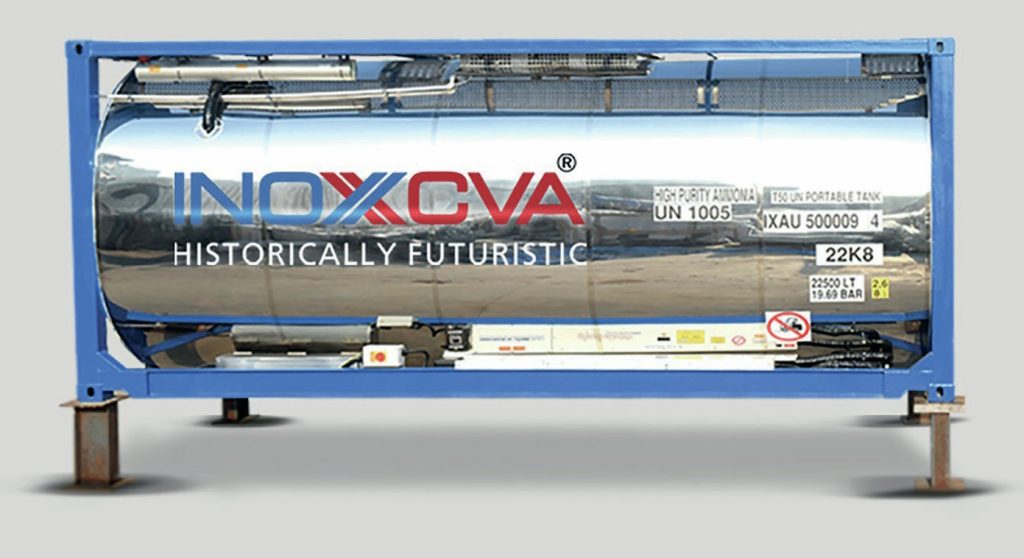
High purity ammonia ISO tank container


Cryogenic storage company INOX India Ltd has launched its first ultra-high-purity (UHP) ammonia T-50 ISO tank container. The container, designed, engineered and manufactured by INOX India is engineered to withstand high pressure levels, and complies with international standards including ASME Sec VIII, Div-1 with U-designated construction. Its core feature is a high-precision internal finish with a surface roughness below 0.3 RA, a standard extended to all piping elements with orbital-welded joints to guarantee the highest level of purity for ammonia. Insulation is via rock wool with polished stainless-steel cladding for superior thermal and acoustic protection. The tank also comes with a spring-actuated emergency shut-off mechanism, facilitating valve closing remotely.

Deepak Acharya, CEO of INOX India Limited said, “by developing India’s first UHP ammonia ISO tank container we are enabling an entire ecosystem that will accelerate semiconductor and solar panel manufacturing capabilities across the world, and reduce our dependence on imports for critical industrial equipment.”
The INOXCVA ammonia tank

Latest in Agricultural

Cherepovets hit by drone strikes; phosphate impact unclear

Multiple drone strikes have hit the industrial city of Cherepovets in Russia's Vologda Oblast region, according to Russian news agency TASS. The area contains PhosAgro's largest phosphate fertilizer production site. Cherepovets has a production capacity of around 700,000 t/a NPK and around 814,000 t/year DAP/MAP, according to CRU data, making it the largest phosphate fertilizer production site across Europe and the CIS. The site also contains several sulphuric acid plants with a combined capacity of 4.5 million t/a, making it Russia's largest production hub for the acid. This entire volume is consumed domestically.

CRU Phosphates+Potash conference focuses on sulphur

CRU’s Phosphates+Potash Expoconference was held in Paris in mid-April, with the Iran crisis uppermost in everyone’s mind. Margins are under pressure, sulphur has become a strategic constraint, and the phosphates investment pipeline is thin. CRU Principal Consultant Humphrey Knight examined the fallout from the closure of the Strait of Hormuz, noting that fertilizers have been hit harder than most bulk commodities. A large share of exportable sulphur and traded urea normally originates in, or passes through, Gulf producers. The effective closure of the strait has squeezed the traded part of these markets, where international prices are set, and pushed benchmarks up sharply. The global phosphate market is structurally tight, and the combination of Chinese export policy and Middle East logistics has pushed the traded segment into a much more fragile state.