Fertilizer International 527 Jul-Aug 2025
7 July 2025

Phosphorus recovery tech emerging at scale
SUSTAINBLE PHOSPHATE PRODUCTION
Phosphorus recovery tech emerging at scale
EasyMining’s Ash2™Phos technology recovers phosphorus from incinerated sewage sludge ash and manufactures a safe, high-grade calcium phosphate product (RevoCaP™) by eliminating contaminants. EasyMining’s Christian Kabbe provides an update on the company’s first full-scale Ash2™Phos plant in Germany.

Breaking new ground
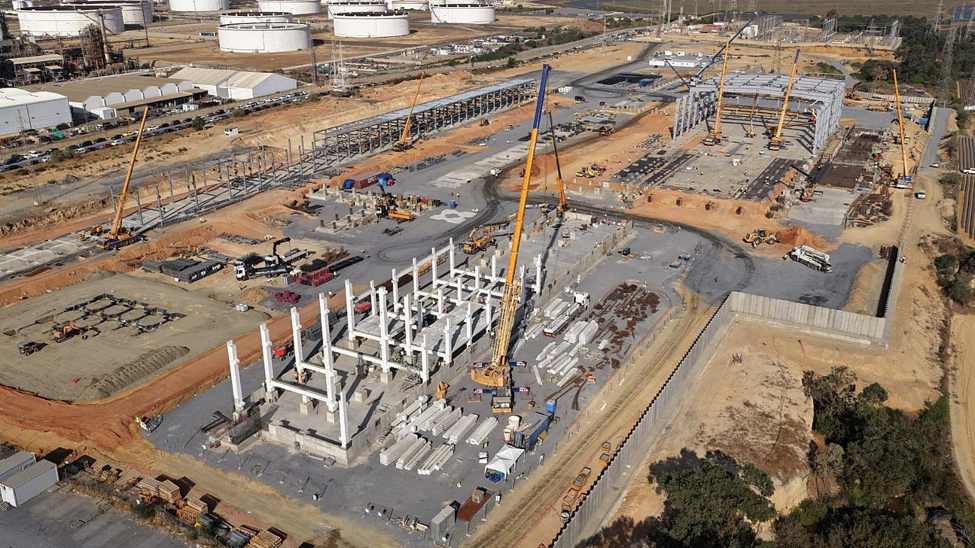
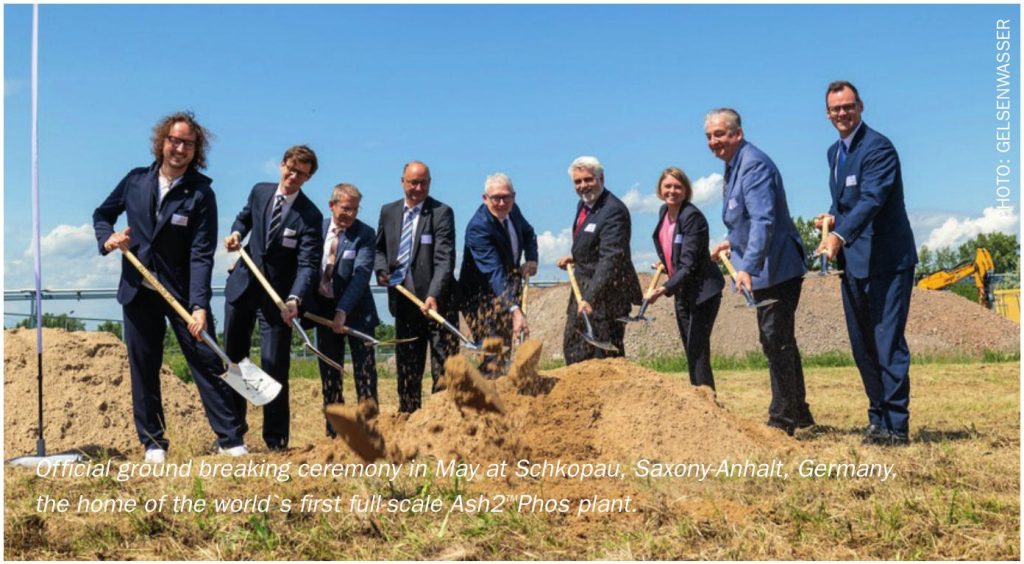
On 26th May, a sunny day in Eastern Germany and in the presence of Prof Dr Armin Willingmann, Minister for Science, Energy, Climate Protection and the Environment in Saxony-Anhalt, the ground was officially broken at the chemical industry park in Schkopau, a site set to become home to the world`s first full-scale Ash2™Phos plant.
“The innovative phosphorus recovery plant will be an example of how environmental protection and resource conservation also pay off economically,” says Willingmann. “I am delighted that Gelsenwasser and EasyMining are investing in this sustainable technology here in Saxony-Anhalt. Saxony-Anhalt can thus once again distinguish itself as an attractive business location and as a state of future technologies. As a state with a strong agricultural sector, Saxony-Anhalt will also benefit from having to import less phosphorus from abroad in the future thanks to its own recycling capacities.”
Over the next two years, Phosphorgewinnung Schkopau (PGS) GmbH is building the recovery plant, with a capacity to process 30,000 tonnes of sewage sludge ash, at the DOW ValueParks site. The plant is scheduled to become operative in 2027.
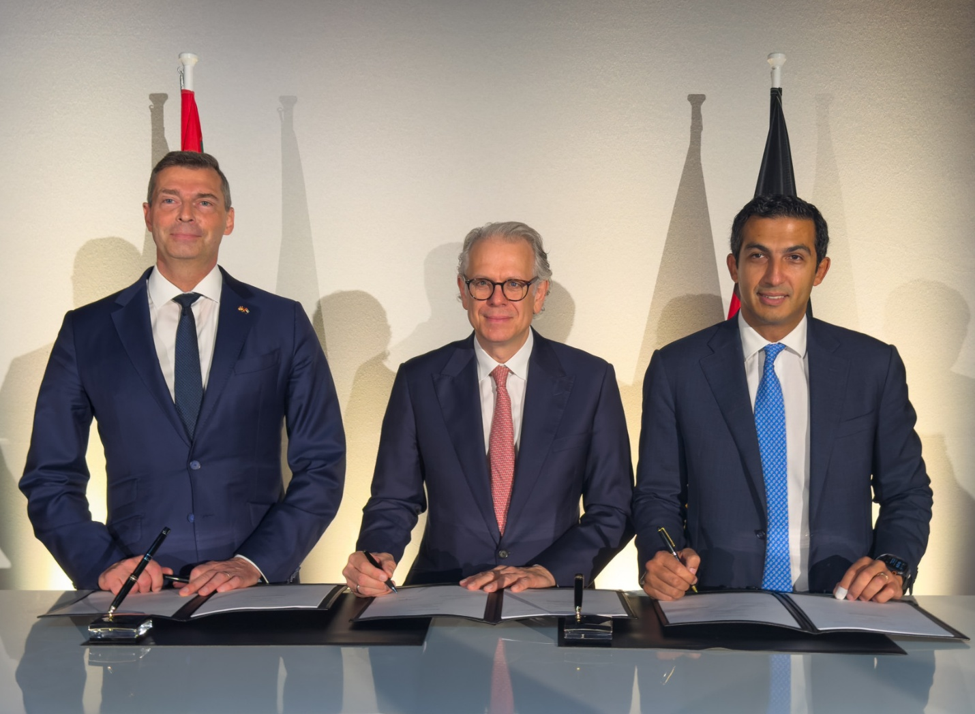
PGS is a joint venture between EasyMining, part of the Swedish environmental company Ragn-Sells, and the German infrastructure and utility company Gelsenwasser. It was founded in 2021 with the specific aim of building and commissioning the Schkopau phosphorus recovery plant. Using EasyMining’s Ash2™Phos technology, Schkopau will recover more than 90 per cent of the phosphorus from its sewage sludge ash feedstock.
The European Commission recently formally approved calcium phosphate extracted from sewage sludge ash for use in organic farming. Consequently, the main product of the Ash2™Phos plant, RevoCaP™, will help boost organic food production as well as contributing to food security in general. Even use as animal feed phosphate is possible, given the quality of the RevoCaP™, although EU legislation to allow this is still pending. Current EU regulations still focus too much on the origin of materials currently, comments EasyMining, instead of their quality.
High quality end-product and marketable co-products
The Ash2™Phos process also recovers other marketable co-products, such as iron and aluminium coagulant chemicals for reuse at wastewater treatment plants, as well as building sand. The process is also highly efficient at extracting and removing pollutants from end-products, not simply diluting or immobilising them, a fact that the process developers EasyMining are keen to emphasise.
“If we are serious about creating a sustainable society, we need to reuse the resources we have already extracted out of the Earth`s crust over and over again. This is especially true for critical raw materials, such as phosphorus,” says Lars Lindén, Managing Director of Ragn-Sells, the parent company of EasyMining.
Secure circular phosphorus supply
Phosphorus is essential for agriculture, yet Europe is almost entirely dependent on imports. In 2024, the European Union imported phosphate fertilizer and phosphate raw materials worth around 4 billion euros from non-EU countries. By recovering phosphorus from sewage sludge ash, the Schkopau plant will contribute to a circular economy and greater self-sufficiency in the EU.
INTERVIEW

Fertilizer International talks to Christian Kabbe, managing director of EasyMining Germany, about the company’s ambitions and achievements to date.
Regulatory push
German regulations mandating phosphorus recovery from sludge have been a key enabler, says Kabbe: “Without regulation, utilities wouldn’t prioritise this – there are too many competing investment demands. But once you show that plants like ours work and have a viable business case, it becomes a no-brainer.”
Phosphorus recovery goes beyond just compliance, according to Kabbe, who sees it as a resource sovereignty issue too. With phosphate rock controlled largely by a few exporting nations – and with additional pressure from its use in lithium iron phosphate (LFP) batteries – the strategic need for European phosphorus sources is becoming urgent, in his view.
“We don’t just need this for food security,” says Kabbe. “We need it for industrial independence. Without access to our own materials, we risk becoming dependent and economically vulnerable.”
Scaling up: quality, volume and reliability
A critical strength of the Ash2™Phos process, according to EasyMining, is its ability to decouple feedstock variability from product quality. Sewage sludge ash is highly heterogeneous, yet the company’s proprietary chemical separation process yields consistent, high-grade products – something that other processes and the direct application of ash have struggled to cope with due to quality fluctuations.
“We’re not just producing something that works,” says Kabbe. “We’re producing something that’s industrially relevant – at scale, with consistent specs, and aligned with existing supply chains.”
Kabbe is crystal clear about what it will take for the circular economy in phosphorus to succeed: “Quality matters. Volume matters. Reliability matters.” Without all three, resource recovery will remain a boutique solution, he suggests. Interesting, maybe, but simply not impactful enough.
Going global?
Europe remains the epicentre of phosphorus recovery, this being largely driven by conducive policy, the concentrated supply of waste streams and technical leadership. Yet Kabbe sees global potential for the technology as urbanisation intensifies and nutrient pressures mount. “As cities grow, the mismatch between nutrient production and land availability for reuse becomes more acute,” he says. “In the end, the global market will move in this direction – policy can accelerate it, but the drivers are already there.”
EasyMining’s vision for the Ash2™Phos process is more than just a clever technology, suggests Kabbe – it’s a blueprint for how resource recovery can integrate different industrial ecosystems, close critical nutrient loops, and secure Europe’s place in a materials-hungry future. For utilities, investors, and regulators, it potentially offers a triple win, in his view, by combining environmental compliance, economic value and resource security.
“We’re not trying to make a niche green product,” Kabbe concludes. “We’re trying to build a real industry.”
Germany was the first country in EU to regulate phosphorus recovery by law. From 2029, most of the country’s sewage treatment plants must recover phosphorus from sewage sludge. The plant in Schkopau will help to fulfil this legal requirement and serves as a model for large-scale nutrient recovery throughout the EU.
Henning Deters, Chairman of the Management Board of GELSENWASSER AG, says: “The establishment of clean phosphorus recycling promotes Germany’s independence from a vital raw material and leads to a high reduction of pollutants in the material cycle. By mono-incinerating sewage sludge and recovering phosphorus from the ash, we process waste from municipal wastewater treatment and strengthen water and soil protection in Germany.”
Unique technology
As highlighted in previous articles (Fertilizer International 509, p58; Fertilizer International 519, p47), Ash2™Phos technology recovers phosphorus from sewage sludge ash and manufactures a safe, high-grade calcium phosphate product (RevoCaP™) with defined quality criteria by eliminating deleterious contaminants.
EasyMining`s business ethos and model is to create value by keeping materials previously thrown away by society in circulation and reusing these as often as possible – without compromising public health or the environment. This follows the guiding vision of the Swedish parent company Ragn-Sells: “We want to be living proof, that caring for the earth and good business go hand in hand.”
For the company, it is not just about cherry picking small fractions from bigger material flows. Sewage sludge ash contains more than just P, for example, and Ash2™Phos therefore recovers the other valuable elements present by extraction and detoxification. The process, says EasyMining, closes many loops – not just one – and consequently is very effective at generating commercial-grade homogeneous products from heterogeneous, variable quality ash.
Securing critical materials
As global demand for critical raw materials intensifies, Europe faces a resource reality check. Phosphorus – an essential nutrient for agriculture and an emerging ingredient in electric battery technology – is one such material. Almost entirely imported, its supply chain is vulnerable, fragmented, and increasingly unsustainable. But buried in the ash of incinerated sewage sludge, says EasyMining, lies a domestic source of phosphorus, long overlooked and now increasingly being reclaimed.
But recovery alone is not enough, says Christian Kabbe, managing director of EasyMining Germany: “There’s no point in recovering material and ending up in a market that doesn’t exist. Volume, quality and reliability are everything.”
This principle has shaped EasyMining’s strategy from the ground up. The Schkopau plant in Germany is designed as a volume hub: sourcing sewage sludge ash from across the country during its demonstration phase, and later from regional sources as additional Ash2™Phos plants come online.
The ultimate ambition of EasyMining and Gelsenwasser is to build up total sewage sludge ash processing capacity to 300,000 t/a at Ash2™Phos plants strategically placed across Germany, these being capable of yielding about 150,000 tonnes of the main RevoCaP™ product annually. There should be a plentiful supply of raw materials available, with Germany alone predicted to generate more than 600,000 t/a of sewage sludge ash in future.
A sustainable and circular pathway
Already today, more and more European countries, especially those with large populations and high livestock densities, are pursuing the pathway of large-scale phosphorus recovery from sewage sludge ash. This should allow high volume and efficient phosphorus recovery from waste streams, which have been discarded previously or only partially recovered. Neglected until now, these secondary resources represent a valuable economic base for those countries and regions where primary phosphate resources are scarce or absent.
“For Europe – given its high dependence on mineral resources beyond its borders – there is only one economic future for survival and that is circular!,” sums up Christian Kabbe.