Fertilizer International 525 Mar-Apr 2025
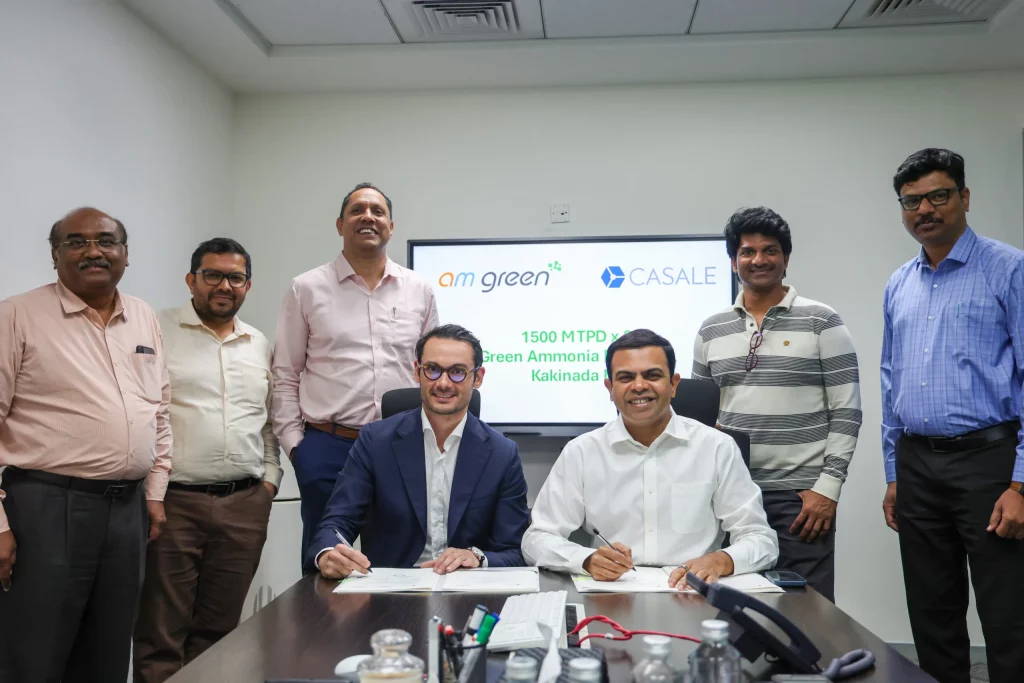
Casale to convert Kakinada complex to green ammonia


INDIA

Casale to convert Kakinada complex to green ammonia

AM Green has selected Casale as its technology partner for India’s largest under-development green ammonia complex in Kakinada, Andhra Pradesh.

Casale will convert two existing ‘grey’ ammonia plants at the complex to produce 1,500 t/d of carbon-free ammonia instead. The green ammonia project has already reached a final investment decision (FID), placing Kakinada on track to become the largest green ammonia complex in India – and possibly the world – according to Casale.

To deliver the Kakinada project, Casale is combining its extensive experience in delivering revamping projects with its innovative FLEXIGREEN® suite of low-carbon technologies. Its scope of services includes the:

• Green ammonia license

• Basic engineering package

• Review of detail engineering

• Supply of proprietary equipment.

Casale is delivering the project as part of an international consortium alongside Technip Energies and John Cockerill.

Federico Zardi, Casale’s CEO, said: “As we embark on this transformative journey with AM Green, we are immensely proud to leverage our expertise in executing revamping projects alongside our cutting-edge FLEXIGREEN® technology. This collaboration not only highlights our strong track record in revamping ammonia plants but also underscores our role as a leading partner in green ammonia technology.”

Gautam Reddy K, AM Green Ammonia’s CEO, said: “We are proud to partner with Casale on this groundbreaking project to transform our a previously fossil feedstock based grey ammonia plant into a renewable energy driven, one million tonnes per annum green ammonia complex in India – one of the largest in the world. This collaboration represents a pivotal moment not only for AM Green but also for India’s progress towards reducing energy dependence and creating a decarbonised economy.”

Latest in Asia

Coromandel starts trial operations at new acid plants

Coromandel International says that it has started trial production at its new sulphuric acid and phosphoric acid plants in Kakinada, Andhra Pradesh. The company says that this marks a crucial step towards transforming the unit into a fully integrated facility, significantly enhancing production capacity and diminishing reliance on imported raw materials for fertiliser manufacturing. The company is now focusing on a phased ramp-up. The new plants have of 2,000 t/d of sulphuric acid and 650 t/d of phosphoric acid, respectively. The integration of these acid plants is strategic, aligning with Coromandel's objective to strengthen backward integration in its fertiliser manufacturing value chain. By producing key intermediates in-house, the company aims to secure stable supplies, enhance cost efficiencies, and achieve greater self-sufficiency, thereby reducing dependence on imported raw materials. The project aims to replace over 50% of the Kakinada plant's imported acid requirements and mirror the integration levels seen at its Vizag and Ennore facilities.

Indonesian nickel shutdown to cut sulphur/acid demand

Four Chinese-operated nickel plants at the Indonesian Morowali Industrial Park have temporarily ceased operations following a fatal landslide in February, in a development that will significantly reduce regional demand for sulphur and sulphuric acid. The shutdowns affect facilities run by China’s GEM Co. and its partners, which together account for 30% of Indonesia’s high-pressure acid leaching (HPAL) capacity. The move comes amid heightened regulatory scrutiny. The largest of the four plants, PT QMB New Energy Materials, could remain offline for up to three months.

NCOC seeks arbitration over sulphur fine

The North Caspian Operating Company (NCOC), which operates the huge Kashagan oil field in Kazakhstan, has said that it is seeking international arbitration to resolve its ongoing dispute with the government of Kazakhstan. Kazakhstan has imposed a swingeing $4.6 billion fine for alleged violations of sulphur storage regulations at the NCOC site. In December, a special administrative court in Astana turned down an appeal by NCOC, although it also granted leave to appeal in a higher court. NCOC, a partnership between Shell, Eni, TotalEnergies, ExxonMobil, China National Petroleum Corporation, Inpex and Kazakh state oil and gas company KazMunayGaz, continues to maintain that its sulphur handling operations have been conducted in compliance with Kazakhstan’s laws and that it had the required permits in place.