• Skip to main content

    Nitrogen+Syngas 362 Nov-Dec 2019

    Problem No. 57: Higher moisture content in urea melt due to vacuum pressure issues


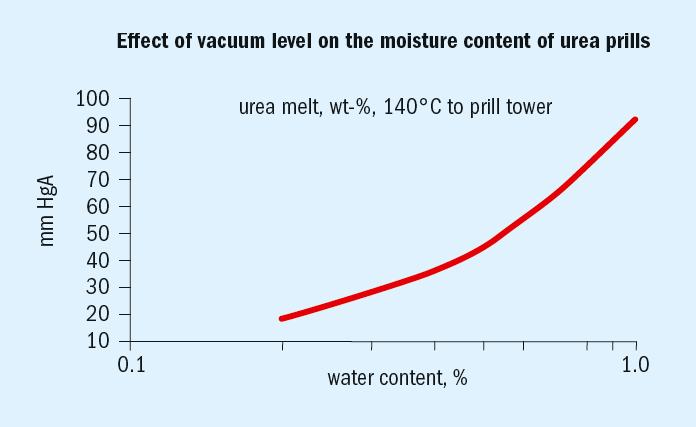
    To illustrate the direct effect of vacuum level on the moisture content of urea prills please refer to the wt-% urea melt graph for aqueous urea at 140°C. As the absolute pressure increases (lower vacuum) the urea melt declines in concentration (water content % increases). With this illustrative graph, one can quickly see the effect of suction pressure on the moisture content of the urea melt. A non-optimum vacuum pressure is one cause of high moisture content in the urea melt, but there are also other possible causes as you will read in the round table discussion below. Sharing troubleshooting cases leads to a much wider view on the possible causes and helps to solve problems more quickly.

    Latest in Technology

    Ammobia and Lummus to commercialise ammonia for low-carbon energy

    Ammobia, a developer of modular ammonia production technology, has announced an agreement with Lummus Technology to license and deploy Ammobia’s ammonia production system. Through this partnership, Ammobia’s ‘Haber-Bosch 2.0’ synloop technology is to be deployed in commercial installations worldwide and used in integrated solutions that complement Lummus’ hydrogen portfolio, including marine fuels and energy storage […]

    Partnership to develop green ammonia in Africa

    GreenGo Energy and Jiangsu Shuangliang New Energy Equipment Co., Ltd. have signed a memorandum of cooperation to jointly advance large-scale green ammonia projects in Mauritania and Namibia. The companies say that the agreement brings together GreenGo’s integrated renewable energy and Power-to-X project development experience with Shuangliang’s smart green power-to-hydrogen systems, equipment manufacturing and engineering services. […]