Plant Manager+
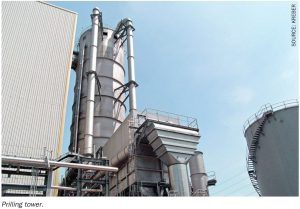
In an ideal natural draft urea prilling tower, molten droplets fall, cool air rises, and prills solidify – but what happens when airflow at the tower base is disturbed? Small adjustments can have big consequences.
Diaphragm seals are applied when pressure or level transmitters need to be protected against harsh conditions like the corrosive ammonium carbamate in urea plants. The process pressure is transmitted via the flexible diaphragm and transmission fluid to the measuring instrument as shown in Fig. 1 below.
This round table discusses the benefits of different additives as an alternative to formaldehyde to improve the quality of prills.
The following case study describes a serious incident and the consequences of erroneously mixing nitric acid with hydrochloric acid. In Part 1 we reported on the incident and the causes that led up to the event. In part 2 the impact, recommendations and lessons learned will be discussed.
The following case study describes a serious incident and the consequences of erroneously mixing nitric acid with hydrochloric acid. In Part 1 we report on the incident and the causes that led up to the event. In part 2 the impact, recommendations and lessons learned will be discussed.
Reverse rotation of an inline four-stage centrifugal CO2 compressor is an unwanted phenomenon which sometimes occurs in urea plants. Reverse rotation can lead to damage to the internals of the CO2 compressor and an expected outage. This discussion shares experiences and provides suggestion on how to avoid reverse rotation of the CO2 compressor.
UreaKnowHow.com reviews the main production options for incorporating sulphur into urea, the world's most widely applied commodity fertilizer.
Mark Brouwer of UreaKnowHow.com reviews the main production options for incorporating sulphur into urea
Green urea is urea based on green ammonia produced from renewable power via electrolysers and bio-based carbon dioxide and its colour is the same as normal urea. But in this round table discussion we discuss the possible causes for urea turning a green colour as found by the initiator of this discussion. We will learn that the colour of urea can be reddish or brownish in certain conditions where corrosion rates are high and/or oil fouling is high. But what can cause urea to turn green? n
In Part 3 of this series on stripper efficiency issues, we continue the discussion on some some of the many causes of lower stripper efficiency. Here we discuss liquid divider fouling and bad installation of liquid dividers.