Market Outlook
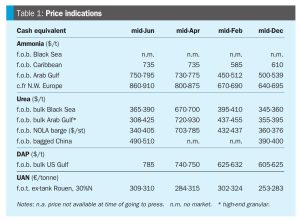
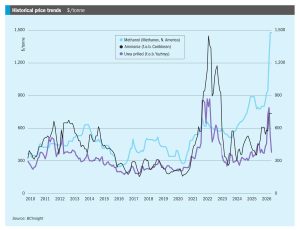
• Ammonia prices look well insulated against any declines over the immediate term, though the upside may be more limited in some regions than others.
Ammonia prices in both hemispheres had levelled out by the end of August, with the exception of a few marginal upticks in some regions on the basis of the latest supply-demand dynamics. All eyes are now on September’s Tampa settlement, which should spell out the extent of the upside pressure set to emerge over the coming weeks.
KBR says that it has been awarded a front-end engineering design (FEED) contract for the development of an ammonia and urea production plant by KAR Electrical Power Production Trading FZE (KEPPT) in Basra, Iraq. Under the terms of the contract, KBR will provide FEED for a proposed 2,300 t/d ammonia production facility and 3,850 t/d urea unit. The design will be executed using KBR’s proprietary ammonia technology.
Eurotecnica says that Zhongneng Chemical Co., Ltd., a major player in China’s nitrogen-based fertiliser sector, has selected Eurotecnica’s proprietary Euromel® melamine technology for a new world-scale facility with a nameplate capacity of 120,000 t/a.
KBR been awarded a front-end engineering design (FEED) contract by Iraq's KAR Electrical Power Production Trading (KEPPT).
Russia’s Ammoni JSC has received funding approval for the Ammonia-2 plant at its Mendeleevsk complex in Tatarstan.
Aliko Dangote, self styled “Africa’s richest man”, has signed a $2.5 billion partnership with the Ethiopian Government to build one of the world’s largest single-site fertiliser plants in Gode, Somali Regional State. The was signed on August 28th by Dangote Group and Ethiopian Investment Holdings, the government’s strategic investment arm. Under the agreement, Dangote Group will hold a controlling 60% equity share, with EIH taking the remaining 40%. EIH says that the facility will be “among the top five largest urea production complexes globally… with production facilities boasting a combined capacity of up to three million metric tons per annum.” The project will take gas feedstock via pipeline from the Calub and Hilala gas fields, with provisions for future expansions into ammonia-based fertilisers.
Casale has been awarded a contract to supply melamine technology by Anhui Haoyuan Chemical Group. The new melamine plant will feature Casale’s uLEM-N technology, with a design capacity of 60,000 t/a, and will be fully integrated into an urea plant operated by Anhui Haoyuan. This is the third project that the two companies have developed together, following the successful implementation of two 1,500 t/a ammonia synthesis loop plants based on Casale’s N-LOOP™ technology.
Suiso, a South African company specialising in blue ammonia production, is set to invest $1.7 billion in a coal-to-fertiliser facility in Kriel, Mpumalanga in the east of South Africa. The proposal is for a 1.5 million t/a ‘blue’ ammonia-urea plant which will replace South Africa’s annual imports of 1.2 million t/a of urea, as well as producing 235,000 t/a of blue methanol for fuels, using advanced decarbonisation and carbon capture technologies. Suiso is partnering with Sinopec Ningbo Engineering, Stamicarbon, and ETG – the latter will distribute Suiso’s fertilisers across Africa, supporting local agriculture and long-term food security.
The Chechen Republic’s Ministry of Industry and Trade is reportedly in discussions with Chinese company Wuhuan over the construction of a mew nitrogen fertilizer plant in the region. Wuhuan is being considered as a potential EPC contractor, with technology and design coming from Russian design agency JSC GIAP. A site in the republic’s Naursky district has been earmarked for the project, which aims to produce 1,700 t/dm of ammonia and 3,000 t/d of urea. Development and construction is expected to take five years, with plant startup currently scheduled for the first half of 2030. The total cost of the project is estimated at $2.4 billion.