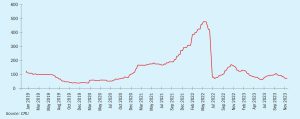
New phosphate demand – India and Brazil
The centre of gravity of the phosphate industry continues to shift, with Chinese exports less important, and fresh demand coming from India and Brazil.
Kazakhstan’s oil and condensate output increased by 7% from 1.79 million bbl/d to 1.92 million bbl/d in early June after sour gas reinjection operations resumed at the Kashagan offshore oil and gas development following a recent outage, according to the Kazkah Energy Ministry. Reinjection of sour gas into two wells resumed on 8th June, enabling operator the North Caspian Operating Company (NCOC) to boost oil and condensate production at a large artificial island in Kazakhstan’s Caspian Sea waters. Reinjection was paused on May 20th following the detection of sour gas during routine sampling and a subsequent integrity test. Kashagan normally produces about 300,000 barrels of oil per day. Kazakhstan expects Kashsgan to raise oil production this year to 18.2 million t/a from 12.7 million t/a in 2022.
The 2023 Middle East Sulphur Conference (MEScon 2023) was the biggest sulphur event in the region to date with over 650 attendees representing 23 countries from across the sour gas and sulphur value chain. More than a conference, this annual event offers conversation, collaboration and community, with leaders and experts from across the industry sharing knowledge, best practice and predictions for the future of sulphur.
Indonesian imports have increased in 2023 so far on a year earlier. As new nickel high pressure acid leach projects ramp up, demand for sulphur is expected to increase further. Swing buyers have been importing significant volumes of sulphuric acid, affecting short term sulphur demand in the second quarter. It remains to be seen if this will continue, we expect sulphur demand to ramp up further in the second half of the year, bringing import expectations for the year to around 2 million t.
ASRL discusses why sulphur tends to be friable and explores several measurements cited in many specification documents, with the purpose of focusing on several modern solid forms. In addition, the measurement of total and extraneous water is explored.
Market Insight courtesy of Argus Media. Urea: Scarcity continued to drive urea prices higher in some markets at the end of April. The US market remains short on urea and prices spiked to reflect this. Nola barges for April were trading as high as $450/st f.o.b. ($490/t cfr), 55 percent up on this year’s low point. Southeast Asia remains short on urea too, amid planned and unplanned turnarounds, with one cargo trading at around $345/t f.o.b.
Bedeschi has been awarded a contract by Tecnicas Reunidas and Wison Engineering for the engineering and supply of new sulphur-handling equipment. Tecnicas Reunidas and Wison Engineering are working in a 70-30 joint venture partnership on the North Field Expansion Project (NFXP) Sulphur Project, which forms part of the overall Qatar North Field Expansion Project. Last year were awarded a $600 million contract to process and export sulphur from the projected expansion of the liquefied natural gas (LNG) facilities in Ras Laffan Industrial City. The new sulphur plant will have the capacity to process an average of 5,000 t/d of molten sulphur.
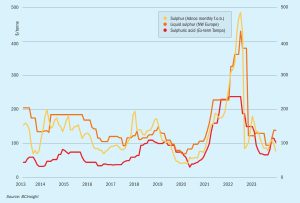
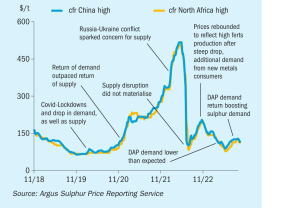
Meena Chauhan , Head of Sulphur and Sulphuric Acid Research, Argus Media, assesses price trends and the market outlook for sulphur.
Sulphur production continues to expand in the Middle East and China both from new refineries and major sour gas projects.
The Sulphur Institute (TSI) held its World Sulphur Symposium in Edinburgh from April 25th to 27th.