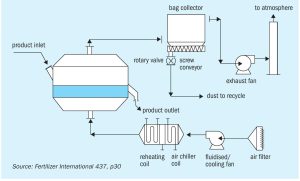
The importance of cooling equipment
Plant operators require effective and efficient equipment for cooling the solid materials generated during fertilizer production. The main options include fluid bed coolers, rotary coolers and bulk flow coolers.

Plant operators require effective and efficient equipment for cooling the solid materials generated during fertilizer production. The main options include fluid bed coolers, rotary coolers and bulk flow coolers.
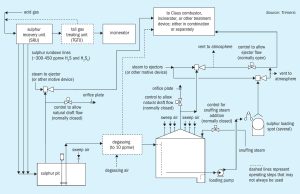
Fires are known to occur in sulphur storage pits and tanks somewhat frequently due to the presence of both flammable material and air, so methods for preventing and extinguishing these fires are critical. D. J. Sachde, K. E. McIntush, C. M. Beitler, and D. L. Mamrosh of Trimeric Corporation review fire suppression methods used in the industry including snuffing/sealing steam, rapid sealing, water mist, and inert gas blanketing. Protective tank design features to reduce the likelihood of a sulphur fire are also reviewed. Benefits and limitations, design considerations, and recommended guidance for suppression and preventative measures are discussed.

Fertilizer coatings play an integral role in minimising the degradation of fertilizers during transport, handling and storage. Increasingly, customers also want to know if the coatings they buy are sustainable too. But what exactly is a sustainable fertilizer coating – and how can its sustainability be properly defined and measured? Lucas Moore , director of coatings technology at Arkema-ArrMaz, weighs up these thorny questions and provides some clear-cut answers.
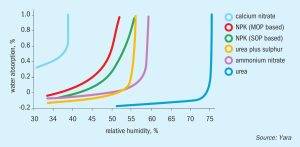
The quality of finished fertilizers can be maintained during transport, handling and storage by protecting the surfaces of granules and prills with coating agents. We survey the range of anti-caking, water repellent and anti-dusting additives currently on the market.

The degradation of fertilizer granules during handling and storage can be economically-costly and therefore needs to be avoided. Preventing unwanted caking and dust formation requires tailor-made coatings, as Kim ten Wolde, product manager at Holland Novochem, explains.

Every five years since 1955, the Chinese government has prepared its ‘Five Year Plan’ for the country’s economy over the coming half decade. This year, the 14th Five Year Plan is being drafted, and given the influence of the Chinese economy over the global chemical sector, its conclusions will be eagerly awaited.
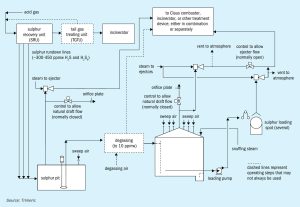
Undegassed molten sulphur can contain several hundred ppmw H2 S. If the headspace in the storage tank is stagnant, the H2 S can accumulate in the vapour space above undegassed liquid sulphur to dangerous levels. Sweeping and blanketing systems are commonly applied to manage the explosion risk in the headspace of molten sulphur storage tanks. D. J. Sachde , C. M. Beitler , K. E. McIntush , and K. S. Fisher of Trimeric Corporation review these approaches, outlining the benefits and limitations, design considerations, and industry experience/guidance for each approach. Calculation methods for natural draft flow of sweep air are also presented.
It’ s not a very worthy thought, I’m afraid, but I must admit it was my first reaction on seeing the terrible pictures from Beirut on August 4th. The explosion that ripped through the centre of the historic and much troubled Mediterranean city was captured from many different smartphone cameras, and watching the expanding vapour cloud from the supersonic shockwave, and witnessing the sheer size of the explosion, it seemed immediately evident to me that it had to be a high explosive responsible, not the fireworks that could be glimpsed sparkling beforehand in the smoke from the burning warehouse. The rising cloud of orange-brown nitrogen dioxide that followed the blast was the clincher – it looked like it was ammonium nitrate yet again.

In a few short years Abu Dhabi has grown to become the world’s largest sulphur producer and exporter, and new sour gas projects will lead to additional sulphur recovery capacity, provided they can overcome economic challenges.
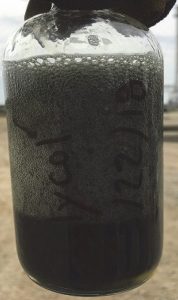
Although amine solution foaming problems have been studied and reported extensively, direct correlations about the root causes of foaming have not been completely established. This article approaches the problems of foaming from a different perspective, rather than theoretical discussions, the topic is centred exclusively on Amine Experts’ field-related experiences with amine foaming episodes.