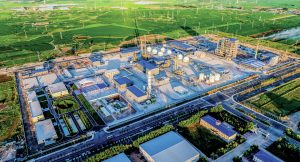
Middle East sulphur
The Middle East remains the world’s largest regional exporter of sulphur, with additional capacity continuing to come from both refineries and particularly sour gas processing.
Kazakh state gas company QazaqGaz says that work is progressing well and on schedule on the 1 billion m3 expansion project at the Kashagan Gas Processing Plant. A recent site report says that seven absorption columns have been installed at the sulphur treatment unit (each weighing between 50-170 tonnes); three sections of the smokestack have been installed at the sulphur recovery block, along with storage tanks and pumps for the heat carrier, instrumentation air, and nitrogen supply units; and a total of 2,177 t of process equipment has been installed. Welding works for tank assembly are ongoing, and over 12,000 meters of underground piping have been laid, and more than 38,000 cubic meters of concrete have been poured.
President Yoweri Kaguta Museveni of Uganda has overseen the signing of signed an implementation agreement for the Uganda Refinery between the Ministry of Energy and Mineral Development, the Uganda National Oil Company (UNOC) and joint venture partner Alpha MBM Investments. Alpha MBM is a UAE-based company led by Sheikh Mohammed bin Maktoum bin Juma Al Maktoum, a member of the Dubai Royal Family. The agreement paves way for the design, construction and operation of the 60,000 bbl/d refinery to be undertaken at Kabaale. Construction is expected to take three years, with UNOC and Alpha MBM Investments as the project partners. The refinery, which will be East Africa’s first major crude processing plant, aims to reduce Uganda’s dependency on imported petroleum products and is expected to meet the local and regional demand for petroleum products.
Avenira has secured an A$7.56 million strategic investment from majority shareholder Hebang Biotechnology to progress its Wonarah phosphate project in Northern Territory. The investment, in which Hebang will acquire 1.08 billion shares priced at A$0.007 each, will boost its equity holding in Avenira to 49%. Hebang has also agreed to provide Avenira with an unsecured drawdown loan facility to be repaid on completion of the placement or after the date of the first drawdown.
Spanish company Ignis has decided to pause work on the renewable energy generation projects it had planned in Chile’s Magallanes region. In a press statement, Ignis said that: “even though we firmly believe that this industry will develop and mature, the company is considering a longer time frame than initially planned and a reduction in the project to adapt it to this new reality.” The company was developing a wind farm to supply the green ammonia plant with hydrogen, but reportedly found the process of leasing the land area to build the turbines slower and more difficult than it had hoped.
Hy2gen says that it has submitted its Courant renewable ammonia project to Quebec’s Minister of the Environment, marking the end of the planning stage. The Ministry will now define an impact study that Hy2gen must carry out to ensure that the project meets safety and environmental impact requirements. Project Courant aims to produce 230,000 t/a of low carbon ammonia for the local mining industry and region around Baie-Comeau, Quebec, using 300 MW of electrolyser capacity to generate renewable hydrogen in what Hy2gen says will be one of the largest renewable ammonia projects in North America. The plant is due to become operational in 2030.
The Port of Açu and renewable fuels company Sempen have signed a contract to reserve an area in the low-carbon hydrogen hub at the port, in the north of the state of Rio de Janeiro, for the construction of a green ammonia plant. The projected facility would have a production capacity of 1 million t/a of green ammonia. A final investment decision (FID) is expected for 2027-2028, with production of the first green ammonia beginning in 2030.
Clariant says that its MegaMax 900 methanol synthesis catalyst has been used in the successful startup of European Energy’s green methanol plant at Kasso, Denmark. The facility uses biogenic CO2 and green hydrogen to produce up to 42,000 t/a of green methanol. Clariant’s Applied Catalyst Technology (ACT) technical service team provided on-site support throughout the startup procedure, overseeing the catalyst loading, reduction, and startup. Clariant says that the catalyst is operating with excellent activity and stability despite the challenging conditions of CO2 -to-methanol conversion.
ATOME says that it has signed a $465 million fixed-price, lump-sum engineering, procurement and construction contract with Casale for its 260,000 t/a green fertiliser plant at Villeta, Paraguay. ATOME believes that this is the first dedicated green fertiliser facility of this scale worldwide. The plant will use 100% renewable baseload power to generate hydrogen for ammonia to supply low carbon fertilizer for the Mercosur region. The project timeline is 38 months, with start-up and first ammonia production expected in 2028. Casale joins Yara, Hy24, AECOM, Natixis, IDB Invest and ANDE as partners to the project. In March ATOME signed non-binding heads of terms with Hy24’s managed Clean H2 Infra Fund for an up to $115 million investment in the project. A full definitive equity agreement is expected in Q2 2025, with final investment decision and full financial closure targeted by the end of the quarter. The full terms envisage a total funding for the project of approximately $625 million which includes not only the cost of construction but also financing, interest, transaction and supervision costs during the build period, with at least 60% coming from debt finance with the balance represented by project equity. ATOME says that negotiations on the definitive full offtake agreement with Yara International are “proceeding well”, with senior Yara representatives having had a successful visit to Paraguay at the end of January. It is anticipated that the definitive agreement will be signed by early Q2 2025, subject to necessary approvals.
Tecnicas Reunidas and Siemens Energy have been awarded the contract to carry out front-end engineering design (FEED) for a major green methanol project in La Robla, Spain. The consortium will work on the project for Spanish developer Reolum, part of a partnership that says it is building the largest green methanol plant in Europe. The La Robla Nueva Energia facility will combine biogenic CO2 from a co-located biomass-based cogeneration plant with green hydrogen to produce 140,000 t/a of low carbon methanol. Tecnicas Reunidas will focus on the biogenic carbon capture and methanol production units, while Siemens Energy will handle the renewable hydrogen unit. Johnson Matthey has been selected to supply its eMERALD methanol technology, while Mitsubishi Heavy Industries will license it CO2 capture technology for the project.