
The Atlantic just widened
T he high-price environment for fertilizers and other commodities, including natural gas, is having very different consequences globally.

T he high-price environment for fertilizers and other commodities, including natural gas, is having very different consequences globally.
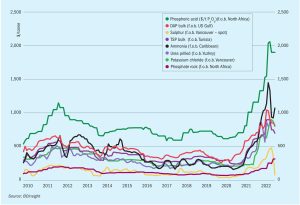
Market Insight courtesy of Argus Media
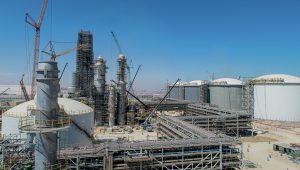
Saudi Arabia’s Ras Al-Khair Industrial City has signed an industrial land agreement with local firm Gulf Copper to develop a copper smelting and casting plant at an investment $319.30 million. The project would be developed on a plot spanning more than 250,000 square metres in the industrial city. No construction timelines were given. The Saudi government has previously signed agreements with Trafigura and Saudi-based Modern Mineral Holding to develop a 400,000 t/a copper smelter at Ras Al Khair which would also include 200,000 t/a of zinc and 55,000 t/a of lead smelter capacity at a projected cost of $2.8 billion.
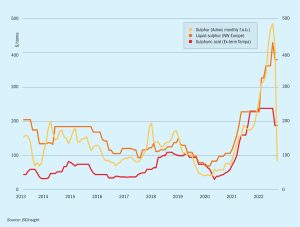
Reduced appetite for sulphur from processed phosphates producers in China will continue to place downwards pressure on pricing in the near term. l Phosphates-based demand is likely to remain low in the second half of 2022 as issues surrounding affordability persist, slowing import requirements.
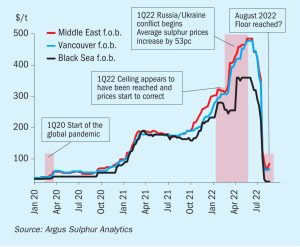
Meena Chauhan, Head of Sulphur and Sulphuric Acid Research, Argus Media, assesses price trends and the market outlook for sulphur.

In increasingly volatile times for commodity markets, companies up and down the fertilizer supply chain are being left financially exposed to price fluctuations. Alison Coughlin and Tom Crane of CME Group explain how derivatives allow fertilizer market participants to protect themselves from the risk of adverse price movements.

Market Insight courtesy of Argus Media
The past couple of years have been quite the wild ride, with major global events dominating markets outside of the usual concerns of broad market supply and demand. It seems like a long time ago now, but this time last year, the price of a barrel of Brent crude was about $75. Go back two years, in the wake of the onset of covid restrictions, and that barrel would have cost you $40 (and just $25 a couple of months before that). In the wake of Russia’s attack on Ukraine, you could easily have paid $130, and it has been hovering around $110/bbl for the past few months. The last time oil spent any time at that level was in 2014, just before the Chinese economy ran out of steam and prices slumped by 70%.
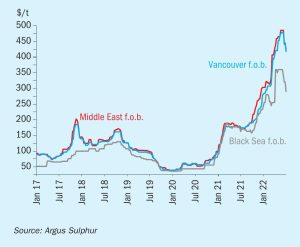
Meena Chauhan , Head of Sulphur and Sulphuric Acid Research, Argus Media, assesses price trends and the market outlook for sulphur.
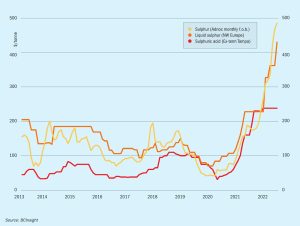
The ongoing recovery from Covid-19 has led to an uptick of sulphur from refineries in regions including the US compared with a year ago. As travel around the global improves, increasing fuel demand points to higher operating rates and improved sulphur recovery.