Syngas project listing 2020
A round-up of current and proposed projects involving non-nitrogen synthesis gas derivatives, including methanol, hydrogen, synthetic/substitute natural gas (SNG) and gas- and coal to liquids (GTL/CTL) plants.
Air Products and Haldor Topsoe have signed a global alliance agreement. Under the terms of the agreement the two companies will use their combined market network for developing potential projects and the combination of their expertise on large-scale ammonia, methanol and/or dimethyl ether (DME) plants to be developed and built globally. It gives Air Products access to Topsoe’s technology licenses and the supply of engineering design, equipment, high-performance catalysts and technical services for ammonia, methanol and DME plants that are built, owned and operated by Air Products. It also allows for the integration of Topsoe’s technology into many Air Products’ technologies including gasification of various feedstocks, and synthesis gas processes.
Process gas boilers with an internal bypass system are an important type of shell-and-tube heat exchanger installed in steam methane reforming units. For decades, two traditional designs have dominated the market: the “hot” and “cold” bypass process gas boiler. Today, a third option based on a new design concept is available: the “bayonet” bypass process gas boiler, with process and mechanical features that can provide superior performance, lower opex and improved reliability. G. Manenti of Alfa Laval Olmi SpA discusses the design and operating principles of the different designs.
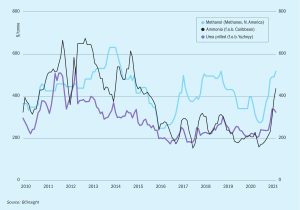
Prices remain at low levels, in part because of oversupply due to new plant start-ups. However, there has also been a contraction in demand, especially for technical ammonia – industrial markets for ammonia in China and East Asia have been badly affected.
Haldor Topsoe has launched a new methanol synthesis catalyst, MK-181 PRIME, based on new technology developed via close study of copper-zinc interactions on the catalyst surface.
The impact of coronavirus on both supply and demand continues to provide considerable uncertainty to the market. Industrial demand seems to have been worst affected, and fertilizer related demand has largely kept up, although shutdowns in India’s ammonium phosphate sector have also affected demand. Spring is traditionally the strongest time for fertilizer demand, and this has helped support prices at least in the short term.
Methanex has said that, in light of the uncertainty in the global economy from the Covid-19 pandemic, it will defer approximately $500 million of previously announced capital spending on its $1.4 billion Geismar 3 methanol project for up to 18 months. Geismar 3, which is intended to eventually produce 1.8 million t/a of methanol, will be placed on temporary “care and maintenance” for up to 18 months, enabling the company to complete the project when market conditions improve. Methanex says it will spend $100 million in Q1 2020 and a further $200 million from April 1, 2020 to September 30, 2021 on the project, the majority of which is spending that occurred or was committed during Q1 2020. This is approximately $500 million lower than the $800 million that was expected to be spent over that same period. Construction activity and procurement of non-critical equipment and bulk materials will be suspended until market conditions allow the Geismar 3 project to restart.
Olefins production from methanol, particularly in China, has come to dominate the methanol market over the past few years. However, environmental and market concerns complicate the outlook there.
The devastating effects of the Covid-19 pandemic continue to be felt around the world. At time of writing, nearly 4 million cases have been recorded, and at least a quarter of a million people have died, with the suspicion of many more, either from accidental or deliberate undercounting. Figures for excess deaths above a normal seasonal baseline show that places such as Turkey, Ecuador and Indonesia have probably been far worse affected than the official statistics show. There are nevertheless finally hopeful signs that Europe, so far the worst affected region, is beginning to follow the pattern of East Asia and Oceania and that cases are falling. The infection also seems to have peaked in North America, though in the US there is a long tail of infections. Elsewhere, cases are still rising in countries such as Brazil and Mexico.
The UK’s Department for Business, Energy and Industrial Strategy has awarded £28 million ($36 million) of government funding to five demonstration projects for low carbon hydrogen production, as part of a larger stimulus package to cut industrial carbon emissions. The projects targeted for funding include: