
Latin America, a regional powerhouse
Latin America has confirmed its status as a pre-eminent global marketplace for fertilizers. We report on demand growth and fertilizer supply and capacity developments within this diverse region.

Latin America has confirmed its status as a pre-eminent global marketplace for fertilizers. We report on demand growth and fertilizer supply and capacity developments within this diverse region.
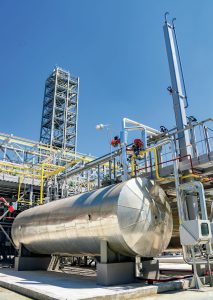
A few years ago DME production from methanol gave a major boost to world methanol demand, with DME being used as a blendstock for LPG. However, demand plateaued and DME has not had the takeoff that its proponents feel it should have. Could new renewable DME processes give it the boost it needs?

The global market for potassium sulphate is on the rise. It has become the preferred potassium fertilizer for many chloride-sensitive, high-value cash crops. This speciality potash product also commands a price premium.

The two agricultural products most strongly associated with the economies of Southeast Asia are the food staple rice and export commodity palm oil. We explore the link between the region’s agricultural productivity and its fertilizer consumption.

In a few short years Abu Dhabi has grown to become the world’s largest sulphur producer and exporter, and new sour gas projects will lead to additional sulphur recovery capacity, provided they can overcome economic challenges.

Reg Adams of pigments and titanium dioxide consultancy Artikol reviews the demand for sulphuric acid in the manufacture of TiO2 , and the prospects for consumption over the next few years.
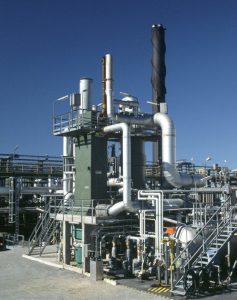
Haldor Topsoe and Comprimo® have announced a global strategic alliance to jointly license the TopClaus sulphur removal and recovery technology. TopClaus combines Topsoe’s energy efficient wet sulphuric acid (WSA) process with the industry-standard Claus process, enabling plant operators to handle acid gases and achieve sulphur removal efficiencies of above 99.9%. The Claus part of the unit recovers elemental sulphur from acid gases, and the tail gases from the Claus unit are then treated in the WSA unit, where the remaining sulphur compounds are converted into sulphuric acid.
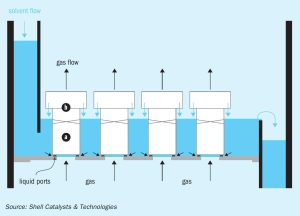
G. Bowerbank and W. Blas of Shell Catalysts & Technologies discuss low cost strategies to maximise value at existing gas processing facilities. Changing solvents, introducing advanced column internals or a combination of both are relatively simple and cost-effective options for boosting production or revenue with minimal investment.
Do you remember Peak Oil? This was the theory, driven by research originally conducted by petroleum geologist M.K. Hubbert in the 1950s, that oil production inevitably followed a bell curve, with supply eventually peaking as easier reserves were exhausted, leading to an inflexion point in production and a long tailing off. Originally Hubbert was talking solely about US oil production, and he seemed to have been borne out by the evidence. But a lack of discoveries of new large fields in the 1990s led to a revision of the theory that predicted a global production peak in 2005-6, potentially leading to rapidly rising oil prices until demand destruction occurred.
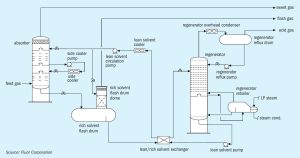
Fluor’s case study of recently constructed ultra-sour gas treating facilities provides new information about the operation of DGA-based AGRUs. B. Lynch and C. Graham of Fluor Corporation discuss how using this knowledge and leveraging the recent improvements to process simulators in the gas sweetening space, Fluor has developed an efficient, flexible, and cost effective solution in the two-stage absorption process to maximise mercaptan removal from ultra-sour gases with minimal equipment.