Sulphur and the aviation industry
A move towards so-called ‘sustainable aviation fuels’ (SAF) could see refineries having to recast their operations. What might this mean for sulphur production?
Meena Chauhan, Head of Sulphur and Sulphuric Acid Research, Argus Media, assesses price trends and the market outlook for sulphur.
Global demand for rare earth metals is increasing, particularly for electric vehicle batteries and renewable energy devices, potentially leading to increased use of sulphuric acid in their extraction.
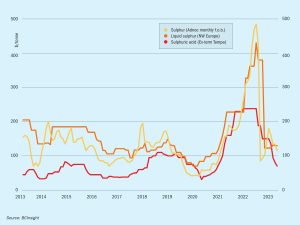
Sulphur markets suffered a correction in July-August that was more of a collapse; from $500/t to less than $100/t. Though it seems to have been something of an over-correction, and prices have moved back up since then, it is one of the most extreme price swings that sulphur has ever seen, comparable to the peak and precipitous fall in 2008. Indeed, at a time when commodity prices of all kinds have seen extremely high levels of volatility, sulphur has been more volatile still than just about all of them.
Saudi Aramco has confirmed a phased development approach for its $100 billion-plus Jafurah unconventional onshore gas project, which is expected to produce up to 2 billion cubic feet per day of gas by 2030, raising the company’s overall gas production capacity by 50% over that time frame. Aramco says that the first development phase for the Jafurah gas plant is likely to come on stream by 2025, and it is progressing with the phased development of a project that will reach a raw gas processing capacity of 3.1 bcf/d.
H.J. Baker’s chief operating officer (COO) Luis Masroua has become president of the company.
Inshan S. Mohammed of Sulfur Recovery Engineering shares lessons learned from a recent SRU shutdown assistance programme involving an error with the tags used within the BMS system installed on a direct-fired reheater.
T he end of August saw a paper published in the Journal of the Royal Geographical Society by Dr Mark Maslin of University College London. Widely reported, it looked at the prospects for sulphur production in an era of declining fossil fuel use, concluding that there could be “a shortfall in the annual supply of sulphuric acid of between 100 and 320 million tonnes by 2040, depending on how quickly decarbonisation occurs”. It added that “unless action is taken to reduce the need for sulphuric acid, a massive increase in environmentally damaging mining will be required to fulfil this resource demand.”
A large portion of the oil reserves of Canada and Venezuela exist as oil sands. By the mid-2000s, production from these sources had topped 5.5 million bbl/d. But with Venezuela’s economic implosion and increasing environmental scrutiny of oil sands production, what is the future for this high sulphur fuel source?
Marco van Son and Frank Bela of Comprimo share lessons learned from SRU war stories, including: inadvertent NH3 destruction in an oxidising atmosphere, rich amine emulsion, SWS fixed valve trays, H2 spiking of SRU feed, rich amine flash drum early warning, V-ball fuel gas safety shutoff valves, TGTU methyl mercaptan, and commissioning and Murphy’s Law.