

Edition Tag: Nitrogen Syngas 2025-09-30
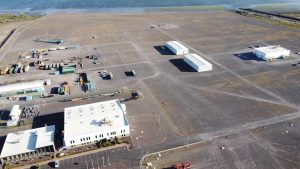
South America’s nitrogen industry
South America has become the largest importing region for nitrogen fertilizers, with Brazil overtaking India as the world’s largest urea importer. While there have been attempts to use local gas to develop a domestic nitrogen industry, these have faced challenges on a number of fronts.
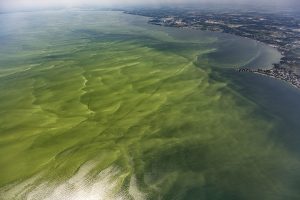
Nitrate wastes as a source of ammonia
The past few years have seen a rapid increase in attempts to generate ammonia from streams of nitrate polluted wastewater, but how practical are these methods?
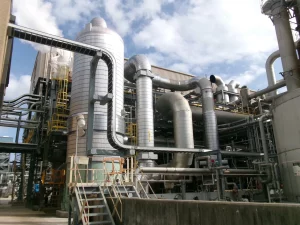
Demand for nitric acid
Nitric acid demand continues to be dominated by fertilizer uses via various nitrate and NPK fertilizers, but industrial chemical production, metallurgical uses and explosives production are continuing to contribute to growth, especially in Asia.
Is the world ready for CBAM?
At the end of this year, the European Union’s Carbon Border Adjustment Mechanism (CBAM) will move from its transitional phase into its ‘definitive’ phase, whereby the carbon costs of goods entering the EU will need to be priced in. CBAM requires suppliers to calculate the carbon emissions of their fertilizer (and other, e.g. steel) products, including indirect emissions, for example from electricity consumed in the process, and emissions of precursor or raw materials. They will then need to purchase CBAM certificates to cover embedded emissions above the established free allowance benchmark rates determined by the European Commission: 1.57 tonnes CO2e/tonne ammonia and 0.23 tCO2e/t nitric acid.
People
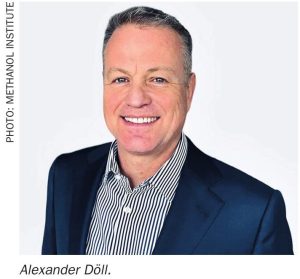
The Methanol Institute (MI) has appointed Alexander Döll as its new Chief Executive Officer. He succeeds Greg Dolan , who is retiring after nearly 30 years of service and leadership. Döll brings more than 25 years of international experience across the energy, chemicals, and sustainability sectors. He has held senior positions at leading companies such as Dow and OCI Global, with a strong focus on public affairs, policy, and commercial strategy. His career spans Europe, the United States, the Middle East, Africa, and Southeast Asia; regions that are key to the future of the methanol industry. Before this appointment, he served as MI’s Chief Operating Officer, helping to guide the organisation during a period of significant growth and momentum.
Market Outlook
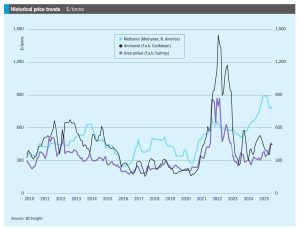
• Ammonia prices look well insulated against any declines over the immediate term, though the upside may be more limited in some regions than others.
Price Trends
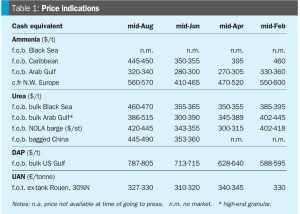
Ammonia prices in both hemispheres had levelled out by the end of August, with the exception of a few marginal upticks in some regions on the basis of the latest supply-demand dynamics. All eyes are now on September’s Tampa settlement, which should spell out the extent of the upside pressure set to emerge over the coming weeks.

Agreement for ancillary works on blue methanol plant
Transition Industries LLC has signed a heads of agreement with Italian contractor Bonatti SpA to deliver key infrastructure for the Pacifico Mexinol green methanol project in Sinaloa. Under the agreement, which includes a fixed lump-sum price, Bonatti will handle detailed engineering, procurement, construction, pre-commissioning, commissioning and startup for upgrades to the Terminal Transoceánica de Topolobampo port facilities. The work will cover methanol loading operations for export, underground transfer pipelines, vapor recovery systems, and dual fiber optic cables linking the main plant to the port. Bonatti may also build a closed-loop water pipeline to recycle municipal wastewater for plant operations, avoiding freshwater use and reducing environmental impact.

BASF and Yara end low carbon ammonia project
BASF and Yara International ASA say that they have jointly decided to discontinue their project to develop a 1.4 million t/a low-carbon ammonia production facility with carbon capture and storage in the US Gulf Coast region. The companies say that this decision reflects their “commitment to focus on initiatives with the highest potential to achieve their respective value creation goals.” Yara will continue its ammonia strategy as previously communicated, evaluating and maturing equity investment opportunities in US ammonia to determine the optimal project portfolio.