Category: Technology

Lowering CO2 emissions with EARTH® technology

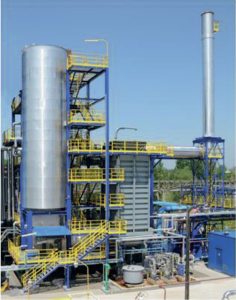
TechnipFMC’s EARTH ® technology, with its structured catalyst jointly developed by TechnipFMC and Clariant, has been proven to be a cost effective way to drastically improve productivity and energy efficiency of the steam reforming process, while reducing the CO 2 footprint per unit hydrogen and syngas product. The technology can be applied in projects to increase the capacity of ammonia and methanol plants and allows significant reduction of greenhouse gas emissions. S. Walspurger of Technip Benelux B.V. and S. Gebert of Clariant GmbH report on the EARTH ® technology and its applications.

Sulphur dust control through suppression

Fugitive dust emissions during the handling and storage of formed sulphur can result in negative environmental impacts and under specific conditions result in an explosion hazard. Enersul has developed a dust suppression system specifically targeted at controlling sulphur dust particles. The Enersul SafeFoam Transfer System (STS) reduces sulphur fines at critical transfer points throughout any sulphur handling system, resulting in a significantly safer and more environmentally friendly sulphur handling system.

Super selective hydrogen sulphide removal

The removal of hydrogen sulphide (H2 S) has become increasingly important as the oil and gas industry moves towards more efficient and sustainable production of lower emission clean fuels. BASF and ExxonMobil* have jointly developed a proprietary amine, OASE® sulfexx™ , to help refiners and gas processors achieve sulphur removal targets while reducing their carbon footprint via lower energy consumption. This new solvent technology is suitable for low and high pressure applications and shows superior performance characteristics over generic and promoted MDEA formulations, as well as sterically hindered amines such as FLEXSORB™ SE and SE Plus.

Reducing the CO2 intensity of hydrogen production

There is an urgent need to limit the rise in global temperatures to avoid severe environmental and societal impact. This can be expressed as a target to achieve net zero carbon emissions by 2050. The provision of decarbonised hydrogen at scale is an essential step in helping to achieve net zero. Johnson Matthey’s Low Carbon Hydrogen (LCH) technology permits the needs of scale and urgency to be met. J. Pach of Johnson Matthey presents a serious response to a serious threat.

Impact of heat recovery arrangement on package reliability

Dr M. Olbricht and Dr J. Weidenfeller of Schmidtsche Schack | ARVOS (SCS) discuss the impact of the heat recovery equipment arrangement in an ammonia plant downstream of the secondary reformer on reliable boiler operation. A detailed investigation was performed by SCS in response to an operator experiencing difficulties in maintaining water quality in this critical equipment. Water quality has a crucial impact on the lifetime and reliability of the equipment.

Hydrogen for fuel cell vehicles and stationary power

As the world focuses on clean fuels for the 21st century, there is an emerging opportunity to use ammonia as a source of hydrogen. Hydrogen fuel cells are expected to play a significant role as part of a clean energy portfolio. T2M Global and its development partner, SAFCell, are collaborating to develop a modular system to produce hydrogen from ammonia using a novel solid state separation system that does not require pressure or solvents. P. Patel of T2M Global, C. Chisholm of SAFCell and V. Pattabathula of Incitec Pivot explain the challenges, the opportunities and the current status of this new technology.