Market Outlook
New supply-side capacity additions in 2023 will increase export availability from the Middle East. Projects have already been ramping up in Qatar, Saudi Arabia and Kuwait.

New supply-side capacity additions in 2023 will increase export availability from the Middle East. Projects have already been ramping up in Qatar, Saudi Arabia and Kuwait.

Daniel R. Egger of Sulzer Chemtech Ltd discusses mist elimination challenges in strong sulphuric acid applications and presents the unique Sulzer KnitMesh XCOAT™ mist eliminator as an ideal solution for corrosive services such as in sulphuric acid drying towers.

Sulphur is a relatively safe and inert solid. However, it has a number of unique physical and chemical properties which can give rise to hazards, particularly during transport and handling.
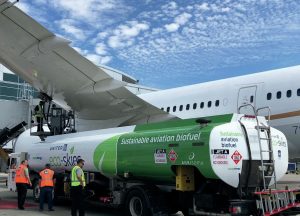
A move towards so-called ‘sustainable aviation fuels’ (SAF) could see refineries having to recast their operations. What might this mean for sulphur production?
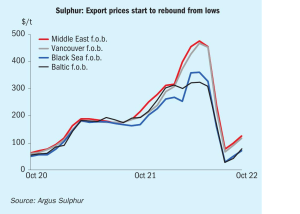
Meena Chauhan, Head of Sulphur and Sulphuric Acid Research, Argus Media, assesses price trends and the market outlook for sulphur.
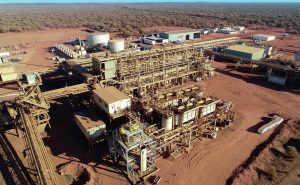
Global demand for rare earth metals is increasing, particularly for electric vehicle batteries and renewable energy devices, potentially leading to increased use of sulphuric acid in their extraction.
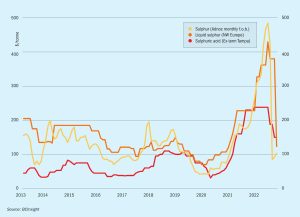
Sulphur markets suffered a correction in July-August that was more of a collapse; from $500/t to less than $100/t. Though it seems to have been something of an over-correction, and prices have moved back up since then, it is one of the most extreme price swings that sulphur has ever seen, comparable to the peak and precipitous fall in 2008. Indeed, at a time when commodity prices of all kinds have seen extremely high levels of volatility, sulphur has been more volatile still than just about all of them.

Market Insight courtesy of Argus Media

Fertilizers are always political to some extent, sitting as they do at the intersection of key commodities such as oil and gas on the one hand and food on the other. Markets for major nitrogen derivatives have often been distorted by political decisions to achieve self-sufficiency in fertilizer production, such as in, e.g. China or India. But over the past couple of months ammonia has found itself particularly in the political spotlight, in the context of the ongoing conflict in Ukraine, which continues to shape and indeed re-shape global commodity markets.
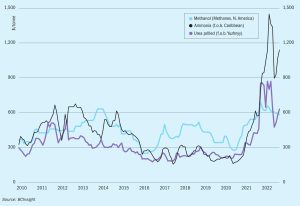
The ammonia market appears to be oversupplied as of the end of October 2022, with a ready availability of spot cargoes. Coupled with increased availability from European producers due to an easing of gas prices, this seemed to indicate bearish market sentiment for the immediate future.