
Bringing balance to blueberries: the power of nitrate and iodine
Supplying nitrate with iodine has been shown to deliver blueberry yield and quality improvements, says Katja Hora, SQM’s Research Manager.

Supplying nitrate with iodine has been shown to deliver blueberry yield and quality improvements, says Katja Hora, SQM’s Research Manager.
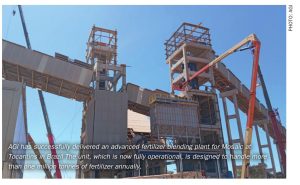
AGI (Ag Growth International) recently installed its first vertical fertilizer blending tower system in Brazil for Mosaic.
Venezuela’s nitrogen industry faces uncertainty from US military intervention, as outlined in a recent CRU analysis. Strategic facilities State-owned Pequiven manages three northern coastal plants with 2.4 Mt annual ammonia capacity and 3.0 Mt urea capacity. These sites link directly to PDVSA pipelines and nearby natural gas operations. Historical disruptions and 2023 rebound US sanctions […]

Metso has completed the expansion of its service centre in Antofagasta, Chile, adding an additional 1,200 m² of operational capacity, totalling 4,800 m² of technical workspace. Strategically located in the La Negra industrial district, at the heart of northern Chile’s mining area, the service centre has tripled its technical-commercial agreements in recent years, becoming a key strategic partner for major mining companies in the country. Following the expansion, the centre can now repair and refurbish large-scale equipment including HRC™ and high pressure grinding roll units, Vertimill® grinding technology, and mills for mining customers. It also supports beneficiation and dewatering technologies, such as filter plate pack service offerings. In addition, the centre provides service capabilities for mining crushers, grinding mills, screens, and car dumpers.
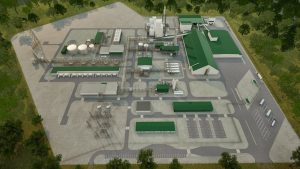
ATOME has signed a definitive offtake agreement with Yara International for its Villeta project in Paraguay.

Chile’s state-run mining company Enami says that it has received an environmental permit for a new $1.7 billion copper smelter, as part of the modernization of its Hernan Videla Lira smelting facility in the northern Atacama region. The new facility will process up to 850,000 t/a of copper concentrate, and its electrolytic refinery will produce up to 240,000 t/a of copper cathodes for use in electronics, construction and renewable vehicles. Enami says that the modernisation will “ensure profitable and sustainable operations, and practically triple the capacity of the old smelter.”

Copper production in Chile may stall at around 5.5 million t/a because of the growing challenges mining companies face, according to Maximo Pacheco, chairman of state-owned Codelco.
YPF says that its modernisation of the Luján de Cuyo refinery has taken a step forward with the installation of a hydrodesulphurisation reactor, designed to remove sulphur compounds from diesel fuel by means of a catalytic process using hydrogen. The installation forms part of the refinery’s New Fuel Specifications (NEC) project, intended to produce of fuels with a lower environmental impact. The new reactor was built in Mendoza by IMPSA. With a length of 38 meters and a weight of 456 tons, it was moved from Godoy Cruz to the YPF plant in a logistic operation that involved Vialidad Nacional, Mendoza Police and local authorities. It will now be integrated into the HDS II unit, designed to reduce sulphur content in diesel to 10 parts per million, in line with current environmental requirements. The NEC plan includes new process units, such as H2 II and SE33, the adaptation of existing facilities and the improvement of auxiliary services. The project, already 85% complete, will allow all the diesel oil produced in Luján de Cuyo to comply with the highest emission requirements.

The El Teniente mine, located in the O'Higgins region, suffered a collapse on 31 July. The collapse in the Andesita sector of the mine is understood to have been as a result of seismic activity that registered 4.2 on the Richter scale. It remains unknown whether the seismic activity was caused by the mining operations or natural activity, according to industry sources. Underground operations are to be halted for an unknown period of time while the open air sector, which represents around 10% of the total production, will remain open, according to industry participants.
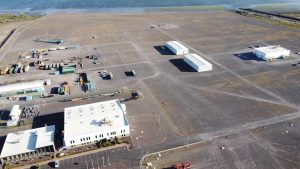
South America has become the largest importing region for nitrogen fertilizers, with Brazil overtaking India as the world’s largest urea importer. While there have been attempts to use local gas to develop a domestic nitrogen industry, these have faced challenges on a number of fronts.