Sulphur 423 Mar-Apr 2026
Dyno Nobel sells Phosphate Hill to Mayfair


AUSTRALIA

Dyno Nobel sells Phosphate Hill to Mayfair


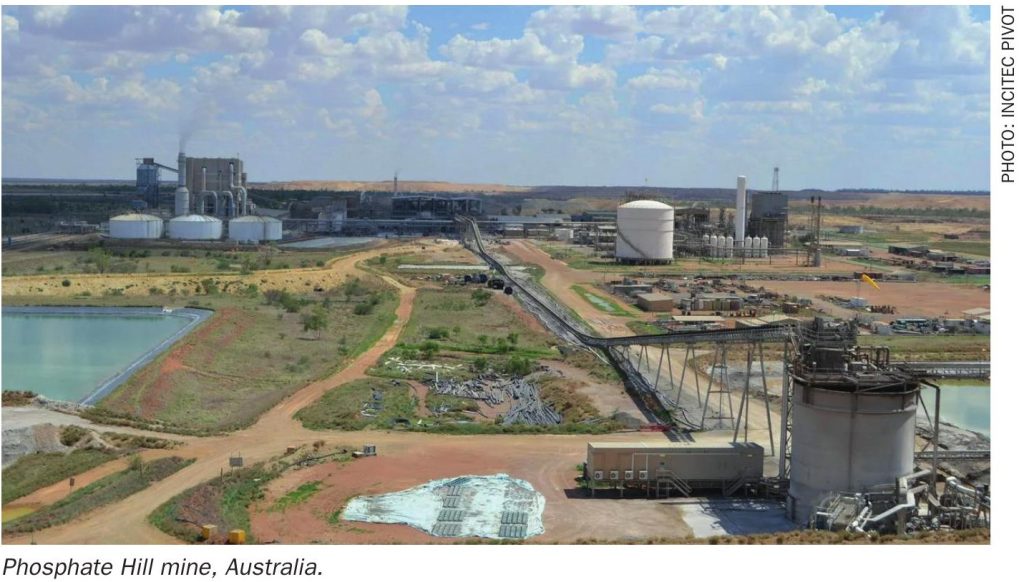
Dyno Nobel has signed a binding agreement for the sale of the Phosphate Hill plant in Australia to Ryowa II GPS Pty Ltd, a wholly owned subsidiary of Mayfair Australia Corporation, it announced 9 March. The purchase is for a nominal A$1.00 (US$0.70), with a deferred value of up to A$100 million payable to Dyno Nobel subject to certain conditions and performance hurdles. Phosphate Hill produces around 400,000 t/a DAP and 200,000 t/a MAP.

Mayfair is set to take over the operation from 1 April 2026. Dyno will provide approximately A$80 million of inventory at completion to support the continuity of operations. The deal secures employment for Phosphate Hill’s roughly 540 employees and contractors, enabling continuity of operation for the North-West Queensland region, Dyno said.

Securing natural gas and sulphuric acid from Glencore’s Mt Isa copper smelter is critical to Phosphate Hill, and the operation is a critical outlet for the smelter’s by-product. Glencore said in July 2025 it had no choice but to start work on placing the loss-making smelter and Townsville refinery in Australia into care and maintenance until market conditions improve, and in October, Canberra and the Queensland state government reached an agreement with Glencore for up to A$600 million of support, so that the smelter and refinery can operate for another three years. The deal concludes the separation of all fertilizer businesses and achieves the company’s strategic objective of transforming into a “pure play global explosives leader”.

Dyno announced last October that it would close Phosphate Hill by 30 September 2026 if it is unable to sell the asset, and the company noted it would still do so if this deal fails to go through. Dyno’s sale of the Incitec Pivot fertilizers distribution business to Ridley Corporation Limited, which was agreed in May, was successfully completed on 30 September 2025. The deal did not include the acquisition of the Phosphate Hill site or the closure and remediation costs associated with the Gibson Island and Geelong manufacturing operations. Ridley also did not acquire Dyno Nobel’s contract with Perdaman for the supply of 2.2 million t/a urea, which was sold to Macquarie Group’s Commodities and Global Markets business. Consideration payments of up to A$145 million are subject to operational milestones for the project, which is expected to commence production in 2027.


Latest in Industrial

Devon and Coterra merger creates shale major

Devon Energy has signed a definitive merger agreement with Coterra Energy. The companies say that the combination will create a leading shale operator with a high-quality asset base anchored by a premier position in the economic core of the Delaware Basin. The combined company will be named Devon Energy and will be headquartered in Houston while maintaining a significant presence in Oklahoma City. The companies say that they have identified $1 billion in annual pre-tax synergies which, together with technology-driven capital efficiency gains and optimised capital allocation will drive near and long-term per share growth.

Coromandel starts trial operations at new acid plants

Coromandel International says that it has started trial production at its new sulphuric acid and phosphoric acid plants in Kakinada, Andhra Pradesh. The company says that this marks a crucial step towards transforming the unit into a fully integrated facility, significantly enhancing production capacity and diminishing reliance on imported raw materials for fertiliser manufacturing. The company is now focusing on a phased ramp-up. The new plants have of 2,000 t/d of sulphuric acid and 650 t/d of phosphoric acid, respectively. The integration of these acid plants is strategic, aligning with Coromandel's objective to strengthen backward integration in its fertiliser manufacturing value chain. By producing key intermediates in-house, the company aims to secure stable supplies, enhance cost efficiencies, and achieve greater self-sufficiency, thereby reducing dependence on imported raw materials. The project aims to replace over 50% of the Kakinada plant's imported acid requirements and mirror the integration levels seen at its Vizag and Ennore facilities.

Duqm Refinery looking at further expansion

Following an increase in its processing capacity, Duqm Refinery is now looking at further expansion projects at the $9 billion refinery project located, in the Special Economic Zone at Duqm (SEZAD) on Oman’s southeast coast. The refinery, which now has an expanded capacity of 255,000 bbl/d, is run by OQ8, a joint venture between Kuwait Petroleum International (KPI) and Oman’s OQ Group. Speaking to local media, CEO Abdulla Al Ajmi said that OQ8 has now begun front end engineering design on a reformer unit to upgrade naphtha into high-octane gasoline components such as reformate, a critical step in producing finished, specification-grade fuels. In addition to the proposed reformer unit, Duqm Refinery is also exploring opportunities to enhance value creation from its refining by-products, notably sulphur and coke.